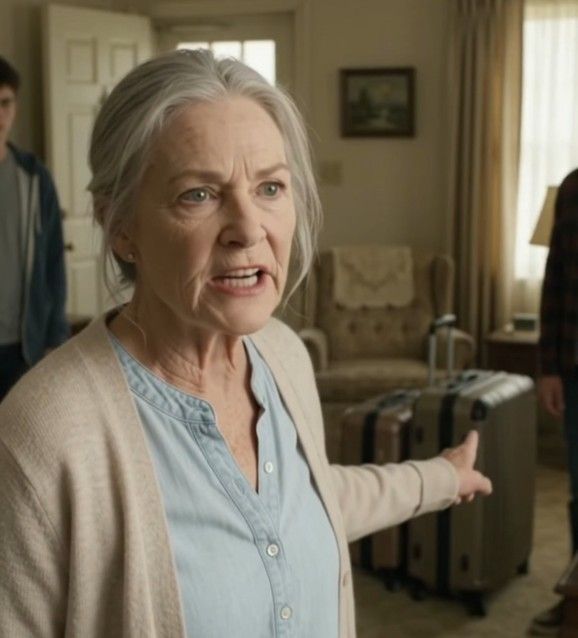
“Lennox, put that away,” he said. She didn’t. Her manicured finger hovered above the confirmation as though the appointment itself gave her authority over me. I stared at the screen and recognized the phone number listed for my emergency contact: Terrence’s. No one had told me about an appointment. No doctor had questioned my ability to manage my home. I had been balancing my own bills that morning when they knocked. And yet these two people had come prepared to turn my refusal into evidence that I was confused.
I stood slowly, conscious of the distance between us and the front door. “You arranged an evaluation without asking me?” Lennox smiled again. “You forget things. We need to be realistic.” I asked her to name one thing I’d forgotten that endangered me. She mentioned a birthday card I’d mailed late and the time I hadn’t answered my phone during an afternoon walk. Terrence looked down. I turned toward him. “Did you agree to this?” His lips moved before any sound emerged. “She said it was just a precaution.”
“It’s leverage,” I answered. The word steadied me. Lennox had wanted me frightened enough to hand over a key and a bedroom, perhaps more. I walked toward the kitchen counter, keeping my phone within reach. She followed, insisting that family had a right to intervene before things became serious. I told her to leave my home. She laughed and said I couldn’t force them out with two suitcases and nowhere to go. “You can call a hotel,” I said. “You can call a landlord. You can call the people whose luxury vacations you paid for. But you cannot claim my house.”
She grabbed one suitcase and dragged it toward the hallway. Terrence stepped in front of her. “Stop,” he said. She jerked the handle away, and the case struck a side table. A framed photograph fell, but the glass didn’t break. I picked up the frame and placed it safely on the counter. My hands were shaking now. I hated that they could see it. Lennox pointed toward my fingers as though she’d been waiting for that evidence. “See? She’s unstable.” I lifted my phone and told her I was calling the police if she refused to leave.
The change in Terrence was immediate. He took the suitcase from her, set it beside the door, and said, “We’re going.” Lennox stared at him in disbelief. She reminded him that they had no money and no plan. “Then we make one,” he answered. “We’re not doing this to Mom.” She opened her mouth, then closed it when she saw my phone recording the conversation. She snatched her coat from the chair. As they crossed the threshold, she leaned toward me and whispered, “You’ll regret choosing a building over your family.”
I closed the door and turned the lock. Only then did my knees begin to tremble so hard I had to sit on the stairs. The house smelled of the cinnamon toast I’d made that morning. A clock ticked in the living room. Nothing looked different except the fallen photograph, yet the familiar rooms felt abruptly unsafe. I called my neighbor June, who had lived across the street for twenty years. She came carrying her keys and a sweater, sat beside me, and listened without interrupting while I repeated what Lennox had said.
June asked whether I had a lawyer. I remembered the woman who handled the final paperwork when I paid off the mortgage. Her name was Laura Price. I called her that afternoon and explained the appointment, the threat, and the money Terrence and Lennox had spent. Laura asked me to save the recording, change my door code, and request records from the evaluation company. She was careful not to promise that no one could make a false report, but she assured me that an appointment arranged by a daughter-in-law did not give that daughter-in-law control over my home.
The evaluation company replied the following day. Someone had submitted an online intake form claiming to be my authorized representative. Attached was a power-of-attorney document bearing my name. I stared at the image on Laura’s computer screen. The signature looked almost right, but the final letter curled the wrong way. I had never signed it. Its date fell on a Saturday when I had been helping June paint her porch. Laura printed the page and asked whether there were any documents Lennox might have copied. I remembered the paperwork from the $40,000 down payment I’d given them.
At that closing, Lennox had offered to organize my documents. She had scanned my driver’s license and several signed forms, saying the lender needed copies. I had thought she was being helpful. Laura explained that the forged document could be challenged and that we should notify the affected institutions and law enforcement. She also recommended alerts on my credit and title records. I sat very still while she wrote out the steps. It was strange how easily my quiet home could become an asset in someone else’s plan when the person planning it believed I wouldn’t fight back.
Terrence came to Laura’s office three days later without Lennox. He looked as though he hadn’t slept. He admitted that the incapacity appointment had not been his wife’s first idea. Weeks before they arrived, Lennox had spoken to a loan broker about using my house as collateral for the boutique’s debts. The broker asked for proof of authority. Terrence said he’d refused to sign anything and believed the matter had ended. Then Lennox had produced the document claiming my power of attorney. “I knew it couldn’t be real,” he whispered. “I didn’t know how far she’d gone.”
I felt anger move through me, slow and hot. “You knew she was trying to use my house, and you still brought suitcases to my door?” Terrence’s face crumpled. He admitted he’d hoped I would simply offer them rooms so there’d be no need for the other plan. He’d convinced himself that moving in was the harmless alternative to a fraud. “You made my consent into an obstacle to work around,” I said. “Not a decision to respect.” He nodded. There was no defense. Laura asked him to provide every message and record he still had, and he agreed.
The messages exposed a second betrayal. The $300,000 boutique investment hadn’t been a straightforward gamble on a friend’s struggling store. Much of the money had been transferred into accounts controlled by Lennox’s cousin under a supposed expansion agreement. The boutique had never received the full sum. The expensive gifts and trips had drained the rest of the house proceeds, while loan payments and interest continued to accumulate. Lennox had concealed the transfers from Terrence and described them as temporary bookkeeping. When the business finally failed, she began looking for another asset to pledge.
Terrence stared at the statements for a long time. “She told me it was all going into the store,” he said. Laura answered that an independent forensic accountant would need to trace the funds and determine what claims might exist. She didn’t promise he would recover his money. I was relieved by her caution. For months Terrence had lived on promises: the boutique would take off, the next vacation would repair the marriage, the sale proceeds would last until something better came along. He needed facts, even unpleasant ones.
Lennox called me that evening from an unfamiliar number. She began pleasantly, asking whether I’d reconsidered letting them stay for a little while. When I mentioned the fraudulent document, her voice went cold. She said I was misunderstanding the arrangement and suggested that old age could make memories unreliable. I told her all further communication had to go through Laura. She laughed and claimed I was overreacting. “You need us,” she said. “You just don’t know it yet.” I ended the call before she could turn that sentence into another threat.
I spent the next several weeks learning to protect what I’d built. June helped me install a brighter porch light. Laura recorded the necessary notices, contacted the institutions that had received the false paperwork, and filed a report about the forged signature. I asked my doctor for an ordinary assessment of my health and decision-making, not to satisfy Lennox but to have a clear contemporaneous record in case she repeated her accusations. My doctor listened, looked at my carefully kept medication list and accounts, and asked whether I felt safe at home. I realized I hadn’t asked myself that question in years.
Terrence rented a small room from a coworker and found extra shifts at a repair shop. He and Lennox separated after she refused to give him full access to the financial records. He asked whether I could lend him enough for a deposit on an apartment. My heart squeezed. I wanted to reach for my checkbook, to erase one problem so I could feel useful again. Instead I told him I would help him make a budget and compare rental listings, but I would not give him more money. He nodded without arguing. It was the first small sign that he might be hearing me.
He came by on Sundays, always calling first. Sometimes we worked in the garden. Sometimes we sat at the kitchen table with invoices and a calculator, separating what he owed from what Lennox had concealed. I did not rescue him from the numbers. He had to see the cost of his decisions in his own handwriting. When a creditor called, he answered. When he missed a payment, he contacted them before they contacted him. It was slow, humiliating work. I understood the humiliation, but I no longer believed it entitled him to use my retirement as a shortcut.
The fraud investigation eventually produced consequences neither Lennox nor her cousin could talk away. Banking records and messages documented the transfers, and an inquiry found that the power-of-attorney document had been falsified and used in an attempted loan application. The attempted borrowing never went through, but the false submission remained serious. Civil proceedings required restitution from the funds that could be recovered, while criminal charges relating to the forged authorization were resolved with a court judgment and supervised conditions. The boutique’s remaining assets were liquidated, and Lennox lost access to the business she had used to move the money.
The day Laura told me about the outcome, I expected to feel victorious. Instead I sat beside the window and watched a delivery van crawl down the street. I thought about the young woman who’d married my son, the confident smile at their wedding, the gifts I’d given them for birthdays, and the days when I’d defended her impatience because I wanted harmony. The harm was real, and the consequences were deserved. But none of it made me happy. It only meant my house was safe and that a lie had finally stopped being useful.
Terrence and Lennox’s divorce took longer. She blamed him for giving Laura the messages, and he admitted that he’d hidden financial troubles because he feared her anger. During counseling he began to name patterns he’d previously dismissed: threats when he disagreed, silent treatment after ordinary mistakes, and the way he had been trained to regard his mother’s generosity as a resource instead of a choice. I listened without interrupting, but I insisted he also name his own actions. “Fear explains why you hesitated,” I told him. “It doesn’t erase the fact that you put me in danger.”
He cried then, sitting at the same table where he’d once asked for rent-free rooms. “I know,” he said. “I almost let her take your home because I couldn’t bear another argument.” I reached across the table and held his hand. “I love you,” I answered. “I’m still angry. Both can be true.” He lowered his head, and I let the silence stay. I had learned that love did not always have to hurry toward comfort. Sometimes it had to leave enough space for truth to settle.
I kept one page from the investigation in a separate folder: the intake form Lennox had submitted without my knowledge. At first I thought I should destroy it the moment the case ended. Then I realized I wanted a record of the day I had finally defended myself. Not to stare at it or reopen the hurt, but to remember that my fear had not made me powerless. Laura suggested I also keep a simple emergency plan, a list of trusted contacts, and copies of the documents that proved my wishes. I did, then returned the folder to a drawer and went outside to water my flowers.
As winter passed, Terrence began helping a local nonprofit repair homes for older residents. He replaced porch rails, fixed leaky faucets, and installed grab bars for people who wanted to remain independent. The work paid very little, but he continued after his required volunteer hours ended. One day he came home with a blister across his palm and told me about a woman who’d cried because she could finally step into her shower safely. “She said she didn’t want to lose her house just because her knees were bad,” he said. I watched him look around my kitchen and understand something he’d missed for years.
I also began doing things I’d postponed while trying to help my son. I joined a walking group, took a pottery class, and traveled with June to a quiet seaside town where we spent three days reading and laughing at ourselves for packing too many sweaters. When we returned, I painted my front door a deep blue. Terrence offered to help, but I told him I wanted to do the first coat myself. He brought the ladder and stood nearby without taking the brush from my hand. That simple respect felt more valuable than a room full of apologies.
In early spring Laura returned a packet of original closing papers from the old house Terrence and Lennox had sold. Inside was the handwritten acknowledgment I’d included with the $40,000 down payment. I had forgotten I’d written anything beyond the bank form. The note said I was giving the money freely to help my son begin a home of his own, and that I hoped he would one day offer someone else a safe place without making them pay for it in gratitude. I’d signed it with love. I sat for a long time, remembering how proud I’d felt watching Terrence turn the key in his first front door.
A week later Terrence arrived carrying a battered toolbox. Inside, carefully wrapped, was a small wooden key rack he’d made when he was twelve. He’d kept it in storage through every move, even while expensive furniture and electronics came and went. The hooks were uneven. Burned into the wood were the words HOME IS WHERE MOM SAYS COME IN. He set it on the table and looked embarrassed. “I made it for you, but Dad said the letters were crooked. I never gave it to you.” I ran my fingers over the rough lettering and couldn’t speak.
There was a folded piece of paper taped to the back. Twelve-year-old Terrence had written a promise in uneven pencil: When I grow up, I’m going to help Mom keep her house because she always helps everybody else. He had forgotten the note. I hadn’t known it existed. For months I had wondered whether the kindness I’d tried to teach him had disappeared completely. The little rack didn’t absolve him of anything, but it reminded me that the person who had hurt me had also once understood what safety meant. That understanding could be recovered only through the choices he made now.
Terrence offered to hang it beside my freshly painted door. I said yes. He measured twice, drilled carefully, and stepped aside so I could decide whether it was straight. Then he handed me the first hook. I hung my own key there. No spare key was given to him. He didn’t ask for one. Instead he stood on the porch and said he’d been offered steady work with the nonprofit’s repair crew. He planned to repay the $40,000 over time, even though I told him it had been a gift. “Then let me give something back without being asked,” he said.
His first repayment arrived a month later, along with a note explaining how much he had saved and what he still owed. I put the money into a small fund to help older homeowners make necessary safety repairs. When I told him, he smiled and asked whether I wanted help choosing projects. I said yes, but only after an independent committee reviewed the applications. We laughed. My rules had become familiar enough that he no longer saw them as punishment. They were simply the shape of a relationship in which both people mattered.
On a warm evening in June, June came over with lemonade, and Terrence brought bread from the bakery near his room. We ate supper on the porch while the street filled with the sounds of children playing and lawn sprinklers clicking. He told us about the house he’d repaired that morning, where an elderly man had saved a jar of screws for forty years. June told a story about the blue paint she’d spilled on her shoe. I listened and felt something I hadn’t felt since that chilly October morning: ordinary peace, undramatic and complete.
