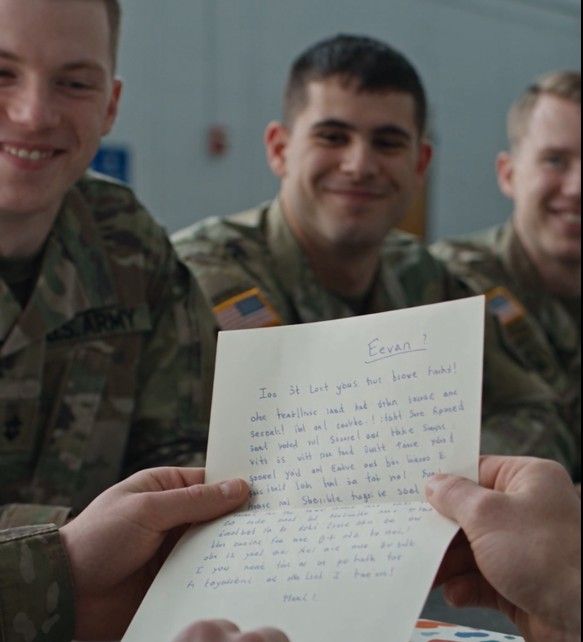
“Read it to us, then.” The folded letter passed from one recruit’s hand to another before its owner could reach across the table.
Nineteen-year-old Evan Cole stood in the barracks common area with his jaw held tight. The envelope bore his younger sister’s bright stickers, making it immediately recognizable to everyone who had watched him check for mail all week.
The joking had begun with the hearts she drew around his name. Evan smiled through that part, accepting the small embarrassment because he wanted to belong and because missing home already felt like something the others could smell.
Then a recruit named Dean unfolded the letter. “Your mom writes a lot,” he said, glancing at the closely spaced lines.
Evan asked for it back. Dean offered to return it if he read the first paragraph aloud, turning privacy into a performance the room expected him to complete.
Nobody there knew how hard reading had been for Evan in school. He could manage what he needed with time and concentration, but unfamiliar handwriting and an audience made the words stop behaving like words.
He had learned to hide the struggle behind forgotten glasses, headaches, and jokes. Joining the Army had felt like a chance to be measured by more than the classroom moments he carried around inside himself.
Now Dean held the page just beyond his hand. Someone laughed, then stopped when Evan’s expression didn’t change.
“Give it back,” Evan said. His voice was louder this time.
A sergeant entered from the corridor. Dean folded the paper quickly and claimed they were helping Evan practice a speech, an explanation so flimsy that the room went still around it.
Sergeant Avery asked whose letter it was. Evan answered, and the paper finally came back across the table.
He put it inside the envelope without looking down. Avery told the others to leave, then asked whether Evan wanted to report what happened.
Evan heard report and imagined the incident becoming the way everybody remembered him. He said it was nothing, staring at the stickers until their colors blurred.
Avery didn’t argue. He pulled out a chair and asked whether the letter contained something Evan was worried about.
It was an unexpected question. Evan had been so busy protecting the page that he hadn’t managed to understand all of it.
“My sister said I should call,” he admitted. “But the times didn’t work out yesterday.”
Avery offered to sit with him while he read. Evan almost refused, then heard the exhausted pride in his own silence and wondered how many more years he wanted to spend defending it.
“I might need help,” he said. The sergeant nodded as though help were an ordinary thing a person could ask for.
They unfolded the letter together. His sister described school, a broken bicycle, and the neighbor’s new puppy before the handwriting changed halfway down the page.
Their mother had added a note. Evan recognized the way she crossed her letters even before he made sense of the words.
She wrote that his sister was trying to make everything sound normal. There had been a change at home, and she wanted him to hear it from her before anyone else called.
Evan looked up. Avery waited, one hand resting beside the page without taking it away.
The barracks telephone rang in the corridor. When somebody called Evan’s name, he stood with the unopened meaning of his mother’s last paragraph still between his fingers. 👇
Evan carried the letter into the corridor with Sergeant Avery beside him.
The telephone rang again before he reached it.
“Cole,” someone called. “Your mother.”
His stomach tightened.
He picked up the receiver.
“Mom?”
For a second there was only breath on the other end.
