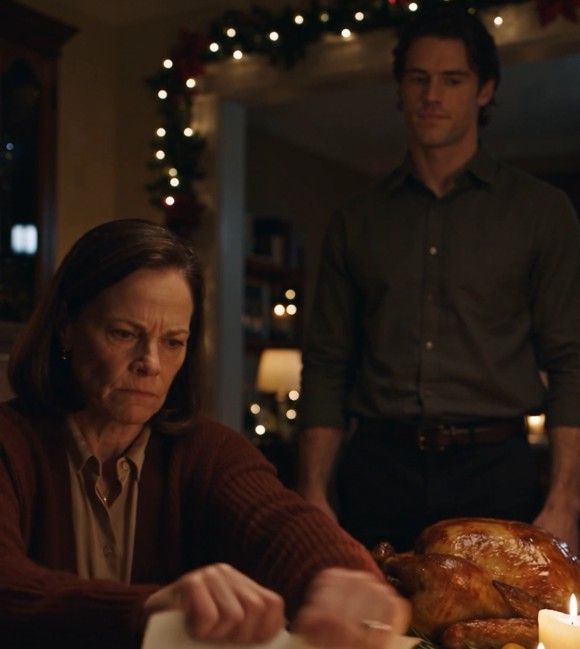
His eyes moved toward the living room, where his daughter was showing Helen the plant.
“Can I ask you something?”
“You can ask.”
“Do you still want me to inherit the house?”
The question carried no expectation now. Only fear.
I considered it.
“Yes,” I said. “But you will inherit it as a person, not as a reward for surviving me.”
He looked down.
“I don’t know if I deserve it.”
“That is not the measure.”
“What is?”
“Whether you can care for it without believing it owns you.”
He nodded slowly.
“I want to be that person.”
“Then become him.”
He wiped his eyes with the heel of his hand.
“I love you, Mom.”
“I love you too.”
The words did not erase what had happened. They did not unlock the old arrangement or restore the years before Vanessa moved in. But they crossed the distance between us without pretending the distance had never existed.
Inside, the children had placed the rosemary plant on the windowsill.
Sunlight touched its leaves.
We ate at the long dining table, but I did not use my mother’s china. I used sturdy white plates that could survive being dropped. Nathan carved the roast. Helen poured sparkling water. The children argued over the last dinner roll.
No invoice appeared beside my plate.
No one discussed the house as though I were absent from it.
After dinner, Nathan helped me wash the dishes. He stood at the sink with his sleeves rolled up, just as Richard had done.
“Your father used to dry everything in the wrong order,” I said.
“What is the right order?”
“Plates first. Glasses last.”
“Why?”
“Because your father said plates were less likely to break.”
Nathan looked at the glass in his hand.
“That seems backwards.”
“It was.”
He laughed.
The sound startled me. I had not heard it freely in my kitchen for a long time.
Later, when the children had fallen asleep upstairs, Nathan and I sat in Richard’s office. The blue folder rested in the locked drawer. The white folder lay on the desk.
He looked at the photograph of Richard and me in Niagara Falls.
“I barely remember that trip.”
“You complained the whole way.”
“I was six.”
“You complained like an adult.”
“What did Dad say?”
“He said you had important opinions.”
Nathan smiled at the photograph.
“I miss him.”
“So do I.”
“I was angry at him for leaving.”
“You were a child.”
“I was angry at you too.”
“I know.”
“I thought you were keeping everything from me.”
“I was trying to keep one thing for myself.”
He nodded.
“I understand now.”
Outside, snow began to fall.
The house settled around us with familiar sounds: the furnace clicking on, a branch brushing the upstairs window, the old clock in the hall counting each second. For years, I had listened to those sounds alone and believed they were echoes.
They were not echoes.
They were the house breathing.
Nathan stood and walked to the bookshelf. He ran his finger along the row of Richard’s old tools, each one labeled in his handwriting. Then he took down the smallest screwdriver.
“Can I borrow this?”
