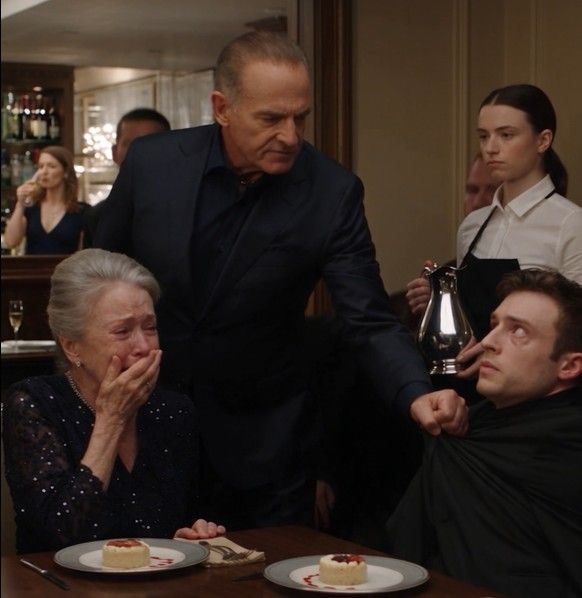
Roman saw it before Harper did. His eyes dropped to her chest, to the tiny red dot that trembled against the white cotton of her uniform shirt, and something in his face changed—something cold and ancient and utterly without fear. He didn’t shout. He didn’t panic. He simply wrapped both arms around her, rolled her hard against the side of the SUV, and pressed her flat against the pavement with his body covering every inch of her.
“Don’t move,” he said, and his voice was calm, almost conversational, as if he were discussing the weather. “Not a muscle. Not a breath.”
Harper couldn’t breathe. She couldn’t think. She could feel his heartbeat against her back, steady and slow, and she could hear the chaos around them—shouts, footsteps, the crack of another shot that hit the SUV’s window and sent glass raining down on them like ice. She squeezed her eyes shut and waited to die.
But she didn’t die. Roman’s men moved through the darkness like shadows, and within ninety seconds, the shooting stopped. A voice called out from somewhere to the left—”Clear!”—and then another from the right—”Clear!”—and then Roman was lifting himself off her, pulling her to her feet, brushing glass from her shoulders with hands that were surprisingly gentle.
“Are you hurt?” he asked.
She shook her head. She couldn’t speak.
“Good.” He turned to one of his men, a broad-shouldered man with a scar across his jaw. “Find him. I want him alive.”
The man nodded and disappeared into the night. Roman turned back to Harper. His expression was unreadable. “You saved my mother’s dignity tonight. And then you saved her handbag. And then you nearly got yourself killed for it. Why?”
Harper’s voice came out shaky but clear. “Because she was crying. And because I don’t like bullies.”
Roman stared at her for a long moment. Then he did something unexpected. He laughed. It was a real laugh, warm and surprised, and it transformed his face into something almost human. “You’re either the bravest person I’ve ever met or the most foolish. I haven’t decided which.”
“Neither have I,” Harper admitted.
He reached into his jacket and pulled out the black business card again. He pressed it into her hand. “This time, don’t leave it on the table. You’re coming with me.”
Harper looked at the card. Then at the shattered restaurant window. Then at the black SUV with its windows blown out. Then at Roman Moretti, the most dangerous man in New York, who was looking at her like she was the most interesting thing he had seen in years.
“Where are we going?” she asked.
“Somewhere safe. Someone just tried to kill me. And you were standing right next to me when they did. That makes you a target.”
Harper felt the blood drain from her face. “I’m a waitress. I don’t have enemies.”
“You do now.”
The next few hours were a blur. Roman’s men drove them to a private hangar outside the city, where a small jet was waiting. Beatrice was already on board, wrapped in a cashmere blanket, a cup of tea in her hands. She looked up when Harper walked in and smiled—a real smile, warm and relieved.
“You’re safe,” Beatrice signed.
Harper signed back. I’m safe. Thanks to your son.
Beatrice’s eyes flickered to Roman, who was standing in the doorway, his phone pressed to his ear. He’s not as terrible as he pretends, she signed.
Harper glanced at Roman. He was barking orders in rapid Italian, his jaw tight, his shoulders rigid. I’m not sure I believe you.
Beatrice laughed. Her laugh was silent, but her eyes sparkled. Give him time.
The jet took off twenty minutes later. They flew to a compound in the mountains, a sprawling estate surrounded by trees and fences and men with guns. Harper was given a room with a view of the valley, a bed with more pillows than she had ever seen, and a closet full of clothes in her size. She stared at the clothes for a long time. Then she sat on the bed and cried.
She cried because she was scared. She cried because she was tired. She cried because she had six hundred and twelve dollars in her checking account and rent due in eleven days and a mother in assisted living who needed her. She cried because she had stepped between a man and his victim, and now she was in a mountain fortress with a billionaire who might or might not be a killer.
But mostly she cried because, for the first time in her life, someone had looked at her like she mattered.
The next morning, Roman found her on the terrace. She was drinking coffee and watching the sun rise over the mountains. He sat down beside her without asking permission. He was wearing a simple black sweater and jeans. He looked almost normal. Almost.
“My men found the shooter,” he said. “He was hired by a rival family. The Marchettis. They’ve been trying to take over my territory for years. They thought if they killed me, my organization would fall apart.”
Harper looked at him. “Will it?”
“No.” He smiled, but it wasn’t a warm smile. It was the smile of a predator. “But they’ll wish it had.”
“What happens now?”
“Now I go to war.” He paused. “But first, I need to ask you something.”
“What?”
“I want you to stay. Not as a waitress. Not as a guest. As my mother’s interpreter. She needs someone she trusts. She needs someone who understands her. She needs you.”
Harper stared at him. “I don’t know sign language. Not fluently. I learned a little in college, but—”
“You learned enough to make her laugh. You learned enough to make her trust you. That’s more than anyone else has done in three years.” He leaned forward. “I’ll pay you triple what you were making at the restaurant. I’ll pay for your mother’s assisted living. I’ll pay for whatever you need. All I ask in return is that you stay with Beatrice. Keep her company. Keep her safe.”
Harper looked at him. She thought about her apartment. Her rent. Her mother. Her life. She thought about the red dot on her chest. The shattered glass. The way Roman had covered her body with his own.
“Why?” she asked. “Why are you doing this?”
Roman was quiet for a long moment. Then he said, “Because you did something no one else has ever done. You saw my mother. Not her money. Not her name. Not her power. Just her. And you treated her like a person. That means something to me.”
Harper looked at the valley. The sun was rising. The sky was pink and gold. She thought about the business card in her pocket. The one she had left on the table. The one he had given her again.
“Okay,” she said. “I’ll stay.”
The next few months were strange and wonderful and terrifying. Harper learned sign language. She learned Beatrice’s moods, her jokes, her stories. She learned that Beatrice had been a concert pianist before she married Roman’s father. She learned that she had lost her hearing in a car accident when Roman was twelve. She learned that Roman had taught himself sign language so he could talk to her.
She also learned about Roman. She learned that he was not just a businessman. He was the head of the Moretti family, an organization that stretched across three continents. She learned that he had killed people. She learned that he had done terrible things. But she also learned that he loved his mother. That he protected his people. That he had a code, twisted and violent though it was, and he never broke it.
One night, she found him in the library. He was sitting in a leather chair, a book open in his lap, a glass of whiskey on the table beside him. He looked tired. He looked human.
“You’re still awake,” she said.
“I don’t sleep much.” He looked at her. “You should be in bed.”
“I couldn’t sleep.” She sat down across from him. “I keep thinking about that night. The restaurant. The gunshots. The way you covered me.”
“You saved my mother. I owed you.”
“You didn’t owe me anything. You barely knew me.”
He was quiet for a moment. Then he said, “I knew enough.”
