A week later, I returned to Seattle and met with Marcy. We spread the documents across her conference table, but this time I did not feel the urgency of a house about to be lost. Marcy explained the difference between a promise in an agreement, a recorded interest, and a court’s authority to enforce remedies. We would follow the actual terms and local process, and we would not claim I had automatically become the owner just because a date passed.
She asked what outcome mattered most to me. I said I wanted to recover a fair part of the money, protect the value I’d sacrificed, and avoid needless displacement if my parents were willing to cooperate. She drafted a proposal consistent with those priorities: a structured lease at market rent, documented payment dates, regular review, and a separate path for selling or refinancing if the arrangement failed.
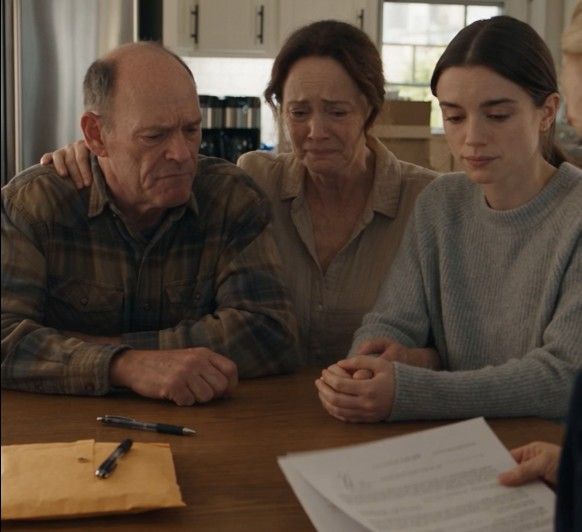
Dad arrived at the next meeting accompanied by an attorney he had chosen. Mom sat beside him in a navy cardigan. Lena did not attend, though she had sent several paragraphs of advice that Dad carried folded in his pocket.
Marcy asked Dad’s lawyer to explain the notice as they understood it. The lawyer calmly confirmed the agreement was serious, that it had been signed, and that the disputed property provisions would require proper enforcement rather than appearing overnight. He also pointed out that rent would have to be realistic for my parents’ income.
For the first time, my father heard the facts from someone who had no reason to flatter me or Lena.
“I thought Emma would never make us pay,” he admitted.
The room became still. Mom stared down at her hands.
I felt as if a locked door had opened. It was not that he had misunderstood the papers entirely. He had understood the promise but imagined that my affection would cancel it.
“Why?” I asked.
“Because you’re Emma. You always find a way.”
I wanted to shout that my way had cost a duplex, years of savings, and months of sleep. Instead, I asked a question I’d never asked before. “What did you think I would use to support myself when I retired?”
He looked at me with genuine surprise. “You make good money.”
“I do. That isn’t the same as having unlimited money. I sold an income-producing property to help you.”
Mom lifted her face. “I didn’t know you sold the duplex.”
“I told you when the wire went through.”
She blinked, then whispered, “You did.”
That was the moment I saw how easily my work had disappeared into the family’s version of events. They had called me capable so often that they’d stopped imagining capability involved cost.
We adjourned without signing anything. My parents needed time to review their budget and seek advice. I went home and slept deeply for the first time since Thanksgiving.
The following week, Dad sent a spreadsheet. It was clumsy but earnest: retirement income, insurance, utilities, groceries, and an estimate of what they could pay monthly without needing another rescue. I checked the totals, asked for documentation of a few figures, and forwarded the material to Marcy.
Mom called to explain they had canceled their cable package and a subscription to a private dining club Lena liked using. I hadn’t known they belonged to a dining club. Mom sounded embarrassed. For once, I didn’t tell her the embarrassment was unnecessary. It was information they needed to feel long enough to make different choices.
That winter I met with a financial planner to examine what my rescue of the house had done to my own future. I brought the duplex sale documents, the tax calculations, and an updated account of my investments. The planner did not scold me for helping my parents. She simply asked me to set a limit on what I could give without damaging the retirement I was building.
We ran several projections: conservative returns, periods without work, medical expenses, and the possibility that some of the family advance would be recovered slowly. On the screen, lines rose and flattened. None of them felt as impressive as the story Lena told her friends about our parents’ elegant home. But each line represented actual years of my life. I printed the analysis and put it in the same folder as the agreement.
I also began calling an old friend, Priya, on Sundays. She had asked me to join a hiking group for months, and I had always said the family needed me. The first walk was short, along a trail beside a cold lake. We talked about work, books, and the best place to buy cinnamon rolls. When my phone buzzed, I glanced at it and put it away. There was no emergency, only Lena asking whether I could speak to Mom about a hotel reservation.
Priya asked whether I would answer. “Not today,” I said, and we walked on. The sentence felt awkward in my mouth but easy in my chest.
At home, I reorganized the second bedroom I’d used to store boxes from the duplex. I hung a photograph of its front porch, not to punish myself for selling it, but to remember that the money represented patient work. I placed the framed picture above my desk beside the draft rent proposal. Seeing them together helped me hold two truths: I had helped people I loved, and I was entitled to protect the future I still hoped to have.
Lena appeared at my apartment the next Saturday, wearing a cream coat and carrying a bouquet that looked expensive. She had flown in without telling me. When I opened the door, she held out the flowers as if we’d quarreled over seating arrangements instead of a $680,000 debt.
“Can we not ruin Mom and Dad’s lives over a technicality?” she asked.
I let the flowers stay in her hands. “It isn’t a technicality.”
“You’re going to make them tenants in their own home.”
“They agreed to terms that protect the money I advanced. We’re trying to find a workable solution.”
