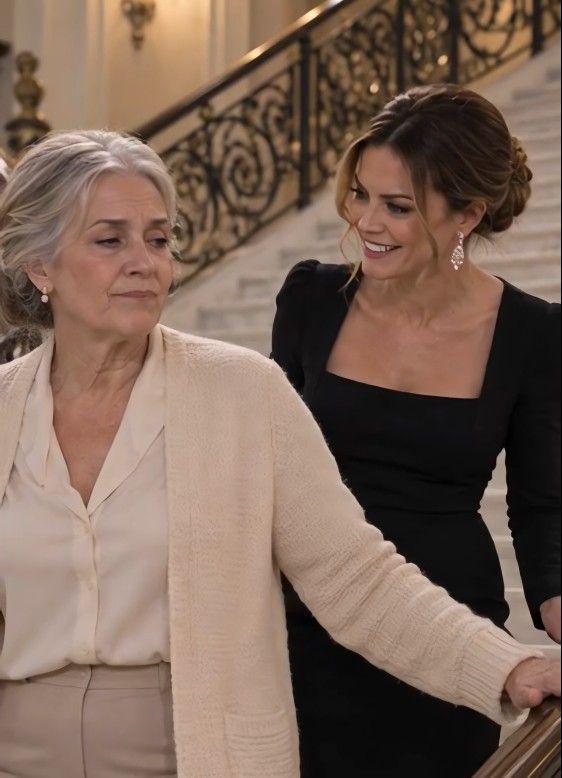
Evelyn Parker was partway down the marble staircase when Victoria Lane told her she should stop coming to her own son’s home. Victoria mocked Evelyn’s place in Alexander’s life and followed her down the stairs. Moments later, Evelyn was on the floor shaken and hurt. When Alexander arrived, Victoria tried to frame the incident as something Evelyn had caused herself. Then Marcus appeared with a tablet and told Alexander he needed to see something.
“You should stop coming here.” Victoria Lane said. The line landed before anyone in the room had time to soften it or pretend it meant something else.
“This is my son’s home.” Evelyn Parker said. No one could take the words back once they were in the air; the next silence made them feel even sharper.
Victoria Lane answered, “His home. Not yours.” The answer changed the temperature of the scene, not because it was loud, but because it forced everyone present to respond to the reality already in front of them.
Then came the line that pushed the confrontation another step forward. “You don’t love my son.” Evelyn Parker said, and the people around them watched the balance of the moment shift again.
“You should have stayed away.” Victoria Lane said. The words were followed by the kind of pause in which breathing, eye contact, and the smallest movement suddenly mattered.
“Mom.” Alexander Reed said. No one could take the words back once they were in the air; the next silence made them feel even sharper.
Marcus answered, “Sir, you need to see this.” The answer changed the temperature of the scene, not because it was loud, but because it forced everyone present to respond to the reality already in front of them.
The screen showed Evelyn descending carefully and Victoria following behind, closing the distance. Victoria’s face drained of color as the footage approached the instant she had insisted never happened.
For several seconds, nobody moved. Evelyn Parker could hear the ordinary sounds of Alexander’s mansion continuing around the crisis, which somehow made the moment harder to escape. The first instinct was to answer the last accusation immediately, but Evelyn Parker did not. A hand tightened, then loosened. A breath came shallow and uneven, then steadied. The object at the center of the scene — the tablet showing staircase surveillance footage — remained exactly where everyone could see it. That mattered. It kept the argument from drifting into old grievances or convenient denials. Victoria Lane tried to read the silence as weakness, but the silence was doing something else: it was giving Evelyn Parker enough time to choose the next sentence instead of having it chosen by fear. When Evelyn Parker finally looked up, the expression was not triumphant. It was tired, focused, and unwilling to pretend anymore. The people nearby sensed the change before they understood it. Shoulders lowered. Someone who had been avoiding eye contact finally looked directly at Victoria Lane. The physical distance in the room seemed to widen, not because anyone stepped far away, but because the old emotional arrangement had stopped working. For the first time, the question was not whether Evelyn Parker could endure one more humiliation. The question was what everyone would do now that the humiliation could no longer be hidden inside a private family explanation.
The room wanted a simple answer, but the truth came in layers. Evelyn Parker began with what could be verified from the tablet showing staircase surveillance footage; every time Victoria Lane tried to jump ahead, Evelyn Parker brought the conversation back to the same concrete point. The discipline irritated Victoria Lane, because vagueness had always been useful. Then the missing context finally surfaced: The surveillance recording showed Victoria’s hands strike Evelyn’s back and showed Evelyn had not turned, threatened, or reached toward Victoria first. Earlier clips also established that Evelyn had entered and moved through the house normally before the confrontation, destroying the suggestion that she had simply become confused on the stairs. The people listening needed a moment to understand why that detail mattered. Their faces changed one after another. A person who had defended Victoria Lane earlier looked down. Someone else shook their head slowly, not in confusion now, but in disappointment. Evelyn Parker felt the revelation land physically — a hollow pressure beneath the ribs, a sting behind the eyes — because facts can hurt more than accusations when they confirm what trust had tried not to see. Victoria Lane called the conclusion unfair. Evelyn Parker did not respond to the adjective. Instead, Evelyn Parker asked whether any part of the newly exposed fact was false. That was the question Victoria Lane could not answer cleanly. Silence took over again. It was different from the earlier silence. This one belonged to accountability. It gave everyone enough space to realize that the conflict had never been about one bad mood or one embarrassing scene. It was about a series of decisions that had relied on Evelyn Parker staying confused, ashamed, or too emotionally exhausted to compare them.
The argument sharpened because Victoria Lane finally understood that charm, pressure, and family history were not going to reset the room. Evelyn Parker kept the focus narrow. No personal attack. No guesses about motive. Only actions, words, and their consequences. That discipline exposed how often Victoria Lane relied on making every conflict so emotionally chaotic that no one could remember what the original issue had been. One trusted person quietly repeated a verified fact when Victoria Lane tried to deny it. The repetition landed. Victoria Lane’s face tightened. Evelyn Parker watched the mask slip — not into theatrical evil, but into frustration that other people were no longer cooperating with the preferred story. It was a revealing frustration. The confrontation forced everyone to choose between loyalty to a person and loyalty to reality. Some choices came slowly. Some arrived with tears. One person apologized for having stayed silent. Another admitted they had suspected something but wanted peace. Evelyn Parker answered that peace built on one person’s humiliation was not peace. After saying it, Evelyn Parker had to sit down. The sentence cost more than it looked. Someone placed a hand nearby, not touching until Evelyn Parker gave a small nod. That gesture — permission before comfort — became one of the first signs that the new pattern would not repeat the old one.
The decision was painfully ordinary in its wording and enormous in its effect. Evelyn chose to let Alexander see the full recording even though she feared what it would do to his relationship. She refused to leave quietly to preserve that relationship and told her son he had to make his own decision with the truth in front of him. Victoria Lane stared as though a private law of the family had been broken. In a way, it had. The old law said that Evelyn Parker would absorb the inconvenience so everyone else could remain comfortable. The new rule said each adult would carry the consequence of their own choices. Evelyn Parker repeated the decision once, more slowly, then refused to negotiate against it in the same emotional moment. That refusal protected the choice from being eroded by guilt.
Victoria Lane had spent much of the conflict assuming that relationships would protect every decision from consequence. That assumption failed. Victoria’s control collapsed as the decisive moment played. She tried to interrupt the video, then to explain the shove as instinct, but the footage showed the approach and force clearly. Alexander ended her access to the home and ended the relationship after she blamed Evelyn for being present. The same household staff who had once avoided Victoria’s anger no longer treated her instructions as authority. The important thing was not humiliation; Evelyn Parker actively stopped others from turning the moment into ridicule. Accountability did not need an audience laughing. It needed an audience remembering. The people present watched the result, watched Victoria Lane’s confidence disappear, and watched Evelyn Parker refuse to soften the facts merely to make the moment easier. When it was done, there was a long silence. In that silence the victims were finally able to look at one another without checking Victoria Lane’s face first. That was the most irreversible change of all.
The practical consequences continued after the emotional confrontation. Alexander preserved the footage, arranged medical care for Evelyn, and changed the home access codes. He also told staff that Evelyn’s visits were not subject to approval by any future partner. Evelyn spent several weeks recovering and refused to return to the staircase until she chose to. None of those steps were glamorous. They involved signatures, returned belongings, changed routines, uncomfortable calls, canceled assumptions, and the slow work of documenting what everyone now agreed had happened. Evelyn Parker insisted that each step be explained before it was accepted. That insistence prevented a new version of the same dynamic from forming under the label of help. Victoria Lane was allowed to respond through the appropriate channels and conversations, but no longer allowed to dictate the timing or the emotional terms. That distinction lowered the temperature. It also made the outcome durable. Supporting characters who had depended on Evelyn Parker began solving problems they once would have handed over automatically. The first attempts were clumsy. Some complained. Some were embarrassed. But each solved problem became proof that dependence had been exaggerated into entitlement. Evelyn Parker watched from a healthier distance. There was relief in discovering that other adults could survive disappointment.
The first hour after the confrontation was almost harder than the confrontation itself. Adrenaline faded and left Evelyn Parker tired enough to feel every bruise to trust, every sentence replaying in memory. Support came from Alexander and Marcus, who preserved the footage and kept the confrontation from becoming another private argument. The people involved stayed nearby without crowding. When Evelyn Parker finally spoke, it was not about the biggest revelation. It was about a tiny earlier moment that had hurt and never been acknowledged. That opened a different kind of conversation. The people around them began taking responsibility for the ways they had normalized the pattern. One admitted to changing the subject whenever Victoria Lane became cruel. Another confessed that keeping family peace had seemed easier than defending Evelyn Parker. Evelyn Parker said quietly that the peace had been paid for with one person’s dignity. No one argued. The conversation was painful, specific, and useful. By the end, there were no dramatic promises — only practical commitments about visits, money, privacy, caregiving, and who would be present if another difficult conversation became necessary.
The people around Evelyn Parker slowly found their places after the central conflict. Marcus, who had worried that bringing the tablet would cost him his job, was thanked privately rather than turned into a hero. Evelyn told him the courage had been in refusing to look away. Alexander made that principle part of how the household would operate going forward. Some relationships were repaired; some were redefined; one or two were allowed to end without another dramatic fight. Evelyn Parker learned that an ending can be peaceful even when it is not a reunion. The people who remained close understood that and stopped pushing for a picture-perfect family scene.
The most important healing conversation happened when Evelyn Parker sat down with people who had chosen to support Evelyn Parker and asked a question that had been avoided for years: why had everyone assumed Evelyn Parker would keep carrying the cost? Alexander apologized not only for the incident but for every time he had let Victoria make Evelyn feel like a guest who needed permission. Evelyn admitted she had minimized the hostility because she feared being labeled possessive. They rebuilt their relationship around direct conversations instead of messages carried through a partner. The answer was not flattering. Because Evelyn Parker had been competent. Because Evelyn Parker had been generous. Because saying no had been rare. Because other adults had become comfortable treating strength as an unlimited resource. Hearing that hurt, but it also clarified the path forward. Strength would no longer be measured by how much pain Evelyn Parker could absorb. It would be measured by the ability to protect peace before crisis made protection urgent.
