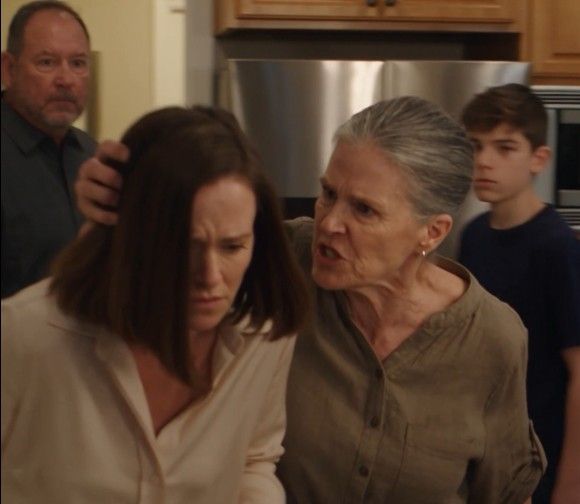
Daniel’s silence.
Then—before I ever entered the kitchen—another conversation.
Daniel and his mother had already discussed the missing money.
They hadn’t merely framed me.
They needed everyone to accuse me before anyone could find out where the money was truly being sent.
The officer paused the video.
Daniel’s mother stopped shouting.
Daniel took a step back.
And I finally understood.
The five thousand dollars was never the point.
It was a distraction.
A test.
A way to keep me from asking the one question that could destroy them.
Where was the rest of the money going?
And who else was involved?
The officer turned toward me.
“Ma’am, do you know what this account is connected to?”
I looked at Daniel.
He was already pale.
His mother was already reaching for her phone.
And the recording was still playing.
I didn’t answer the officer right away. I was still staring at the screen. The account number was visible. It was a series of digits I didn’t recognize. But something about the routing number was familiar. I had seen it before. On Daniel’s laptop. On a statement he had left open one night when he thought I was asleep.
“It’s a shell company,” I said quietly. “Registered in Delaware. But the mailing address is a P.O. box in Baltimore.”
The officer wrote it down. “Do you know who owns it?”
I looked at Daniel. He was shaking his head. Not at me. At his mother. A small, desperate movement. Like a child trying to signal that he was not the one who should be punished.
“I don’t know,” I said. “But I know someone who might.”
I called my brother. His name was Michael. He was a forensic accountant. He had been telling me for years that something was off about Daniel’s family. I had always defended them. I had always said I was being paranoid.
He answered on the second ring.
“Claire? It’s late. Are you okay?”
“No,” I said. “I need you to look at an account number.”
