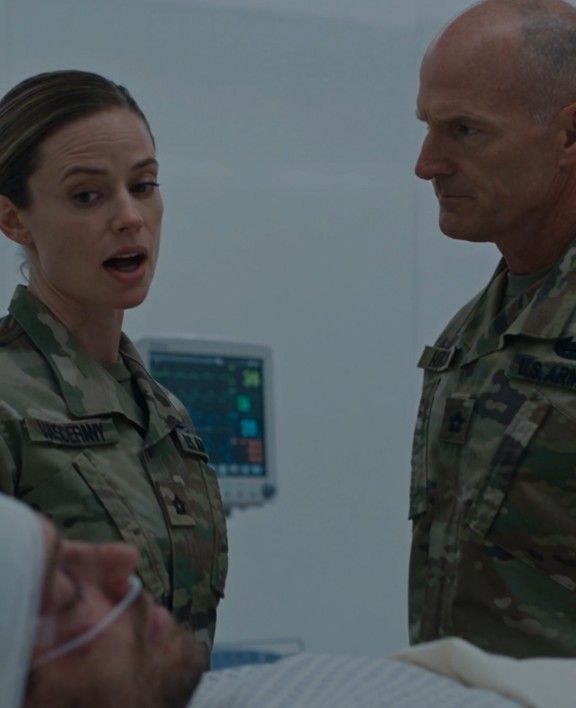
Reeves looked at it and then at her. “You knew Brooks.”
“I treated him twice before today.”
“That why he used your first name?”
“No.”
She was sure of that much. Eli had always called her Captain Shaw, even when she told him he could stop apologizing for showing up in her ward with blisters, dehydration, and once a cut he had ignored for two days because he did not want to seem weak. He had been earnest in the exhausting way very young soldiers sometimes were, determined to prove he belonged wherever older people told him he had to belong.
The physician carefully removed the tag from the prisoner’s hand and placed it in a specimen cup so investigators could preserve it.
Under the broken chain was a folded strip of waterproof paper.
Reeves saw it too.
“Open it.”
The physician looked at Natalie.
She nodded once.
Inside was a short line written in block letters, smeared but readable.
NATALIE SHAW. WARD 3. SHE WILL LISTEN.
Natalie sat down.
She knew the handwriting.
Eli’s.
Reeves stopped looking suspicious. He looked confused.
“Why would Brooks write that?”
Natalie searched her memory and found a conversation from six weeks earlier. Eli had come to the ward after escorting a local civilian injured near a checkpoint. The man had been frightened of military personnel and would not answer questions. Natalie had asked everyone else to leave the room, brought him water, and waited until he was calm enough to explain where his family was.
Eli had watched from the doorway.
Later, while Natalie filled out paperwork, he had said, “You listen different.”
She had laughed. “That is not a medical term, Private.”
“No, ma’am. I mean you wait for the whole answer.”
At the time, she had barely remembered the exchange by the end of the shift.
Now his words were in her lap in another form.
Reeves read her face. “Brooks trusted you.”
Natalie looked at the unconscious prisoner. “Apparently enough to tell someone else.”
The investigators wanted the paper immediately. Natalie allowed them to photograph it but refused to let them wake the patient. Reeves did not argue this time.
Instead, he pulled a chair to the far wall and waited.
That changed the room more than an apology would have.
