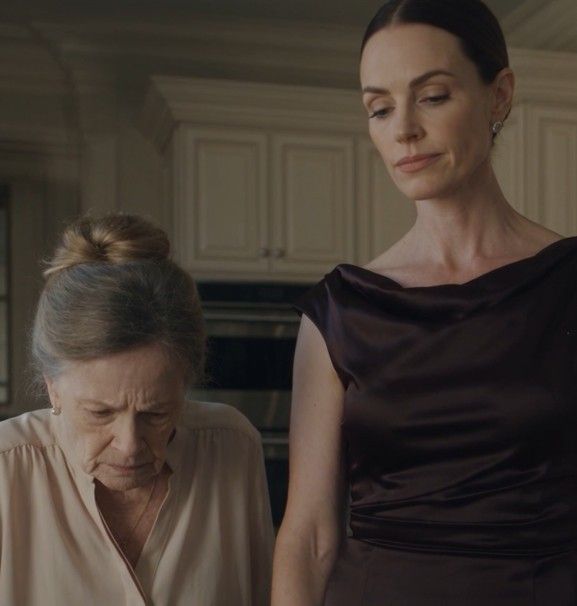
Sarah gave a disbelieving laugh. “Elena, please. You knocked into me.”
“I was facing the stove,” I said. “You were behind me.”
Adrian turned toward his wife. “Go ask the guests to wait.”
She lifted her chin. “You’re not taking this seriously, are you?”
“I’m taking Mom to get checked.” He looked back at me. “Can you walk?”
I tried to straighten and couldn’t. A sharp ache caught beneath my left shoulder blade. Adrian steadied me, but I asked him to move slowly. My knees trembled. I was suddenly more frightened by my body than by Sarah.
One of the guests appeared in the doorway, a woman named Nora who worked with Adrian. She took in the pot, my pale face, and Sarah standing beside the counter.
“Do you want me to call someone?” she asked.
“Yes,” Adrian said. “Please call for medical help.”
Sarah’s face tightened. “This is absurd. You’re turning an accident into a spectacle.”
Nora had already taken out her phone. She stepped into the hall to make the call. I watched her go with an unexpected rush of relief. Something was happening that I did not have to manage alone.
The ambulance team arrived while the guests waited quietly in the dining room. I answered their questions: where the pain was, whether I felt dizzy, whether I could breathe comfortably, whether I had been struck. I told the truth again. The words still frightened me. Saying them a second time also made the room feel less unreal.
At the hospital, clinicians examined me and ordered imaging because of my pain and the force of the impact. I had bruising and a painful injury that required rest and follow-up, but no injury that demanded emergency surgery. I listened to the discharge instructions twice, holding the printed page in my lap like a ticket to somewhere else.
A nurse asked whether I felt safe returning to the same address. Adrian was beside the bed. I wanted to say yes so that he would not look devastated. Instead I said, “Not while Sarah is there.”
The nurse nodded as if my answer were ordinary and important. She explained that the hospital could document what I reported, that I could ask for support services, and that choices about contacting authorities were mine, subject to any applicable reporting rules. She offered to have a social worker speak with me privately.
I asked Adrian to wait outside while we talked. It was the first time I had asked him to leave a room so I could tell someone else the truth.
The social worker helped me think about the next forty-eight hours rather than the rest of my life. Where could I sleep safely? Who could collect my things? What would I need for medication and a follow-up appointment? She gave me information about local services and told me I was not responsible for explaining another person’s violence away.
I thought of the apartment I had lived in before my recovery. The lease was still mine. I had kept it because I wasn’t sure how long the rehabilitation would take, though Sarah had mocked me for wasting money on an empty place.
“I can go home,” I said.
When Adrian returned, I told him. He looked startled. “I thought you’d stay until you were completely well.”
“I’ll recover more comfortably in my own apartment.”
He sat down heavily. “Why didn’t you tell me she was treating you like this?”
I wanted to give him the softest possible answer. He looked tired, frightened, and angry. But the habit of softening everything was part of how we’d reached this moment.
“Because you kept telling me how kind it was of Sarah to let me stay,” I said. “I thought you needed to believe it.”
He lowered his face into his hands. I could see the boy who had once cried when he broke a neighbor’s window. He had always felt other people’s disappointment keenly. Somehow, as an adult, he had learned to mistake avoiding discomfort for taking care of people.
“Mom, I didn’t know.”
“I know. But I was there. And now you do know.”
He asked whether he could drive me home. I agreed, on the condition that he first tell Sarah that I wouldn’t be returning and that she must not come to my apartment. He called her in the hospital hallway. I heard very little, only his quiet voice saying, “No, that’s not what Mom said,” and later, “We are not discussing dinner right now.”
At my apartment, I found the little blue blanket I’d left folded on the sofa. The living room smelled faintly of lemon polish. There was no marble floor, no chandelier, no carefully curated table waiting to be photographed. There was my own chair and a lamp I could switch off whenever I wanted.
Adrian carried in my overnight bag. He offered to stay on the couch. I told him I would prefer quiet and that my friend Isabel could come by in the morning. He looked hurt for a moment, then said he understood.
