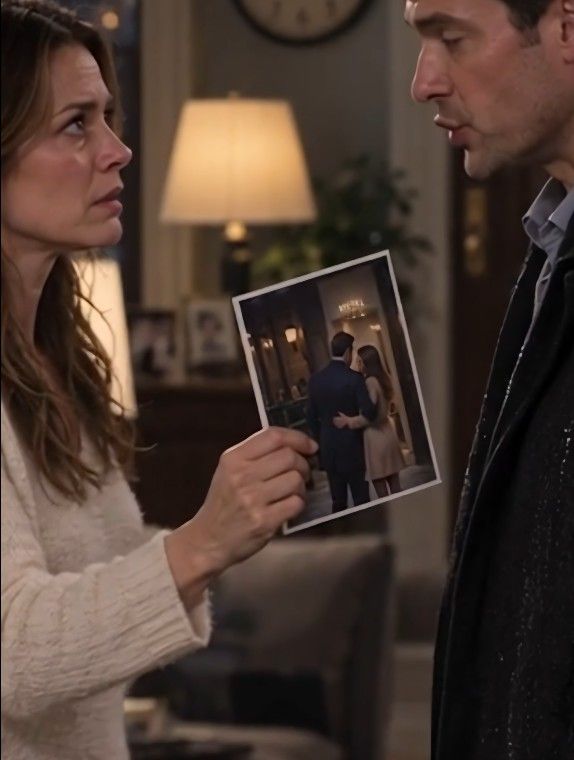
Mark Donovan came home in a rain-damp coat and was met by Claire’s trembling anger. She had already struck him before he understood the accusation. At 8:17 someone had sent her a photograph with no message and no name. Mark had told her he would be in Chicago. The picture showed him outside a hotel with one arm around another woman’s waist, his face close to hers. Claire turned the image toward him and asked the only question she could force through the hurt: why was he holding her?
“Why did you hit me?” Mark Donovan said. The line landed before anyone in the room had time to soften it or pretend it meant something else.
“Because you betrayed me.” Claire said. No one could take the words back once they were in the air; the next silence made them feel even sharper.
Mark Donovan answered, “What are you talking about?” The answer changed the temperature of the scene, not because it was loud, but because it forced everyone present to respond to the reality already in front of them.
Then came the line that pushed the confrontation another step forward. “Don’t pretend you don’t know.” Claire said, and the people around them watched the balance of the moment shift again.
“You told me Chicago.” Claire said. The words were followed by the kind of pause in which breathing, eye contact, and the smallest movement suddenly mattered.
“Look at me.” Claire said. No one could take the words back once they were in the air; the next silence made them feel even sharper.
Claire answered, “I believed you.” The answer changed the temperature of the scene, not because it was loud, but because it forced everyone present to respond to the reality already in front of them.
Then came the line that pushed the confrontation another step forward. “You answer after you see it.” Claire said, and the people around them watched the balance of the moment shift again.
“At 8:17, someone sent me this.” Claire said. The words were followed by the kind of pause in which breathing, eye contact, and the smallest movement suddenly mattered.
“No message. No name.” Claire said. No one could take the words back once they were in the air; the next silence made them feel even sharper.
Claire answered, “Why were you holding her?” The answer changed the temperature of the scene, not because it was loud, but because it forced everyone present to respond to the reality already in front of them.
Mark stared at the photograph while rain ticked against the windows. Claire watched him without blinking. The woman’s identity, the hotel, and the reason Mark had been there remained unanswered.
The crisis did not dissolve when the last voice fell silent. It became heavier. Claire remained in Claire and Mark’s rain-dark living room, aware of every detail the body had ignored during the confrontation: the ache in the jaw, the dry mouth, the pulse in the wrists, the unnatural stillness of people who were waiting to see who would move first. The printed photograph of Mark outside the hotel sat inside that stillness like a question no one could push aside. The anonymous photograph and the mistrust it triggered tried a familiar expression — part annoyance, part disbelief — but it did not produce the old result. Claire did not shrink. The people around them did not immediately look away. That was the first real break in the pattern. Claire took one careful breath and let the shock become information instead of panic. Who had seen what? Which claim could be tested? Which decision could not be undone once made? Those questions arrived one after another. They were practical, almost plain, and because of that they were powerful. The anonymous photograph and the mistrust it triggered had expected emotion to make Claire easier to control. Instead, emotion sharpened the need for clarity. No one in the room was ready for what came next, but everyone understood that the next answer had to be grounded in something stronger than loyalty, shame, or family pressure.
There was a moment when Claire nearly stopped. The next fact would change relationships, not just end an argument. But withholding it would preserve exactly the arrangement that had caused the damage. So Claire continued. The explanation began with the printed photograph of Mark outside the hotel and ended with the truth that had been protected from view: Mark explained that the woman was the widow of a former colleague who had contacted him unexpectedly while he was traveling. She had received distressing news in the hotel lobby and nearly collapsed outside; the photograph caught the instant Mark steadied her and leaned close enough to hear her over the rain. Mark had changed his return route without telling Claire because the meeting involved private family matters that were not his to disclose, a decision he now understood had made the photograph devastatingly believable. Nothing in the room moved for a beat. Even the anonymous photograph and the mistrust it triggered seemed stunned by how complete the picture became once the missing piece was named. The first response was denial. The second was minimization. The third was an attempt to blame the pressure of the situation. Claire listened to all three and then asked a simple question: which choice, specifically, had someone else forced the anonymous photograph and the mistrust it triggered to make? No answer came. That silence did not make Claire feel powerful. It made Claire sad. Accountability was necessary, but necessity did not make it painless.
The confrontation that followed was messy in the human way real confrontations are messy. The anonymous photograph and the mistrust it triggered spoke too quickly, stopped, began again, and reached for explanations that contradicted one another. Claire did not answer every sentence. That restraint made the important answers sharper. When the anonymous photograph and the mistrust it triggered said the situation had been misunderstood, Claire asked which visible action had been misunderstood. When the anonymous photograph and the mistrust it triggered said family should protect family, Claire asked why protection had only ever been expected from the person being hurt. Support was already available in concrete forms: Mark and Claire’s counselor, who later helped them separate what the photograph proved from what each had assumed. Nobody took over the scene. A trusted person stayed close enough to make the new boundary real and spoke only when a fact needed confirmation. That was important to Claire; being supported was not the same as being rescued. The point was not to replace one authority with another. It was to restore Claire’s right to decide what happened next. In Claire and Mark’s rain-dark living room, people who had once avoided conflict began admitting what they had seen or ignored. None of those admissions were dramatic on their own, but together they removed the last shelter from denial. A look. A canceled visit. A cruel joke everyone had pretended not to hear. A financial expectation treated as automatic. A door that had been closed too hard. The pattern became communal knowledge. The anonymous photograph and the mistrust it triggered’s anger rose as control fell. Claire felt fear move through the body, but this time fear did not dictate retreat. The fear was acknowledged, and the boundary remained.
Then came the decision everyone had been circling. Claire chose not to demand the woman’s private story as the price of believing Mark. Instead, she asked for the parts of the timeline that belonged to Mark and acknowledged that striking him had crossed a line regardless of whether the photograph had shown an affair. Claire hated how final the words sounded. Part of the heart still wanted an outcome in which nobody had to lose anything — no relationship, no home, no reputation, no sense of family. But that outcome had already been made impossible by the choices that caused the crisis. Pretending otherwise would only transfer the loss back onto Claire. The anonymous photograph and the mistrust it triggered pleaded for time, then demanded it, then accused Claire of cruelty for refusing it on the old terms. Claire offered something narrower: time to take responsibility, not time to continue control. That distinction became the line every next decision would have to follow.
The anonymous photograph and the mistrust it triggered’s collapse of control was not cinematic in the cheap sense. It was worse for someone who had relied on dominance: it was procedural, witnessed, and difficult to reverse. The false story around the image collapsed when travel records, the timing of Mark’s calls, and the woman’s brief voluntary confirmation matched his account. There was no villain to punish, but the couple treated the anonymous image as a warning about how easily secrecy and fear could turn fragments into certainty. Every step tied back to a choice already made, a word already spoken, a record already created, or a boundary already crossed. Claire did not have to invent a punishment. The consequences had been built into the conduct from the beginning; they only needed to be allowed to arrive. The anonymous photograph and the mistrust it triggered protested, then bargained, then became very quiet. Around the room, people who had previously been afraid of making the anonymous photograph and the mistrust it triggered angry began speaking in normal voices. That change in volume was almost shocking. No one was whispering permission anymore. No one was asking whether the anonymous photograph and the mistrust it triggered would approve. Claire watched that change and understood that accountability can alter a room before it alters a life. When the final practical step was completed, the silence afterward felt vast. Nobody rushed to fill it. The people who had been hurt needed to hear what safety sounded like when the person who controlled the mood no longer controlled the outcome.
The aftermath required more than feelings. Mark agreed that privacy for another person could not mean misleading Claire about his own whereabouts. Claire agreed that suspicion could not justify violence. They spent time apart, replaced rushed accusations with direct questions, and decided that trust would be rebuilt through behavior rather than demands for proof of love. Claire spent time on details that would have seemed cold during the crisis and understood later that those details were a form of care. Clear access. Clear ownership. Clear responsibility. Clear contact. When those things were no longer ambiguous, emotional manipulation had less room to operate.
For the rest of that evening, Claire did not make any more permanent decisions. That was part of the healing too. Crisis had trained everyone to believe every emotion required an immediate answer. A trusted person helped protect the quiet. Food was reheated. A blanket appeared. Someone washed a cup and left it upside down to dry. Those ordinary gestures were almost unbearably tender after so much tension. They did not erase what happened; they reminded Claire that life contained more than the people who had demanded the most space.
The people around Claire needed clear outcomes of their own. The photograph was kept only long enough to document the incident, then Claire asked Mark whether he wanted it destroyed. He did. They tore it together, not as a ritual of denial but because the woman in the image did not deserve to remain an object in their marriage. Practical support had come from Mark and Claire’s counselor, who later helped them separate what the photograph proved from what each had assumed. That mattered, but closeness still had to be earned through consistency. One relationship recovered slowly through repeated acts of respect. Another remained more distant because closeness would have asked Claire to forget too much. Both outcomes were allowed. Closure did not require every person to sit at the same table. It required every important relationship to have a clear, honest shape. Claire stopped measuring success by whether the whole family looked united from outside. The new measure was simpler: could the people inside the relationship tell the truth without fear? Where the answer was yes, connection grew. Where the answer was no, distance remained.
The family did not heal in a single gathering. Their hardest conversation centered on why the image had been so easy for Claire to believe. It exposed old insecurities neither had created but both had been stepping around. Mark listened without treating her fear as an excuse for the slap. Claire listened without treating his good intention as an excuse for poor communication. One conversation lasted only twelve minutes before Claire became overwhelmed and ended it. That ending was respected. The next conversation lasted longer. There were pauses in which nobody knew what to say, and for once nobody filled the pauses with blame. The people closest to Claire learned to ask, ‘Do you want help, or do you want me to listen?’ The question gave Claire back control over the kind of support being offered. Another person brought up forgiveness. Claire answered that forgiveness was not amnesia and reconciliation was not an entitlement. The room accepted that. Over time, specific repairs replaced abstract promises. Items were returned. Accounts were separated. Keys, schedules, caregiving expectations, and holiday plans were clarified. People who had relied on Claire’s generosity began making their own arrangements. The process was not punitive; it was adult. With each practical change, the emotional pressure decreased.
The next boundary test came sooner than Claire expected. A request arrived in the familiar urgent tone, asking for an exception because the situation was supposedly different this time. Claire read it twice before answering. In the past, the word urgent would have erased every other consideration. Now it triggered a question: urgent for whom? The answer made the decision clearer. Claire responded with one calm sentence that preserved the boundary and offered only the help that could be given freely. There was disappointment on the other end, but no catastrophe followed. The world did not collapse because Claire said no. That ordinary discovery became one of the clearest signs that healing had begun. Later, someone in Claire’s support circle asked whether guilt had appeared. It had. The difference was that guilt no longer received decision-making authority. They talked about how strange it felt to let an uncomfortable feeling exist without immediately paying money, changing plans, surrendering space, or apologizing for having needs. The conversation ended with both of them laughing softly at how revolutionary something so basic could feel.
A few weeks later, Claire returned mentally to the object that had anchored the crisis: the printed photograph of Mark outside the hotel. It was tempting to throw it away, hide it, or remove every reminder. Instead, Claire chose a gentler approach. The object was handled, documented if necessary, and then placed somewhere that felt appropriate rather than frightening. That choice mattered because it separated memory from control. The past could be remembered without being allowed to direct the present. Someone close enough to notice the change did not make a speech about it. A cup of tea appeared. A chair was pulled closer. They sat together and talked about an entirely unrelated subject until the conversation turned naturally toward future plans. The shift felt almost miraculous: a room once dominated by crisis was capable of holding boredom, jokes, and plans again.
The final repair was social rather than legal or financial. People who had heard only fragments of the conflict began reaching out. Claire refused to campaign for sympathy and refused to supply private details merely to win public approval. A short truthful explanation was enough. Some people understood immediately. Others preferred the simpler old explanation. Claire let them keep their distance. That restraint protected dignity. It also deprived the anonymous photograph and the mistrust it triggered of another arena in which to force a performance. Over time, reputation settled around behavior rather than gossip. The people who mattered most had seen the truth directly and were now watching what everyone did with it. That was sufficient.
The next boundary test came sooner than Claire expected. A request arrived in the familiar urgent tone, asking for an exception because the situation was supposedly different this time. Claire read it twice before answering. In the past, the word urgent would have erased every other consideration. Now it triggered a question: urgent for whom? The answer made the decision clearer. Claire responded with one calm sentence that preserved the boundary and offered only the help that could be given freely. There was disappointment on the other end, but no catastrophe followed. The world did not collapse because Claire said no. That ordinary discovery became one of the clearest signs that healing had begun. Later, someone in Claire’s support circle asked whether guilt had appeared. It had. The difference was that guilt no longer received decision-making authority. They talked about how strange it felt to let an uncomfortable feeling exist without immediately paying money, changing plans, surrendering space, or apologizing for having needs. The conversation ended with both of them laughing softly at how revolutionary something so basic could feel.
A few weeks later, Claire returned mentally to the object that had anchored the crisis: the printed photograph of Mark outside the hotel. It was tempting to throw it away, hide it, or remove every reminder. Instead, Claire chose a gentler approach. The object was handled, documented if necessary, and then placed somewhere that felt appropriate rather than frightening. That choice mattered because it separated memory from control. The past could be remembered without being allowed to direct the present. Someone close enough to notice the change did not make a speech about it. A cup of tea appeared. A chair was pulled closer. They sat together and talked about an entirely unrelated subject until the conversation turned naturally toward future plans. The shift felt almost miraculous: a room once dominated by crisis was capable of holding boredom, jokes, and plans again.
The final repair was social rather than legal or financial. People who had heard only fragments of the conflict began reaching out. Claire refused to campaign for sympathy and refused to supply private details merely to win public approval. A short truthful explanation was enough. Some people understood immediately. Others preferred the simpler old explanation. Claire let them keep their distance. That restraint protected dignity. It also deprived the anonymous photograph and the mistrust it triggered of another arena in which to force a performance. Over time, reputation settled around behavior rather than gossip. The people who mattered most had seen the truth directly and were now watching what everyone did with it. That was sufficient.
The next boundary test came sooner than Claire expected. A request arrived in the familiar urgent tone, asking for an exception because the situation was supposedly different this time. Claire read it twice before answering. In the past, the word urgent would have erased every other consideration. Now it triggered a question: urgent for whom? The answer made the decision clearer. Claire responded with one calm sentence that preserved the boundary and offered only the help that could be given freely. There was disappointment on the other end, but no catastrophe followed. The world did not collapse because Claire said no. That ordinary discovery became one of the clearest signs that healing had begun. Later, someone in Claire’s support circle asked whether guilt had appeared. It had. The difference was that guilt no longer received decision-making authority. They talked about how strange it felt to let an uncomfortable feeling exist without immediately paying money, changing plans, surrendering space, or apologizing for having needs. The conversation ended with both of them laughing softly at how revolutionary something so basic could feel.
The final surprise felt beautiful because it had been prepared quietly all along. Weeks later, the anonymous sender was never identified, and Claire realized she no longer needed the identity to heal. The beautiful surprise was quieter: Mark showed her a new travel calendar with every change marked openly and an empty line labeled ‘things I can’t share — but I can tell you I can’t share.’ Claire laughed at the awkward wording and kept it. Looking back, the clues were there in small gestures, unfinished sentences, and the way someone had protected the printed photograph of Mark outside the hotel instead of throwing it away. Claire understood the pattern only when the final piece was placed gently into the open. The reaction was not a dramatic collapse. It was a long exhale, a smile that kept failing because tears interrupted it, and the realization that those months would not be remembered only for what was taken. They would also be remembered for what was returned.
