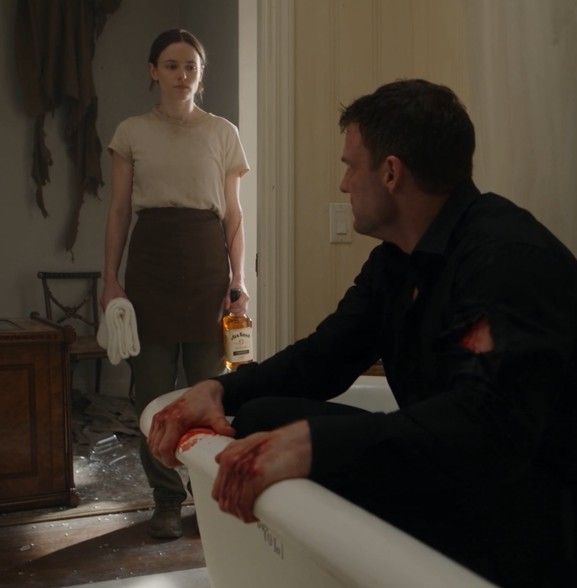
“Thank you. For the whiskey.”
He hung up.
I arrived at seven. The address led to a brownstone on Beacon Hill that looked like it had been carved from money and silence. The kind of house that didn’t announce itself—no gates, no guards, just a heavy wooden door and a brass knocker that had been polished so many times it looked liquid in the evening light.
He opened the door himself. No staff in sight.
He was wearing a dark sweater instead of a suit. The first thing I noticed was his hands. The bandages were gone. The wounds were still visible—raw, pink, healing—but his hands were bare. He hadn’t hidden them. For a man like him, that was an act of extraordinary vulnerability.
He stepped aside. I entered.
The interior was warm. Not the cold luxury I’d expected. Bookshelves lined every wall, floor to ceiling. A fire crackled in a stone hearth. The smell of food—real food, not restaurant food—drifted from a kitchen I could see through an archway. Something with rosemary and lemon. A table was set for two by the window, with candles and simple white plates.
No staff. He’d cooked this himself.
“You cook,” I said.
“I used to. Before I forgot how.”
We sat. He poured wine—a deep red, nothing ostentatious—and for a few minutes we ate in silence. The food was simple and excellent. Roasted chicken, potatoes, greens from what looked like a windowsill garden.
It was the most human thing I’d ever seen him do.
“I need to tell you something,” Reed said, setting down his fork. “About that night.”
“You don’t have to.”
“I know. But I’m going to.” He looked at the fire. The light played across his face, softening the hard edges, and for a moment he looked less like a king and more like a man who’d been awake too long. “Senator Whitford didn’t just leave the meeting. He made a threat. Specific. Directed at someone I—” He paused. Recalibrated. “Someone I care about. Someone he knew would be enough to make me compliant.”
“What kind of threat?”
“The kind that doesn’t leave marks on the body. The kind that leaves marks on the soul.” His voice was controlled, but I could hear the tremor beneath it—the same tremor I’d heard in the bathtub. “He has people who can make things disappear. People, places, evidence. He’d been using that power for thirty years. And that night, he made the mistake of using it on me.”
“So you destroyed the room.”
“I destroyed the room.” He looked at his hands. The healed wounds. “I chose furniture over a human being because I knew if I didn’t destroy something else, I would destroy myself. And I couldn’t afford to—not with what was coming.”
“What’s coming?”
“The end of Senator Whitford.” His eyes met mine. “I’ve spent the last week building a case. Financial records, witness statements, evidence of coercion and—worse things. Things I was complicit in allowing because it was easier to look away than to fight.” He paused. “Until you walked into that bathroom.”
“What did I do?”
“You stayed.” He said it simply, like it was the most radical thing in the world. “I have spent my entire adult life ensuring that no one ever sees me outside the armor. You saw me. And you didn’t run. You poured whiskey on my hands and told me to squeeze.”
I said nothing. My throat was tight.
“That night,” he continued, “I realized I had become the thing I swore I’d never be. Powerful, yes. Feared, certainly. But alone. Utterly, by design, alone. And alone is where people like Whitford do their worst work, because there’s no one standing next to you to say ‘that’s wrong’ or ‘that’s enough’ or ‘you don’t have to do this by yourself.'”
“You’re not alone anymore,” I said. “If you want.”
He looked at me. The fire cracked and shifted, sending new light across his face. I watched the armor—the real armor, not the suit, not the title, but the wall of aloneness he’d built brick by brick—take a hit.
Not crumble. Not yet. But crack.
“I want,” he said.
Over the next three weeks, the case against Senator Whitford unfolded like a blade. Reed was meticulous, surgical, and relentless. He’d gathered evidence that Whitford had been extorting, threatening, and systematically destroying anyone who stood in his path for decades. Other powerful men had looked away. Reed had looked away too—until he didn’t.
