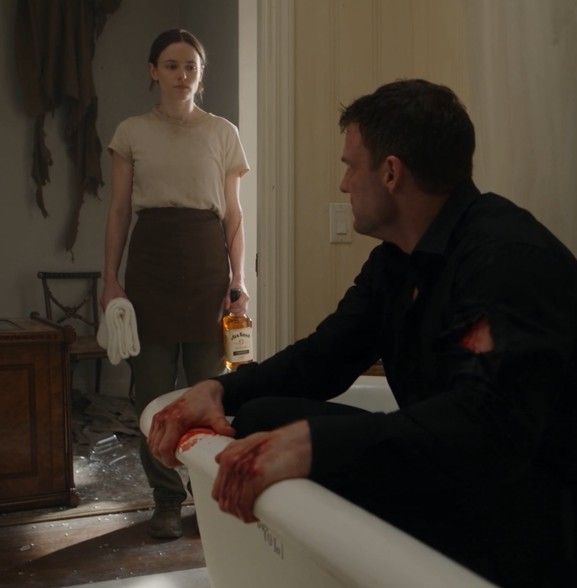
“You split your knuckles open in an empty bathtub. That’s not fine.”
“You don’t know what fine looks like for someone like me.”
“Maybe not. But I know what it looks like when someone’s been alone with something too heavy for too long.”
The silence that followed was different from before. Not the silence of danger. The silence of a question landing somewhere unexpected.
He turned his head. Studied me. The way a man who’d learned to read every microexpression in a boardroom might try to read a kitchen worker sitting on a bathroom floor in stained kitchen whites.
“How old are you?” he asked.
“Twenty-three.”
Something moved behind his eyes. Recognition, maybe. Of what, I didn’t know yet.
“Twenty-three,” he repeated, almost to himself. Then he looked at his bandaged hands. “You should leave before anyone comes back. What you’ve seen—this isn’t something people walk away from unchanged.”
“People like you mean?”
“People who see the man behind the name.”
I almost laughed. Not because it was funny, but because of how precisely he’d identified the thing I’d spent my entire life avoiding. Seeing people. Letting people see me. The whole architecture of my existence was built around the principle that nobody looks too closely at the kid who mops the floors.
“I’ve been invisible my whole life,” I said. “I’m good at it. But right now, you’re bleeding, and nobody else is coming.”
“You don’t know that.”
“I saw the security guard run out the back door fifteen minutes ago. He was white as the walls. Whatever happened up here, he’s not coming back.”
Reed’s jaw tightened. I watched him process that—the same way he probably processed bad news in meetings, quickly, ruthlessly, extracting the essential data.
“And you came up,” he said.
“Because of the breathing.”
He went still.
“The sound,” I clarified. “Through the vent. When someone goes that quiet, it means they’ve decided no one’s coming. I know that sound.”
His eyes found mine again. This time, there was something in them I hadn’t seen before. Not fear, not anger, not calculation.
Recognition.
He knew that sound too.
“Who did this to the room?” I asked. Not gently. Directly. Because gentle hadn’t worked and I didn’t have time to build a better approach.
Reed looked at the overturned table. At the splintered chairs. At the evidence of whatever fury had torn through this space like a tornado through a house.
“I did.”
“Alone?”
“Yes.”
“That’s a lot of furniture for one man.”
He almost smiled. Almost. The expression arrived at the edge of his face and then couldn’t find the rest of it.
