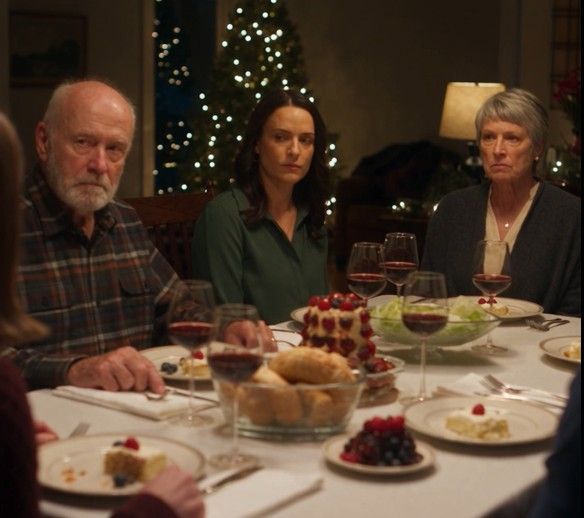
“She also said something else. At the end. After the part addressed to you, there was another page. Folded separately. With my name on it.”
I went very still.
“She never gave it to me when she was alive. She left it in the envelope with yours and apparently waited for me to be desperate enough to snoop.” A sound escaped my mother’s throat—not a laugh, not a sob, something in between. “Even dead, she knew exactly how to get to me.”
“What did it say?”
My mother was quiet for so long I thought she’d hung up. Then:
“It said, ‘Diane, I know you’re reading this because you looked. I know you’re angry. I want you to know that I forgave you a long time ago for the way you treated me, and I hope someone forgives you someday for the way you treated them. The money was never the point. The point was that I wanted to give Emily something you couldn’t take from her. Not because you’re cruel. But because you don’t know how to hold anything without squeezing it.'”
I closed my eyes.
My mother’s breathing was audible through the phone—shallow and uneven, the breathing of someone trying very hard to keep something contained.
“I squeezed everything,” she said. “I squeezed your father until he had nothing left. I squeezed Lauren until she became a mirror of me. I squeezed you until you stopped calling.”
“Mom—”
“I’m not done.” She took a breath. “I squeezed Lily. At Christmas. I squeezed a five-year-old child and called her a burden, and I need—” Her voice broke apart. It didn’t shatter dramatically. It came apart the way bread comes apart—softly, along the lines of its structure, revealing something underneath that was warm and porous and real. “I need you to know that I know. I know what I am. I’ve always known. Your grandmother was right. I don’t know how to hold anything without squeezing.”
I sat at my kitchen table with my hand pressed over my mouth, listening to my mother cry for the first time in my life.
She cried the way she did everything else—efficiently, as if it were a task to be completed. But underneath the efficiency, I heard something I had never heard before. I heard grief. Not performative grief, not grief-as-weapon, but the real, drowning, humiliating grief of a person confronting the wreckage of their own choices.
“I can’t undo it,” she said when she’d stopped. “I can’t undo what I said to you. I can’t undo what I said to Lily. But I want to try to—”
She stopped.
“To what?” I asked.
“To be different. I don’t know how. I’ve never done it before. But I want to try.”
I looked at the envelope on the table. Grandma Ruth’s handwriting stared back at me. *Don’t fight her. Don’t scream. Don’t try to win. Just stand still and let the truth do what truth does.*
“Okay,” I said.
“Okay?”
“Okay, we can try. But Mom—I need you to hear something. If you ever speak to Lily like that again, if you ever put your hands on me or call my family names or use money as a weapon—”
“I know.”
“Do you? Because this isn’t something we can keep doing. I won’t let you hurt her.”
“I know.” Her voice was small. Small in a way that wasn’t performed. Small in the way of something that had finally stopped pretending to be large.
We hung up. The dial tone buzzed for three seconds before it cut off, and then the house was quiet again.
It wasn’t a resolution. It wasn’t forgiveness. It wasn’t the end of anything really, because the truth is that people like my mother don’t transform overnight, and wounds this deep don’t close because of one phone call. But it was a door. A door that had been sealed shut for thirty-four years had cracked open by exactly one inch, and through that inch, something was getting in that hadn’t been there before.
Honesty. Thin. Trembling. Real.
On a Saturday in January, Lauren came to the house.
She brought a card for Lily—hand-drawn, covered in stickers, with a wobbly unicorn on the front that she’d clearly spent an embarrassing amount of time on. Lily took it, studied the unicorn with professional seriousness, and declared it “pretty good.”
“Pretty good?” Lauren pressed her hand to her chest in mock offense. “I used three different colors of glitter.”
