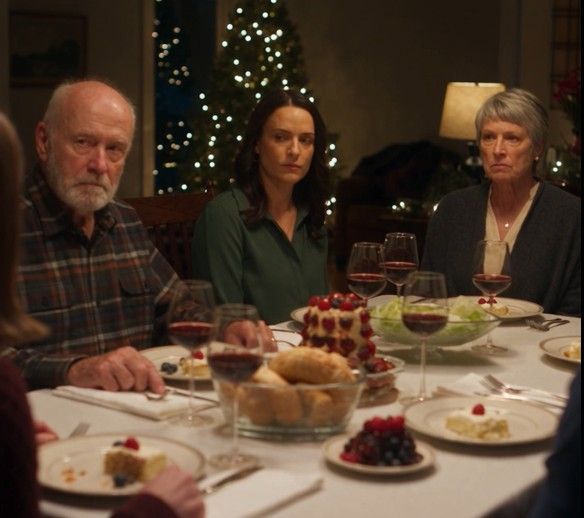
“Did you tell her what Grandma actually said?”
My mother turned. “What is she talking about? What did Grandma say?”
The house was so quiet I could hear the baby monitor upstairs—just the soft static of Lily’s breathing, small and even and untouched by any of this.
Dad opened his mouth. Closed it. His eyes found the floor.
“Dad.” I stepped forward. “Tell her.”
And that was when my father did something I had never seen him do in my entire thirty-four years of life.
He sat down.
Not collapsed. Not slumped. He walked to the armchair in the corner of the living room, the one Grandma used to sit in when she visited, and he sat down with the slow, deliberate gravity of a man who had been carrying something too heavy for too long and had finally reached the place where he could set it down.
He reached into his coat pocket and pulled out an envelope.
It was cream-colored, thick, old. The edges were soft from handling. I recognized my grandmother’s handwriting on the front—my name, written in the careful cursive she’d learned as a schoolteacher sixty years ago.
“What is that?” my mother asked.
Dad held it out to me. His hand was trembling.
“Your grandmother gave me this six months before she died,” he said. “She made me promise to deliver it to you if anything ever happened—if your mother ever found out about the inheritance and tried to take it.”
My mother stared at him. “You knew. You knew about the money this entire time.”
“Yes.”
“And you didn’t tell me.”
“She told me not to.”
“She told you—” My mother’s voice went strange. It didn’t rise the way it usually did when she was losing control. It dropped. It went thin and sharp, like a wire pulled too tight. “She told you not to tell me about thirty thousand dollars she gave to our daughter.”
“It wasn’t thirty thousand,” Dad said quietly.
The room seemed to tilt.
“What?” my mother said.
“The money she left Emily wasn’t thirty thousand. It was one hundred and twenty thousand. The rest was in a separate account—Grandma set it up years before she died. She used a financial advisor. It never went through the family estate at all.”
My mother’s lips parted, but nothing came out.
“Grandma told me,” Dad continued, his voice still low, still steady, as if he were reading from a script he’d rehearsed in his head a thousand times, “that she was leaving the money directly to Emily because she was afraid of what you’d do with it. Those were her words. ‘I’m afraid of what Diane would do with it.’ She said you’d use it to control Emily the same way you controlled—” He stopped.
“The same way I controlled what?” my mother said.
Dad looked up at her for the first time.
“The same way you controlled all of us.”
The silence that followed was not the silence of a room where people had stopped speaking. It was the silence of a room where something structural had just given way—the silence after a wall cracks, the moment before the whole house shifts.
My mother took a step backward. “You’re blaming me. You’re standing in your daughter’s living room and blaming me for—”
“I’m not blaming you for anything. I’m telling you what your mother said because you demanded to know. You walked into this house screaming about stolen money and lies, so here is the truth.” Dad leaned forward. His voice didn’t waver. “Your mother knew. She saw what you were doing to Emily. She saw what you were doing to Lauren. She saw what you did to me. And she decided that at least one person in this family was going to get what they deserved without you having your hands on it.”
