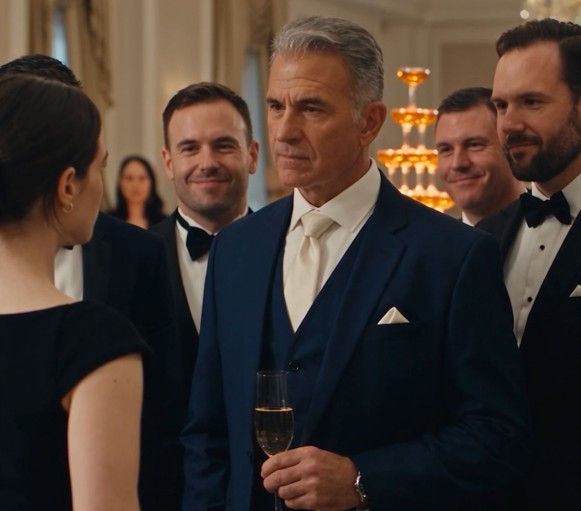
“Mama?” Nora said, confused.
The woman lowered the phone.
“Your mother is downstairs,” she whispered. “Mr. Crane had a car bring her when he realized you were here. She didn’t want you to do this alone.”
Nora’s legs finally gave. She sat down hard on the edge of the small stage where the quartet had been, the notebook falling open in her lap to that letter, her eleven-dollar dress pooling around her knees.
Lawrence sat beside her, not too close, his hands clasped between his knees, looking out at the ballroom that was slowly, awkwardly emptying as the FBI asked guests to stay for statements.
“I didn’t know if you’d hate me,” he said after a long silence.
Nora touched the page. The ink was faded.
“I don’t hate you,” she whispered. “I hate that he had to be brave alone for so long.”
Later, in a small private sitting room off the ballroom where the hotel manager had hastily cleared champagne flutes and brought water and a cold compress for her cheek, Nora’s mother arrived.
Elena Bellweather was thin, her head wrapped in a soft scarf, her coat too big, but her eyes were fierce and clear. She crossed the room without looking at Lawrence, without looking at the Assistant US Attorney waiting respectfully by the door, and gathered Nora onto the small velvet settee, pulling her daughter’s head to her chest the way she had when Nora was six and had fallen on the pier.
“My brave girl,” she murmured into Nora’s hair, rocking slightly. “My foolish, brave girl.”
Nora clutched her mother’s sweater. The compress fell to the floor.
“You knew?” she whispered into her mother’s shoulder. “About the exposure? About what really happened?”
Elena’s hands stilled in her hair. She pulled back just enough to look at Nora’s face, at the red handprint still visible, at the tears.
“No,” she said, and her voice was steady, angry on Nora’s behalf. “I didn’t know. Not until Mr. Crane told me in the car five minutes ago. Your father and I— he tried to tell me the docks were safe. I believed him because I needed to believe him. I am so sorry we both kept you in the dark.”
Lawrence stood by the fireplace, his head bowed.
“It was my call,” he said. “Not your father’s. Not your mother’s. Mine.”
Elena looked at him for a long moment, tears bright in her eyes, then nodded once, a tight, exhausted nod that wasn’t forgiveness yet but was a door left open.
Assistant US Attorney Desai knelt to pick up the compress, handed it to Elena, and spoke softly.
“Ms. Bellweather, Mrs. Bellweather, I know this is overwhelming. We have enough from the notebooks and the original ME report to proceed without you doing anything else tonight. But Daniel’s documentation— it’s extraordinary. It names twelve other workers who were denied compensation. It maps the shell companies. Your father’s work is going to return a lot of stolen wages. And the victim’s fund— the court can order it as restitution. Including medical costs. Retroactively.”
Elena’s hand tightened around Nora’s.
“Chemotherapy?” she asked, as if afraid to hope.
“And rent,” Desai said gently. “And more. We’ll have a victim advocate call you tomorrow. You won’t have to choose again.”
Nora felt her mother shudder, a silent sob she pressed into Nora’s hair so Nora wouldn’t see. Nora held her tighter and looked over her mother’s shoulder at Lawrence, who was crying openly now, his silver hair catching the lamplight.
“Will it be enough?” Nora asked him. “Will it actually change anything?”
Lawrence wiped his face with his palm.
“For the first time in thirty years of watching men like Victor walk away,” he said, his voice thick, “I think yes. Because you didn’t just bring a notebook. You brought witnesses. Three hundred of them. With video.”
He gave a wet, startled laugh.
“Daniel always said you were going to be a problem for powerful men.”
That made Nora laugh too, a short, broken sound that turned into another sob. Elena laughed with her, holding her daughter’s face in both hands, pressing their foreheads together.
