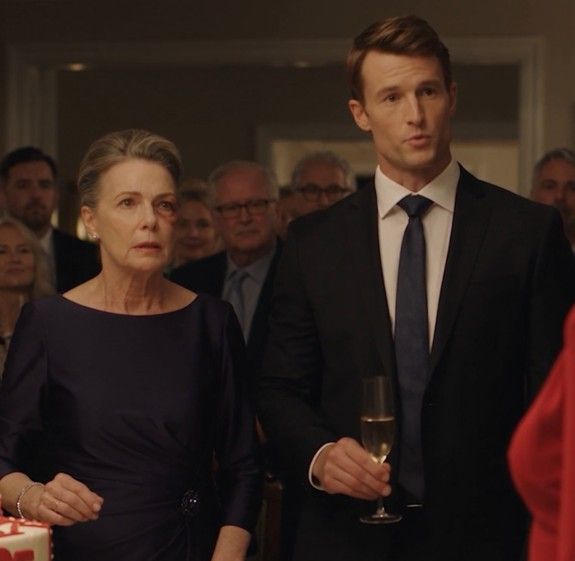
“You said I could borrow it.”
“When?”
“At the house.”
“This morning you told me nobody would believe me. Tonight you told these people I couldn’t remember. You don’t get to use both explanations without answering a simple question.”
She looked toward Daniel. For the first time, he seemed unable to produce a ready explanation. Around us, relatives were watching with expressions I could not read. Shame had made me imagine them as a single hostile audience. They were forty separate people, and some were already moving their chairs aside.
My neighbor Ruth stood. “Evelyn, would you like me to sit with you?”
“Yes.”
That small answer was easier than the larger ones. Ruth sat close enough that her shoulder touched mine. Jaime asked the restaurant manager to join us. He did not ask anyone to restrain Vanessa, or block the doors, or treat a dinner table like a courtroom.
“I want my property returned,” I told the manager. “I want witnesses to what happens next. Then I want to leave with my brother.”
Vanessa unclasped the necklace so sharply that the chain caught in her hair. She pulled it free and placed it on the table. I did not thank her. Ruth slid a clean napkin beneath the diamonds, and I wrapped them carefully.
Daniel whispered, “You’re destroying my marriage in front of everyone.”
I looked at his champagne glass. It still stood beside his place setting, barely touched.
“You made a toast about my injury.”
He opened his mouth, then looked away. I took the folded paper and stood with Jaime’s arm near mine, without letting him pull me upward. Ruth brought my coat. Nobody sang happy birthday. At the door, my cousin pressed a hand against my elbow and said she would call tomorrow. I believed her because she did not try to explain anything.
Outside, cold air stung my split lip. Jaime asked whether I wanted to go home. I said I wanted a doctor first. Until that moment, I had treated the injury as something I needed to disguise rather than something that deserved care.
At the urgent care clinic, a nurse asked how it had happened. I told her without shortening the account to make it less uncomfortable. She photographed the bruising with my consent, checked my vision, and gave me instructions about symptoms that would require emergency care.
When she asked whether I felt safe returning home, I could not answer immediately. Jaime waited in the doorway, his hands in his coat pockets. I realized I had been planning to return to the same upstairs hallway where Vanessa had whispered her threat.
“No,” I said. “Not tonight.”
We went to Jaime’s apartment. His guest room smelled faintly of starch and the cedar blocks he kept in the wardrobe. I laid the necklace on the dresser. Under a plain lamp, the diamonds looked smaller than they had at the restaurant, and far more precious.
Daniel called seven times. I wrote one message: I am safe. Do not contact me tonight. We will communicate tomorrow in writing.
Then I put the phone facedown. I did not sleep much, but the door remained quiet. Nobody entered to tell me what I had forgotten.
The next morning, Jaime brought tea and the attorney’s contact information. He explained that Thomas had asked him to keep a copy of the amendment. He had not known about the slap or the necklace. He had thought Daniel’s move into the house was an arrangement I wanted.
“Why didn’t Thomas tell me the whole story?” I asked.
“He hoped Daniel would tell you himself.”
That answer hurt. My husband had always believed our son could find his way back from a wrong turn. Sometimes that belief had asked too much of the people waiting for him.
I called the attorney myself. Her name was Miriam Hale, and she remembered Thomas’s desk. She asked me to bring any existing documents and cautioned me that an amendment could not resolve every problem we had described.
“We need to separate what was legally authorized from what your son simply began doing,” she said. “And your immediate safety matters before the paperwork.”
With her guidance, I made a police report about the assault and the necklace. I gave the facts I knew and identified what I merely suspected. I did not tell the officer Daniel had stolen my house, because ownership had never changed. I did tell him that papers had been moved and my safe’s code recorded without permission.
Returning home required more care. Daniel and Vanessa had lived there for months. Miriam warned against simply putting their possessions outside or assuming a changed lock settled their occupancy rights. She helped arrange a written demand for an orderly departure and explained the formal route if they refused.
For that first visit, Jaime and Ruth came with me. Daniel was in the kitchen. He looked tired and almost young until he spoke.
“You really called the police.”
“I reported what happened.”
Vanessa stood behind him, wearing a high-necked gray sweater. Without the diamonds, I could see how much of her confidence had depended on possessing something I valued.
“I want to speak to Mom alone,” Daniel said.
“No,” I replied.
The word startled him. I had used it rarely enough that he still heard it as an opening for negotiation. This time I followed it with instructions. We would go to the study. We would collect my records. Nobody would touch my purse, my phone, or the document folder.
The concealed compartment sat beneath the desk’s right drawer, where Thomas had kept a pencil tray. The brass key fitted a tiny lock hidden in the join between two pieces of walnut. Around it, pale gouges scarred the dark finish.
I knelt carefully, feeling the pressure of my bruised face when I bent. Jaime offered to turn the key. I shook my head. Thomas had put it in my hand, and I wanted to finish that movement myself.
Inside lay a thin envelope, a small notebook, and photocopies fastened with a yellow clip. The envelope was addressed to me. I set it aside and opened the clipped pages first.
They were loan records. Daniel had borrowed money from Thomas for a business venture two years before his death. Thomas had kept the repayments, missed dates, and increasingly strained messages together. One printed email mentioned using our house as security for another loan.
