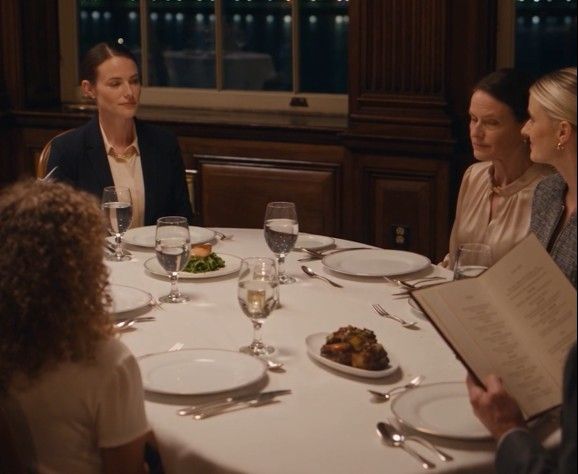
In the lobby, Melody was sitting on a bench between two federal agents. Her mascara was running, her designer jacket was crumpled, and her hands were cuffed in front of her. She looked up when she saw us, and for a moment, her face was naked—no smirk, no sharpness, just fear.
“Claire,” she whispered. “Please. Tell them it’s a mistake.” I walked toward her, and I didn’t feel triumph. I didn’t feel satisfaction. I felt tired. “It’s not a mistake, Melody. They have evidence. They have witnesses. They have recordings.” Her lip trembled. “I didn’t mean to hurt anyone. Victor said it was safe. He said no one would get hurt. He said we just needed to borrow the money. He said we would pay it back.”
“You stole from people who trusted you,” I said. “You used our family name. You used our parents. You used me.” “I was desperate.” “So were the people you robbed.”
She started to cry. “What’s going to happen to me?” “I don’t know. That’s for the courts to decide.” I looked at the agents. “I’ll give a statement. I’ll tell them everything I know.” Melody’s face crumpled. “Claire, please—” “I can’t help you,” I said. “But I can tell you one thing. You were wrong about me. I never thought I was better than you. I just didn’t know how to be your sister without losing myself.”
The agents led her away. She didn’t scream. She didn’t fight. She just walked, small and broken, into the back of a black car, and the door closed behind her.
My mother was crying. My father put his arm around her. Daniel stood apart, his hands in his pockets, staring at the floor. I walked to the window and looked out at the Potomac, at the lights of Washington, at the city I had built my life in.
The next few months were hard. Melody’s trial was long, and the evidence was overwhelming. She and Victor had defrauded more than two hundred people out of nearly eight million dollars. They had used fake statements, forged signatures, and empty promises. Melody had kept the books, and she had known exactly what she was doing. She was sentenced to twelve years. Victor was sentenced to eighteen.
My parents visited her in prison. I didn’t. I couldn’t. Not yet. Maybe not ever. But I did write her a letter. I told her I forgave her for the dinner, for the mockery, for the years of silence. I told her I could not forgive her for the fraud. I told her I hoped she would use her time to become someone different. I told her I would be there when she was released, if she wanted me to be.
The final twist came a year later. I was cleaning out my grandmother’s house—the house I had inherited along with Archer Capital—when I found a box in the attic labeled “For Claire.” Inside were letters, photographs, and a journal. The journal belonged to my grandmother, Eleanor Archer, the founder of Archer Capital. She had written it in the last year of her life.
The first entry read: “My granddaughter Claire is the smartest person I have ever known. She is also the kindest. She will inherit my company, but she will not inherit my wealth until she learns to stand up for herself. I have seen how her family treats her. I have seen how they overlook her. I have seen how they take from her and give nothing back. I am leaving her the company, but I am also leaving her a test. She must learn to say no. She must learn to walk away. She must learn that she is enough.”
The second entry read: “I have also left something for Melody. She will not find it until she is ready. It is a letter, and a key, and a small amount of money—enough to start over, if she chooses. I do not know if she will take it. I do not know if she will change. But I hope she will. I hope she will learn that being loved is not the same as being admired. I hope she will learn that she is enough, too.”
I sat on the floor of the attic and cried. My grandmother had known. She had seen everything. She had loved us both. She had given us both a chance.
I found the letter for Melody. I found the key. I drove to the prison and asked to see her. She came into the visitation room looking older, thinner, softer. She sat down across from me and didn’t speak.
I put the letter and the key on the table between us. “Grandma left this for you,” I said. “She wanted you to have it.” Melody picked up the letter. She read it slowly. Her hands began to shake. Tears streamed down her face. She looked at me, and for the first time in years, I saw the sister I had once known—the one who had taught me to ride a bike, the one who had braided my hair, the one who had promised to protect me.
“I’m sorry,” she whispered. “I’m so sorry.” “I know,” I said. “I’m sorry too.” “For what?” “For letting you become this person. For not saying something sooner. For walking away.” She reached across the table and took my hand. Her fingers were cold, but her grip was strong. “I’m going to do better,” she said. “I’m going to be better.” “I believe you,” I said.
I walked out of the prison into the sunlight. The sky was blue. The air was warm. I drove to my parents’ house and had dinner with them. We talked about Grandma. We talked about Melody. We talked about the years we had lost. My father apologized. My mother apologized. I forgave them. Not because they deserved it. Because I deserved peace.
The final image: I stood in my grandmother’s kitchen, wearing her old black blazer, the one she had left for me, the one I had worn for seven years without knowing its true origin. I made coffee. I sat at the table. The sun streamed through the window. On the counter, beside the coffee cup, lay the journal and the letter and the key. I touched the blazer’s worn cuff and smiled. I was not just Claire Archer, CEO. I was Claire Archer, granddaughter. I was Claire Archer, sister. I was Claire Archer, survivor. And I was finally, truly, home.
The Antique Blazer
