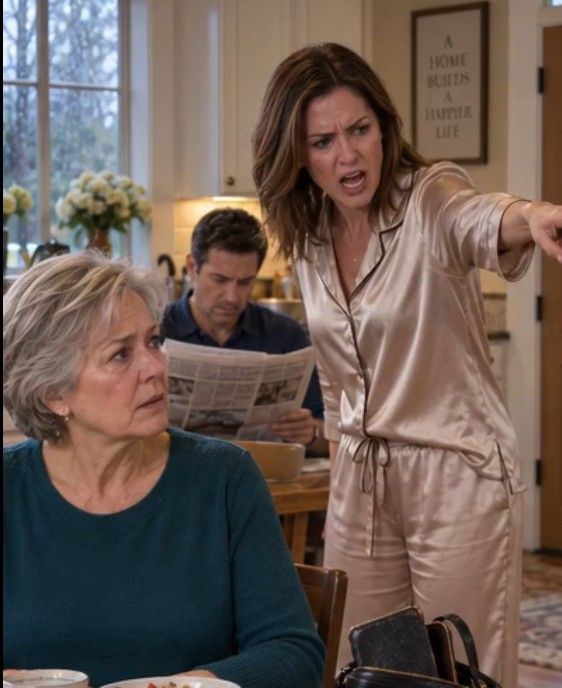
“Stop calling it your house!”
Lauren’s slap had left the room silent.
In front of thirty-two relatives, she announced, “David already agreed we’re selling it.”
The older woman looked toward her son.
David seemed as startled as she was.
“Selling what?”
He turned to Lauren.
“I never agreed to sell anything.”
Until then, Lauren had spoken as though the argument concerned a decision already made.
His denial exposed the first gap in her account.
The homeowner could feel the attention of people she had welcomed into the house.
No one seemed to know whether to look at her, at Lauren, or at David.
She was still absorbing the slap when Lauren’s announcement introduced a second shock.
For a moment, she could not tell which part of it to answer first.
Her son’s denial gave her something solid to follow.
He had not agreed.
Neither had she.
Yet Lauren had said “we’re selling it” with the certainty of someone reporting a completed family decision.
The older woman looked at the familiar room and tried to imagine a conversation about its sale occurring without her.
The distance between what she knew and what Lauren claimed was so large that she almost expected someone to correct a simple mistake.
Nobody did.
David’s confusion remained visible, and Lauren’s confidence began to look like an effort to keep control of the room rather than an explanation.
His mother made herself stay with the present facts.
She did not want thirty-two relatives guessing what she might have promised, intended, or forgotten.
If anyone needed to know whether she had agreed, they could ask her directly.
She was standing in front of them, capable of answering.
Richard was the first to make that answer the center of the conversation.
Richard stepped away from the fireplace and addressed the homeowner directly.
“Did you agree to sell?”
“No.”
David faced Lauren again.
“What did you actually do?”
“I contacted a realtor.”
The question made Lauren’s role clearer even before the phone appeared.
Contacting a realtor was an action she had taken, not evidence that David’s mother wanted to sell.
David repeated his own lack of agreement without allowing Lauren to fold it into a general discussion about what might happen someday.
The homeowner listened to the distinction with growing unease.
She knew relatives had ideas about the future.
Families often did.
Until that evening, she had not understood that an expectation might be used outside the family as if it were permission.
Lauren’s words at the beginning had relied on David’s supposed approval; his denial left her having to describe what she had actually done herself.
The room became quieter as the questions grew more specific.
Nobody needed to raise a voice to make them difficult.
Richard waited for answers instead of offering Lauren a way to finish her explanation for her.
That patience mattered to the older woman.
Too often, a pause in a family argument became an invitation for someone else to explain away the uncomfortable part.
This pause remained open.
She could hear the difference between uncertainty and evasion without having to label either one aloud.
What she needed next was a record of how far the contact with the realtor had gone.
The admission was smaller than the claim she had made, but it opened a much larger question.
