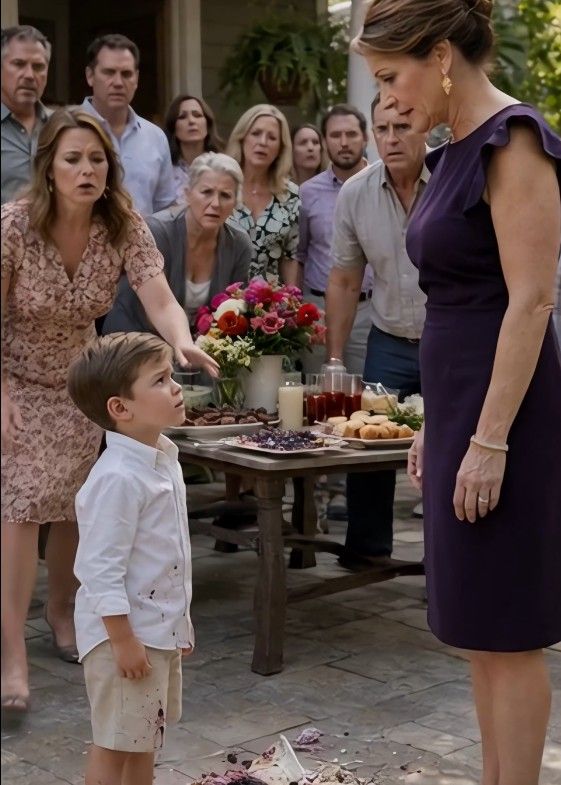
Madeline looked directly at Luke and told the child never to call her Grandma again because, she claimed, he was not really part of the family. Luke’s mother watched the rejection land before Luke could understand what paternity suspicion meant. When Brandon confronted Madeline, she doubled down. Then Luke pressed a hand to his chest, whispered that it hurt, and asked his mother whether he had done something bad.
“Don’t ever call me Grandma again.” Madeline said. The line landed before anyone in the room had time to soften it or pretend it meant something else.
“You are not this family’s grandson.” Madeline said. No one could take the words back once they were in the air; the next silence made them feel even sharper.
Luke answered, “Mommy…” The answer changed the temperature of the scene, not because it was loud, but because it forced everyone present to respond to the reality already in front of them.
Then came the line that pushed the confrontation another step forward. “Did I do something bad?” Luke said, and the people around them watched the balance of the moment shift again.
“Why doesn’t Grandma want me?” Luke said. The words were followed by the kind of pause in which breathing, eye contact, and the smallest movement suddenly mattered.
“What did you do to my son?” Brandon said. No one could take the words back once they were in the air; the next silence made them feel even sharper.
Madeline answered, “Your son?” The answer changed the temperature of the scene, not because it was loud, but because it forced everyone present to respond to the reality already in front of them.
Then came the line that pushed the confrontation another step forward. “Are you sure?” Madeline said, and the people around them watched the balance of the moment shift again.
“Leave my house. Right now.” Brandon said. The words were followed by the kind of pause in which breathing, eye contact, and the smallest movement suddenly mattered.
“Mommy…” Luke said. No one could take the words back once they were in the air; the next silence made them feel even sharper.
Luke answered, “It hurts.” The answer changed the temperature of the scene, not because it was loud, but because it forced everyone present to respond to the reality already in front of them.
The adults stopped arguing the instant Luke said, “Mommy… It hurts.” Whatever Madeline believed about bloodlines, the child in front of her had just been wounded by words he could not possibly deserve.
A strange calm followed the last burst of tension. It was not peace. It was the moment after a door has slammed when everyone realizes the argument is no longer happening in the same way. Luke’s mother stayed close to Luke’s question about whether he had done something wrong and watched Madeline search for the posture that had worked before. The posture did not fit anymore. Too much had happened in plain sight. The room in Madeline’s home after the family confrontation seemed to separate into people who wanted the truth and people who wanted the discomfort to stop. Those were not the same thing. Luke’s mother understood that difference with painful clarity. The temptation to make the moment easier for everyone else was strong; years of habit can survive even the worst betrayal. But easing the discomfort would mean carrying it alone again. Luke’s mother refused. A slow exhale loosened the chest. A small movement of the shoulders replaced the instinct to apologize. When Luke’s mother finally met Madeline’s eyes, there was no performance in the look. It said only that the next decision would be made in daylight, with facts, and with witnesses if necessary. That was enough to make Madeline’s confidence falter.
The first revelation did not arrive as a theatrical confession. It emerged because Luke’s mother asked one precise question and then refused to be distracted from the answer. The question pointed back to Luke’s question about whether he had done something wrong. At first Madeline tried to broaden the argument, bringing up old sacrifices, misunderstood intentions, and reasons everyone was supposed to be grateful. Luke’s mother interrupted only once: not with an insult, but with the same question. That repetition stripped the performance away. Piece by piece, the hidden context surfaced. Medical evaluation showed Luke’s pain was a stress response after the confrontation rather than a hidden catastrophic illness. The paternity rumor Madeline had treated as fact came from an old family dispute she had never verified. Existing birth and medical records were consistent with Brandon’s paternity, and a later voluntary test requested by Brandon himself removed the final excuse Madeline had used to justify rejecting Luke. The explanation did not erase the harm already done; if anything, it made the harm more deliberate because it showed how much had been known in advance. Someone nearby whispered a shocked breath and then covered their mouth. Another person sat down as if standing had suddenly become difficult. Madeline stared at Luke’s mother, searching for a way to turn the revelation into a misunderstanding. There was none that fit every fact. The hardest part for Luke’s mother was not hearing the truth. It was recognizing how many earlier moments now looked different in its light. Comments once dismissed as careless, small financial or emotional pressures, unexplained silences, and the repeated demand to keep family matters private aligned into a pattern. Luke’s mother did not celebrate being right. Vindication felt too close to grief. What mattered was that the truth had finally become specific enough for choices to be made around it.
Madeline reacted first with outrage, then with injury, as though being confronted were worse than the conduct being confronted. The reversal might once have worked. Luke’s mother might once have rushed to soothe the room. Not now. Luke’s mother waited until the accusations ran out and then said, in effect, that discomfort was not the same as harm. That distinction changed everything. Support was already available through Brandon, the clinician who evaluated Luke without minimizing his fear, and a family counselor who helped the adults keep adult disputes away from the child. One trusted person stayed nearby, visibly shaken but steady, and confirmed the detail that Madeline most wanted dismissed. A few people exchanged looks. Someone who had laughed earlier no longer looked amused. In Madeline’s home after the family confrontation, the social protection around Madeline thinned in real time. The confrontation became less about winning and more about naming. What happened? Who made the decision? Who benefited? Who was expected to absorb the cost? Each answer brought Luke’s mother closer to a decision that had been postponed too long. The emotional collapse did not come as screaming. It came when Luke’s mother’s voice broke on a small, ordinary memory — a meal prepared, a room cleaned, a favor given, a promise believed. That memory showed how much trust had been invested before the betrayal. Luke’s mother turned away for one breath, wiped the face, and returned. There was no shame in needing the pause. The pause was part of staying present.
Luke’s mother asked for ten quiet minutes before making the choice. Nobody liked the delay, which was exactly why it was necessary. Pressure had shaped too many earlier decisions. When the ten minutes ended, Luke’s mother returned with the same conclusion: Luke’s mother chose immediate no-contact with Madeline until Madeline completed counseling and could accept clear rules protecting Luke. Brandon chose to take the paternity test not because Luke needed to prove belonging, but because he wanted the rumor ended permanently. The words caused an immediate reaction from Madeline, but Luke’s mother did not retreat. A difficult choice does not become wrong just because the person losing unfair access is angry about it. One ally moved closer. One person began crying. Another stared at the floor. Luke’s mother felt the weight of every reaction and still held the line. The decision was not revenge. It was architecture — a new structure designed so the same harm could not simply walk back in after the room calmed down.
The irreversible part of the downfall was simple: Madeline lost the ability to convert personal pressure into other people’s obligation. Madeline’s authority collapsed when the test confirmed what the records had already supported and Brandon refused to let her reinterpret the result. Family members who had tolerated her suspicion told her plainly that she had chosen a rumor over a child. She lost unsupervised access to Luke and could not regain it through gifts, tears, or appeals to family tradition. The scene was painful to watch because Madeline kept expecting an exception right up to the last moment. There had always been an exception before. Someone had paid, apologized, moved, stayed quiet, or accepted blame just to end the tension. This time no one did. Luke’s mother remained still. The witnesses remained present. The consequence took effect. Madeline’s last words were not noble; they were frustrated and unfinished. Then the room became quiet enough for everyone to realize the pattern had actually broken.
The new boundary became real through consequence: Luke’s mother and Brandon explained the event to Luke in age-appropriate language: adults had said something wrong, he had done nothing bad, and nobody was allowed to make him earn a place in his own family. Madeline’s contact remained limited for months and depended on behavior, not promises. There were protests, but protests were not vetoes. Luke’s mother listened where listening was appropriate and refused to reopen facts already established. That balance kept accountability from becoming revenge and kept compassion from becoming surrender.
After Madeline’s control broke, Luke’s mother discovered that relief was not the same as happiness. The body stayed alert long after the immediate threat had passed. Hands still shook. Sudden sounds still pulled attention toward the doorway. Support came from Brandon, the clinician who evaluated Luke without minimizing his fear, and a family counselor who helped the adults keep adult disputes away from the child. Nobody demanded a celebration. Instead, someone nearby asked small questions: water or tea, lights on or off, company or quiet. Those choices helped restore something the conflict had taken — the feeling that Luke’s mother’s preferences mattered even when they inconvenienced someone else. Later, one supporting character returned to apologize for a specific failure rather than offering a vague expression of regret. The apology named the moment they had looked away, the reason they had been afraid, and the harm their silence had caused. Luke’s mother listened without immediately forgiving. That restraint was important. Forgiveness, if it came, would be earned through changed behavior. Another person offered practical help and was gently told to wait until asked. They did. That was another small sign of healing: support that could hear no without turning it into rejection. The house, room, or gathering place slowly lost the charged quality it had carried. Chairs were moved back. Broken or displaced objects were handled. Phones stopped buzzing. Nobody tried to erase the evidence of the day before Luke’s mother was ready. The silence after consequence gradually became something other than shock. It became room.
Not everyone who had failed Luke’s mother failed in the same way, so not everyone received the same outcome. Madeline eventually delivered a specific apology without mentioning the test, excuses, or what she had been told. She admitted that the cruelest part was making a child carry an adult suspicion. Luke’s parents accepted the apology but restored contact only gradually and always on Luke’s terms. Practical support had come from Brandon, the clinician who evaluated Luke without minimizing his fear, and a family counselor who helped the adults keep adult disputes away from the child. Closeness, where appropriate, was earned by showing up after the crisis, not only during it. Another person offered an apology that Luke’s mother accepted without restoring the former level of trust. That distinction surprised the family at first. Then it became normal. Closure became specific rather than sentimental.
There were setbacks. A familiar tone in a phone call could still make Luke’s mother’s stomach tighten. A sentence beginning with ‘but we’re family’ could still awaken the old reflex to surrender. Luke stopped asking whether Grandma was angry at him. His chest stopped hurting when family gatherings were mentioned. Brandon learned to intervene before his mother’s comments escalated rather than afterward, and Luke’s mother stopped attending events where she had to monitor every room for the next insult. A trusted person helped by naming the reflex without shaming it. ‘You can take time before answering,’ became a sentence Luke’s mother heard often enough to believe. That sentence changed more than the dramatic speeches had. It created space between request and obligation. In that space, Luke’s mother began to discover preferences that had been buried beneath years of managing everyone else’s reactions. Some evenings were spent alone by choice. Some invitations were accepted because they sounded joyful rather than necessary. Money, property, care, and affection began occupying separate categories instead of being used as leverage for one another. The change was gradual, but it was real.
The next boundary test came sooner than Luke’s mother expected. A request arrived in the familiar urgent tone, asking for an exception because the situation was supposedly different this time. Luke’s mother read it twice before answering. In the past, the word urgent would have erased every other consideration. Now it triggered a question: urgent for whom? The answer made the decision clearer. Luke’s mother responded with one calm sentence that preserved the boundary and offered only the help that could be given freely. There was disappointment on the other end, but no catastrophe followed. The world did not collapse because Luke’s mother said no. That ordinary discovery became one of the clearest signs that healing had begun. Later, someone in Luke’s mother’s support circle asked whether guilt had appeared. It had. The difference was that guilt no longer received decision-making authority. They talked about how strange it felt to let an uncomfortable feeling exist without immediately paying money, changing plans, surrendering space, or apologizing for having needs. The conversation ended with both of them laughing softly at how revolutionary something so basic could feel.
A few weeks later, Luke’s mother returned mentally to the object that had anchored the crisis: Luke’s question about whether he had done something wrong. It was tempting to throw it away, hide it, or remove every reminder. Instead, Luke’s mother chose a gentler approach. The object was handled, documented if necessary, and then placed somewhere that felt appropriate rather than frightening. That choice mattered because it separated memory from control. The past could be remembered without being allowed to direct the present. Someone close enough to notice the change did not make a speech about it. A cup of tea appeared. A chair was pulled closer. They sat together and talked about an entirely unrelated subject until the conversation turned naturally toward future plans. The shift felt almost miraculous: a room once dominated by crisis was capable of holding boredom, jokes, and plans again.
The final repair was social rather than legal or financial. People who had heard only fragments of the conflict began reaching out. Luke’s mother refused to campaign for sympathy and refused to supply private details merely to win public approval. A short truthful explanation was enough. Some people understood immediately. Others preferred the simpler old explanation. Luke’s mother let them keep their distance. That restraint protected dignity. It also deprived Madeline of another arena in which to force a performance. Over time, reputation settled around behavior rather than gossip. The people who mattered most had seen the truth directly and were now watching what everyone did with it. That was sufficient.
The next boundary test came sooner than Luke’s mother expected. A request arrived in the familiar urgent tone, asking for an exception because the situation was supposedly different this time. Luke’s mother read it twice before answering. In the past, the word urgent would have erased every other consideration. Now it triggered a question: urgent for whom? The answer made the decision clearer. Luke’s mother responded with one calm sentence that preserved the boundary and offered only the help that could be given freely. There was disappointment on the other end, but no catastrophe followed. The world did not collapse because Luke’s mother said no. That ordinary discovery became one of the clearest signs that healing had begun. Later, someone in Luke’s mother’s support circle asked whether guilt had appeared. It had. The difference was that guilt no longer received decision-making authority. They talked about how strange it felt to let an uncomfortable feeling exist without immediately paying money, changing plans, surrendering space, or apologizing for having needs. The conversation ended with both of them laughing softly at how revolutionary something so basic could feel.
A few weeks later, Luke’s mother returned mentally to the object that had anchored the crisis: Luke’s question about whether he had done something wrong. It was tempting to throw it away, hide it, or remove every reminder. Instead, Luke’s mother chose a gentler approach. The object was handled, documented if necessary, and then placed somewhere that felt appropriate rather than frightening. That choice mattered because it separated memory from control. The past could be remembered without being allowed to direct the present. Someone close enough to notice the change did not make a speech about it. A cup of tea appeared. A chair was pulled closer. They sat together and talked about an entirely unrelated subject until the conversation turned naturally toward future plans. The shift felt almost miraculous: a room once dominated by crisis was capable of holding boredom, jokes, and plans again.
The final repair was social rather than legal or financial. People who had heard only fragments of the conflict began reaching out. Luke’s mother refused to campaign for sympathy and refused to supply private details merely to win public approval. A short truthful explanation was enough. Some people understood immediately. Others preferred the simpler old explanation. Luke’s mother let them keep their distance. That restraint protected dignity. It also deprived Madeline of another arena in which to force a performance. Over time, reputation settled around behavior rather than gossip. The people who mattered most had seen the truth directly and were now watching what everyone did with it. That was sufficient.
The next boundary test came sooner than Luke’s mother expected. A request arrived in the familiar urgent tone, asking for an exception because the situation was supposedly different this time. Luke’s mother read it twice before answering. In the past, the word urgent would have erased every other consideration. Now it triggered a question: urgent for whom? The answer made the decision clearer. Luke’s mother responded with one calm sentence that preserved the boundary and offered only the help that could be given freely. There was disappointment on the other end, but no catastrophe followed. The world did not collapse because Luke’s mother said no. That ordinary discovery became one of the clearest signs that healing had begun. Later, someone in Luke’s mother’s support circle asked whether guilt had appeared. It had. The difference was that guilt no longer received decision-making authority. They talked about how strange it felt to let an uncomfortable feeling exist without immediately paying money, changing plans, surrendering space, or apologizing for having needs. The conversation ended with both of them laughing softly at how revolutionary something so basic could feel.
Just when ordinary life had become the goal, On the first supervised visit Luke agreed to months later, he brought Madeline a drawing labeled only ‘Family’ with no names under the figures. Madeline began to cry, but Luke simply handed her a crayon and said she could add herself if she was going to be kind. The permission was conditional, innocent, and more generous than she had earned. The surprise made Luke’s mother close the eyes for a moment. Nothing about it demanded a response. Nobody asked for forgiveness in exchange. Nobody used it to reopen the conflict. It was a clean act of care. That cleanliness was the twist. After months full of hidden expectations, something good finally arrived with none.
