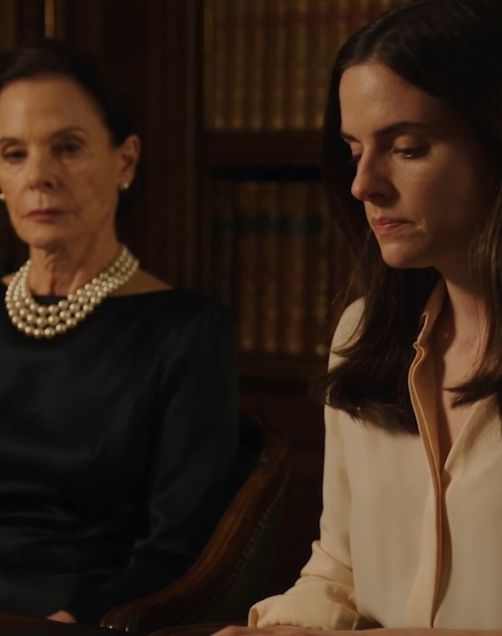
I saw everything then. The way her shoulders curled inward. The way she had taken off her engagement ring and then put it back on because she couldn’t decide if she was still allowed to grieve. The way she kept looking at me, waiting for me to do what fathers are supposed to do.
I gripped my cane until my fingers ached.
“Dad,” she said, and her voice cracked on the single syllable. “Say something. Please.”
My wife placed a hand on my arm. A warning. A claim.
I looked at my daughter and felt thirty years of cowardice rise in my throat.
“If you do not do this,” I said, and my voice sounded like a stranger’s, “we will be ruined.”
Her face changed. Not with anger. With understanding. The worst kind. The kind that makes a child realize her parent has already chosen.
She nodded once, as if I had confirmed a diagnosis of my own.
“Okay,” she said. She picked up the folder again, tucked it under her arm. “I’ll meet him.”
My wife exhaled, satisfied. “Wise girl. He is expecting you tomorrow at seven. At his residence. Dress appropriately. Do not embarrass us.”
My daughter walked to the door. At the threshold she paused. She didn’t look back.
“Did you ever ask Ferris to show you the images, Dad?” she asked to the wood. “Or did you just take his word for it too?”
The door closed without a sound.
That night I didn’t sleep. I sat in that study and stared at the empty space on the desk where the folder had been, and listened to my wife breathing evenly in the next room, and remembered the day my daughter was born. How the nurse had placed her in my arms and she had grabbed my finger with her whole fist.
At six forty-five the next evening, a black car arrived. No license plate I recognized. Two men in dark coats waited at the curb and did not come to the door. My daughter came down the stairs in a simple navy dress. No pearls. No silk. Her hair pulled back. Her face clean of makeup except for a faint line of color on her mouth that made her look older.
My wife inspected her and found her wanting. “You could have tried harder.”
My daughter didn’t answer her. She looked at me. “Will you come with me?”
My wife laughed. “He requested you alone.”
“I wasn’t asking her,” my daughter said, still looking at me.
I stood. My cane slipped against the rug. I caught myself on the edge of the table.
“I will wait in the car,” I said.
My wife’s eyes narrowed, but she said nothing as we walked out. The two men opened the rear door. My daughter slid in first. I followed. The door closed with a soft, expensive thud, and the city began to move past the windows.
Dante Moretti did not live in a fortress. He lived in a brownstone on a quiet street lined with old trees. Warm light glowed behind sheer curtains. A woman’s bicycle leaned against the iron railing. It was so ordinary I felt dizzy.
Inside, the air smelled like coffee and lemon polish. A fire burned low in a stone fireplace. Books lined the walls. Not for show. Worn spines. Cracked leather. A child’s drawing held to the refrigerator with a magnet shaped like an apple.
And the man standing by the window was not what the rumors had made him.
He was younger than I expected. Early thirties. Dark hair cut short. A scar that pulled faintly at the left corner of his mouth, but his eyes were tired, not cruel. He wore a plain gray sweater. His sleeves were pushed up, revealing forearms marked with old burns.
He looked at my daughter first. Not at me. Not with hunger or assessment. With something like relief.
“You came,” he said.
My daughter held the folder like a shield. “You asked for me.”
“I did.” He gestured to a sofa. “Please. Sit. Both of you.”
