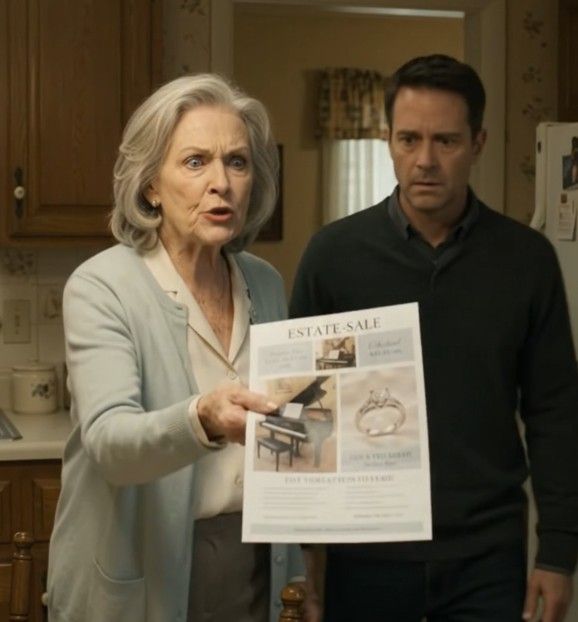
I found it difficult to sleep. The house made its usual nighttime noises, but I heard them differently: pipes settling, wind touching the windowpanes, and the faint click of the hallway latch. I changed the locks. I installed a door camera and chose a medical-alert service after discussing its features with my doctor. These were decisions I made because they increased my safety, not because anyone had proved I couldn’t live independently. Ellen offered to be one of the contacts. Daniel asked if he could be the other. I said yes, provided he understood that answering an emergency call didn’t entitle him to rearrange my life.
The ring was recovered from an appraisal service that had accepted it pending sale. Paige had signed a form identifying herself as its owner. Because of the police report and the auction company’s prompt cooperation, it had not been sold. The officer returned it in a small evidence envelope after the necessary procedures were completed. I held the metal to the kitchen light. There was the fine scratch from the day Daniel, as a toddler, had dropped a spoon against my hand. My husband’s initials still shone inside. I slipped it onto my finger and wept, not because I had nearly lost a valuable object, but because someone had handled the evidence of my marriage as inventory.
Daniel stood on the opposite side of the table. He asked whether he could hug me. For the first time since the truck arrived, I moved toward him. His arms felt familiar. The years fell away for a moment, and I remembered carrying him when he was feverish, both of us terrified because neither of us understood what was happening. Then I stepped back. “I love you,” I told him. “But you will have to learn not to frighten me in the name of loving me.” He covered his eyes. I let him hear the sentence without taking it back.
Investigators established that Paige had misrepresented her right to sell my belongings and had used a signature that was not mine. The facility’s internal review also uncovered irregular referral documents involving Martin, who was removed from enrollment work while the matter was referred to the appropriate authorities. Paige faced criminal charges related to the ring and false authorization, as well as civil claims for losses caused by the attempted sale. Months later she accepted responsibility in a court proceeding and was ordered to make restitution. Martin lost his position after the company’s investigation and a separate disciplinary process. Neither could arrange the sale of my life by presenting themselves as helpful relatives again.
Daniel’s own responsibility was different but real. He had signed the moving order. He had not checked the supposed inspection concerns. He had allowed Paige to speak for me. He couldn’t undo those things by insisting that he had been deceived. He paid the cancellation fees and covered the costs of the locks and security equipment, though I kept the accounts in my name. He also began meeting with a counselor to understand why the prospect of losing me had made him so willing to control me. He told me about the sessions only when I asked. We were learning to leave each other room to choose.
For a while, I couldn’t touch the piano. Paige had put a numbered sticker beneath its keyboard, and even after I removed it, the adhesive seemed to remain under my fingers. I kept imagining strangers lifting the instrument into a truck. Ellen suggested calling a piano technician. I said the instrument was in tune. “Maybe it doesn’t need repairing,” she said. “Maybe it needs someone to come and treat it as music again.” She had a way of making the simplest sentences feel like a door opening.
The technician was a young woman named Mina. She checked the strings, adjusted two sticky keys, and asked who had taught me. I told her about my mother and the afternoons we spent practicing while rain struck the greenhouse roof. Mina asked if I still knew the old piece my mother loved, the one with the gentle left-hand melody. I said I did, though my fingers might not. She invited me to try. The first notes were hesitant. By the second page, my hands remembered a pattern my grief had hidden from me. Ellen waited in the doorway without speaking.
One Sunday Daniel arrived with a repair kit and asked whether he might fix the hallway rail listed in the inspector’s report. I told him that was welcome. When he finished, he stood by the piano and touched its edge. “Dad and I brought this in after Grandma’s funeral,” he said. “Do you remember how we almost couldn’t get it through the doorway?” I remembered perfectly. We had taken off the door and carried the heavy bench separately. Daniel had been young, strong, and patient with me when I could hardly bear to look at the instrument.
He asked permission to open the bench. Inside were scores yellowed at the corners, a metronome, and a packet of postcards tied with ribbon. Daniel lifted out the top score and frowned. On its back was his father’s handwriting. We discovered a folded letter taped beneath the bench lid, a place neither of us had thought to check. The paper was dated the year his father died. Its first line read, “Daniel, if you ever think your mother needs protecting, remember what strength looks like when it is quiet.” Daniel sat down hard on the bench.
His father had written the letter after watching me spend months caring for my own mother, working, and keeping the household together. He thanked Daniel for moving the piano with him, then wrote that its weight was nothing compared with the years of love it carried. “If she needs help,” the letter said, “ask what she wants to keep. Do not start by deciding what she must lose.” It went on to describe the afternoon Daniel, age eight, had insisted on pushing the piano bench beside me because he wanted to be part of the music even when he couldn’t play.
I thought that was the whole message until Daniel turned the page. His father had enclosed a childish drawing: three figures seated at a piano, with the words MOM PLAYS AND WE LISTEN written in uneven capitals. Beneath it was a promise Daniel himself had made at eight: WHEN I AM BIG I WILL CARRY THE HEAVY THINGS, NOT TAKE THEM AWAY. His father had preserved it and later attached it to the letter. That was the beautiful cruelty of the moment. My son had once understood the difference between helping and taking over better than he did as a grown man.
Daniel stared at his younger handwriting for a long time. “I forgot who I was supposed to be,” he said. I told him that no child should have to keep every promise he makes, but that this one might still teach him something. We sat side by side on the bench, leaving the keys untouched. Then he asked whether I would show him the piece I used to play when he was sick. His fingers were clumsy, and he hit several wrong notes. We laughed at the same place we had laughed thirty years earlier. The sound seemed to move dust from the corners of the room.
Spring brought practical changes. I hired a gardener for the steep part of the yard and arranged grocery delivery during icy weather. Ellen and I established a weekly walking group that met at the little park near my house. I kept the piano room open once a month for neighbors who wanted to learn songs, practice for recitals, or simply listen. When Daniel suggested a schedule, I asked him to help distribute invitations instead. He did, without revising my plans. The house grew lively in a way that made safety feel like company rather than confinement.
At the last meeting before summer, Mina brought two teenage students to play a duet. Daniel brought extra chairs and stayed to wash cups afterward. Ellen sat in the front row wearing a ridiculous hat covered in paper flowers. I watched the sunlight cross the piano’s polished wood. No one mentioned the sale flyer, though we all remembered it. The piano was no longer an endangered object awaiting rescue. It was doing what my mother had taught it to do: inviting people into a room where attention could become love.
Daniel’s marriage ended. I never celebrated its failure, and I did not ask for private details that weren’t mine to know. Sometimes he seemed deeply lonely. I could offer him dinner, an honest conversation, or music on a Thursday evening. I could not repair his life by surrendering mine. Once he told me that counseling had made him realize how many times he used the word safe when he actually meant comfortable for himself. “I wanted to stop worrying,” he said. “I should have learned to live with some worry instead of making you live with my decisions.”
On my sixty-ninth birthday, Daniel arrived carrying a small wrapped parcel. Inside was a new music stand and a card, not a plan for me or a list of instructions. He had written, “Tell me what you want to play.” I opened the bench, took out my mother’s favorite score, and handed him the easier part. He protested that he still wasn’t good enough. “Neither was I when she taught me,” I said. We practiced until the daylight softened. The doorbell rang; Ellen came in with cake, followed by Mina and a handful of neighbors who’d learned to ring instead of barging through my front door.
When the candles were lit, Daniel asked me for a wish. I looked at the piano, the ring on my finger, the familiar books in their shelves, and the people who had chosen to gather without ever voting on what my life should become. The house was still old. Someday I might choose to move, or need care, or ask Daniel to help me pack it. None of that frightened me as much now that we had learned to speak honestly. I blew out the candles, put my hands on the keys, and played the opening notes while my son listened—until, smiling, he joined me.
