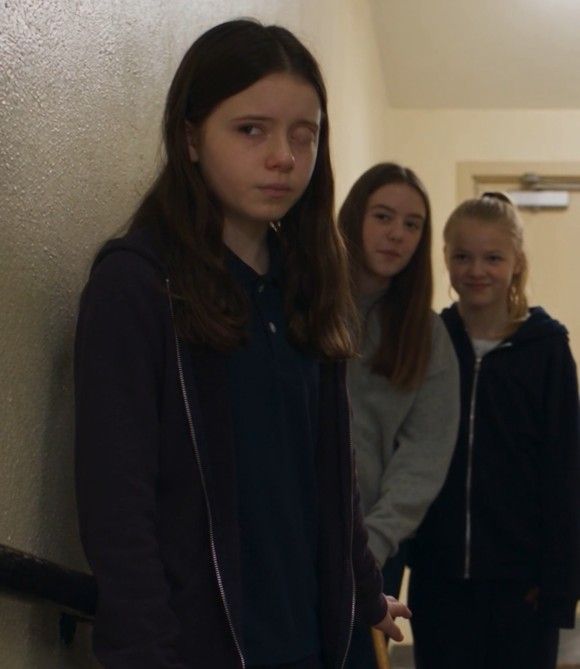
It was a trap.
The footage ended, but the image stayed burned behind my eyes.
I copied the file onto a flash drive. Then I copied it again onto my phone. My hands were steady, but my pulse was not. I had been a counselor for six years. I had seen bullies. I had seen indifferent teachers. I had never seen a staff member wait for a child to fall.
I knew I couldn’t go to the vice principal. Her name was Mrs. Ashford. She was the one who had signed off on every reduced punishment. She was the one who had told Mr. Keene to stay back. I didn’t have proof of that yet, but I knew it in my bones.
So I went to find the girl.
Her name was Lily. I had seen her in the hallways, always alone, always moving with that careful, measured grace. She was a junior. She had been blind since she was five. A car accident, they said. Her parents had died. She lived with her uncle, Victor Grayson, who was the president of the school board.
I found her in the music room. The room was empty, the lights dim. She was sitting at the piano, her cane resting across her lap. She wasn’t playing. She was just listening to the silence.
“You saw it,” she said before I spoke.
I froze. “How did you—”
“Your footsteps,” she said. “You walk heavy when you’re angry. You walked like that after the assembly last month. I remember.”
I sat down on the bench beside her. “Lily, I need to ask you something. And I need you to be honest with me.”
She turned her face toward me. Her eyes were pale and unfocused, but her expression was sharp. “You want to know if I know about Mr. Keene.”
My breath caught. “Yes.”
She nodded slowly. “I know.”
“How long?”
“Since the first time he stood in the hallway and watched Brittany take my cane. That was October. He didn’t move. He just watched. I knew then.”
I felt sick. “Why didn’t you tell anyone?”
She laughed. It was a soft, bitter sound. “Who would I tell? The teachers? They already know. The principal? She’s friends with my uncle. My uncle? He’s the one who told them to let it happen.”
I stared at her. “Your uncle?”
She reached into the pocket of her sweater and pulled out a small device. It looked like a remote control, but smaller. “My father was an engineer. He built this cane for me before he died. It has a camera in the handle. A microphone. A GPS. He said if anything ever happened, I should record it.”
She pressed a button. A small screen on the device flickered to life. “I have hours of footage. Mr. Keene. Mrs. Ashford. My uncle. They talk like I’m not there. They talk like I’m a problem to be solved.”
She played a clip. I heard Victor Grayson’s voice, smooth and cold. “The trust fund matures when she turns eighteen. If she has an accident before then, the money goes to me. If she’s declared incompetent, I control it anyway. Just make sure it looks like an accident.”
I felt the floor drop out from under me.
Lily turned off the device. “I was going to go to the police. But I needed proof. And I needed someone on the inside. Someone who wasn’t bought.”
She turned her face toward me again. “That’s why I let them take my cane today. I heard you in the hallway. I knew you were different. You were the first person who ever stopped.”
I couldn’t speak. I just sat there, my heart breaking for this girl who had been carrying the weight of a conspiracy on her small shoulders.
“I’m sorry,” I finally said. “I’m sorry it took so long.”
She reached out and found my hand. Her fingers were cold, but her grip was strong. “You’re here now. That’s what matters.”
We spent the next hour planning. She had a copy of the recordings on a cloud drive. She had a lawyer—her mother’s best friend, a woman named Diane who had been trying to get custody for years. Diane had been blocked by Grayson at every turn. But with the recordings, she could go to a judge.
We decided to present the evidence at the school board meeting that night. It was already scheduled. Grayson would be there. Ashford would be there. The two girls’ parents would be there. It was the perfect stage.
