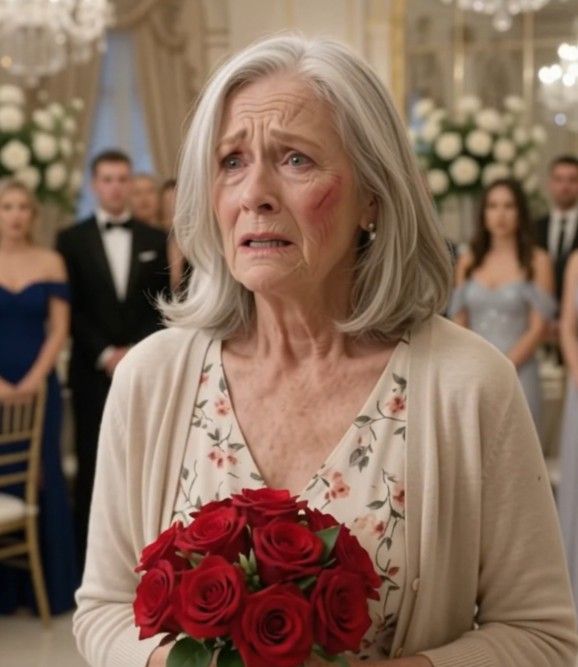
Some guests sent photographs they’d taken before the ceremony. Adrian asked the senders not to circulate images of Eleanor’s humiliation. One guest, an elderly uncle who had watched the slap without moving, came to apologize. He told Eleanor he’d been shocked into silence. She said she understood shock, but not the way silence could stretch while someone was left alone. He began volunteering at a local community center, helping older residents get transportation to appointments. It was an imperfect response to an ugly moment, but Eleanor appreciated seeing that his apology had turned into a choice he kept making.
By late summer, Eleanor could walk into a crowded room without searching instinctively for the nearest exit. She attended a neighborhood concert in the park, wearing a scarf Adrian had bought her years earlier, and stayed until the final song. Adrian sat beside her and let the music settle without asking whether she was all right every few minutes. When she reached for his hand, he took it. Recovery hadn’t arrived like a sudden revelation. It had been built out of small encounters in which nobody expected her to prove she deserved to be present.
When Adrian met her once with attorneys present, she looked less glamorous and more furious than he remembered. She blamed Michael, the coordinator, the bank, and Eleanor in turn. He listened until she ran out of explanations. “You could have told me you didn’t want my mother there,” he said. “We could have argued honestly. Instead you made both of us believe the other had stopped loving us.” Celeste stared at him without answering. Adrian signed the final settlement papers and left. For the first time, he understood that he did not need her agreement to end the harm.
Eleanor’s recovery was slower. She flinched when a stranger moved too quickly near her face. She stopped wearing the floral dress because she couldn’t look at it without remembering the ballroom. Adrian visited her every weekend, sometimes arriving with groceries, sometimes with nothing but time. They worked side by side in her garden, weeding the soil beneath the rosebushes. He didn’t insist they talk about the wedding. When she wanted silence, he stayed. When she asked questions, he answered without protecting himself from blame.
One afternoon she asked why he’d been so eager to build a life among people who made her feel unwelcome. Adrian said that after his father died, he’d become convinced that success meant never needing anyone. Celeste’s world of parties, tailored clothes, and important introductions had seemed like proof that he’d escaped grief and uncertainty. “I was afraid of being the kid who needed his mom,” he admitted. Eleanor brushed dirt from her hands. “You can be a grown man and still need people. That’s not the same as being helpless.”
He apologized for believing Celeste’s story without asking Eleanor himself. It was an apology she’d needed but hadn’t known how to request. “You were excited,” she said. “I thought I should be happy from a distance.” Adrian shook his head. “I let someone else decide how close we were allowed to be.” They sat on the porch until the sun slipped behind the trees. A neighbor’s dog barked somewhere down the road, and the scent of roses drifted through the screen door. It felt like a world that had existed patiently while he forgot to return to it.
Michael began helping with the garden too. He was the one who discovered an old wooden box in the shed while looking for pruning shears. Inside were strips of paper, faded photographs, and a packet of seeds labeled in Adrian’s father’s handwriting. Eleanor sat at the kitchen table holding the packet for a long time. Adrian’s father had planted the first rosebush when their son was born. Every year he took cuttings and rooted them in old coffee tins so the garden would grow alongside Adrian. The red roses at the wedding came from the oldest surviving bush.
Beneath the seeds was a folded letter addressed to Adrian on his wedding day. His father had written it years before his final illness. Eleanor hadn’t known about it. Adrian opened the paper carefully. His father’s words were plain and unpolished: Love is not the room that applauds when you enter. Love is the person who still opens the door after you’ve forgotten the way home. He wrote that if he couldn’t attend his son’s wedding, Eleanor would bring flowers from the garden for both of them. He asked Adrian to make sure she had a good seat.
Adrian read the last sentence aloud and began to cry. All that day he had thought the bouquet was his mother’s humble attempt to offer congratulations. Now he understood it had been a promise kept by two people, one living and one gone. Eleanor covered her mouth with both hands. “He never told me,” she whispered. Adrian laid the letter beside the roses they’d brought inside to dry. “He knew you’d come,” he said. “He knew you would keep showing up.” They sat together until the shadows moved across the table.
The letter changed something in Eleanor too. She had blamed herself for attending uninvited, but her husband had imagined that very act of love years earlier. She brought out the floral dress, washed it gently, and hung it in the sun. Adrian helped her frame a photograph of the red rosebush and the letter, leaving the original safely tucked into the wooden box. They decided not to keep the wedding photographs. The day no longer needed to be preserved as a beautiful lie. They would remember the truth and then make new memories.
A year later, Adrian and Michael organized a small garden lunch for Eleanor’s birthday. There were no photographers or crystal chandeliers. Neighbors brought homemade dishes, children chased each other between the chairs, and someone set a lopsided cake beside the lemonade. Adrian stood to thank the guests, then paused. Eleanor was wearing her floral dress. The faded fabric looked soft in the afternoon light, and her silver hair shone as she laughed at something a child had said.
He told the gathering how his father had grown roses for him and how his mother had kept tending them through every difficult year. He did not retell the slap or name Celeste. Nobody needed the cruelest day of Eleanor’s life turned into entertainment. Instead, he invited her to help him plant a new rose cutting near the porch steps. They knelt together in the soil, pressing it gently around the roots. Michael handed them water, and the smallest guest insisted on patting the earth flat with both hands.
When the lunch ended, Eleanor and Adrian sat on the porch steps as dusk approached. The garden was quiet except for insects and a distant passing car. Adrian slipped his father’s letter from his shirt pocket and read the last sentence once more: Make sure she has a good seat. He looked at the empty rocking chair beside him, then at his mother. “This one’s yours,” he said. Eleanor settled into it, her hands resting easily in her lap. For the first time in a long while, she did not wonder whether she belonged. The roses moved softly in the evening breeze, and the people who loved her were already home.
