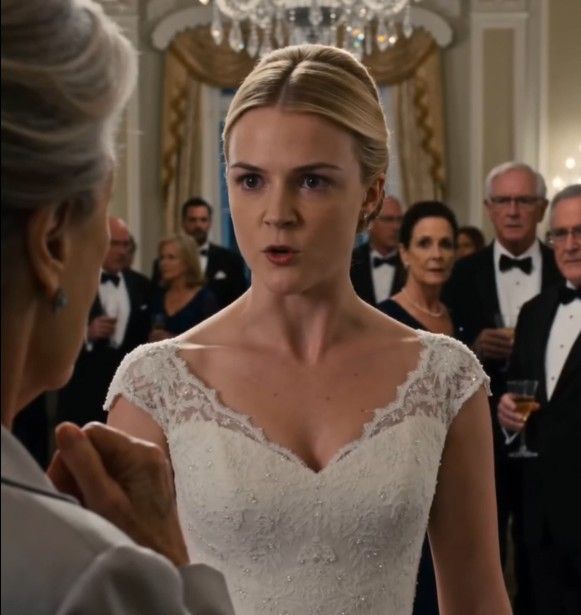
“You’re nothing but a resentful old woman ruining MY wedding!” Tiffany’s words cut across the grand estate ballroom with enough force to make every other sound seem distant. Mrs.
Bennett did not answer. Beneath the chandeliers, Tiffany stood facing her with the certainty of someone who seemed to believe the accusation itself should be enough to produce an apology.
A faint clock clicked somewhere beyond the conversation. Mrs.
Bennett let her thumb move once across the worn ring on her finger. The gesture was small, almost invisible, but it steadied her.
“Resentful old woman.” The insult hurt. But the final words carried more weight.
“Ruining my wedding.” Mrs. Bennett looked at Tiffany.
No explanation followed. Tiffany did not soften the accusation or turn it into something spoken carelessly in anger.
She remained where she was, watching Mrs. Bennett as though everyone already understood what had supposedly been ruined and why the blame belonged to her.
The ballroom offered no privacy. Chandeliers threw warm light over polished surfaces and made every expression visible.
A few people nearby looked away. Others stared.
Whatever happened next, no one could later pretend the humiliation had occurred behind a closed door. Mrs.
Bennett’s thumb remained against the ring. A narrow line of light crossed the floor.
A metal edge caught it sharply. A glass stood half full.
One door remained open by only a few inches. Ordinary details, yet each one arrived with unusual clarity.
Sometimes the body remembered a room before the mind decided what to do inside it. Heat rose into Mrs.
Bennett’s face. For a few seconds, shame urged her to lower her eyes.
She did not. There had been other arguments when silence seemed easier than resistance.
A quiet nod could end tension quickly. Letting someone else have the final word could keep an uncomfortable moment from becoming worse.
Tiffany appeared to expect that familiar pattern now. Mrs.
Bennett gave her nothing. She did not apologize.
She did not retreat. She did not accept that Tiffany’s accusation was true simply because it had been delivered publicly and with confidence.
The clock clicked again. Mrs.
Bennett focused on the exact words. Tiffany had said she was ruining the wedding.
She had not said how. That distinction mattered.
Mrs. Bennett refused to invent the missing explanation.
She would not decide for herself whether Tiffany meant something she had said, something she had done, or merely her presence in the ballroom. Those answers belonged to Tiffany.
The first rush of humiliation began to cool. Something steadier replaced it.
Clarity. If Tiffany wanted to accuse her in front of everyone, then the accusation should survive a simple question.
Mrs. Bennett slowly lowered her hand from the ring.
Tiffany watched the movement. For several seconds, neither woman spoke.
The ballroom remained bright around them. The chandeliers had not dimmed.
The half-full glass had not moved. People were still close enough to witness the silence stretching between them.
At first, Tiffany had seemed perfectly comfortable inside that silence. Then it lasted longer.
Mrs. Bennett did not look toward the door.
She did not make herself smaller. She simply held Tiffany’s gaze.
Calling someone resentful did not prove resentment. Saying a wedding had been ruined did not explain what had actually happened.
Mrs. Bennett realized she did not need an equally cruel response.
She needed the missing fact. Her voice, when it finally came, was quiet enough that Tiffany had to listen.
“You said I’m ruining your wedding.” Tiffany’s expression tightened. Mrs.
Bennett did not look away. “Tell me exactly what I did.” For the first time since the accusation had echoed beneath the chandeliers, Tiffany did not answer immediately 👇
Tiffany opened her mouth, but Mrs. Bennett’s question had changed the room.
The answer did not arrive cleanly. Tiffany tried to redirect the conversation toward tone and timing, but Mrs. Bennett kept returning to the one fact that could be checked: the wedding arrangements. Nobody needed a louder argument; they needed an explanation that could survive being stated plainly. Nobody in the ballroom could undo the earlier words, yet the next choice still belonged to Mrs. Bennett.
Mrs. Bennett noticed the smallest details in the ballroom: a chair slightly out of line, a glass untouched, the hum of air moving through the room. Those details kept the moment from becoming abstract. Whatever happened next would happen here, in front of people who had already heard enough to understand the stakes. That distinction kept the discussion tied to the wedding instead of allowing it to drift into another argument about personality.
When a family witness finally spoke, the intervention was careful rather than dramatic. The point was not to rescue Mrs. Bennett with a perfect speech. It was to confirm one piece of information that Tiffany had hoped would remain vague, and the confirmation narrowed the space available for denial. For Mrs. Bennett, the shift was measured less by volume than by the fact that the question finally remained unanswered until someone addressed it honestly.
Tiffany objected immediately. The objection focused on procedure, manners, and the supposed unfairness of being questioned. Mrs. Bennett listened without interrupting. The longer the explanation continued, the more obvious it became that none of those complaints answered the original issue surrounding the wedding arrangements. The record surrounding the wedding arrangements made that clarity possible without requiring anyone to guess at motives.
A few minutes earlier, leaving quietly might have felt easier. Now Mrs. Bennett understood that retreat would allow the same story to be repeated later without challenge. Staying did not mean creating a spectacle. It meant refusing to surrender the facts simply because someone else was more comfortable speaking with certainty. The significance of that moment was not obvious immediately, but it changed what Mrs. Bennett was willing to accept next.
The material connected to the wedding arrangements was examined piece by piece. Dates mattered. Names mattered. The order of events mattered. Mrs. Bennett resisted the urge to jump ahead because the strength of the truth came from how ordinary and verifiable each part was when placed beside the next. Nobody in the ballroom could undo the earlier words, yet the next choice still belonged to Mrs. Bennett.
A contradiction emerged without anyone needing to accuse Tiffany of lying. One earlier statement could not comfortably exist beside the record now in front of them. Tiffany noticed it too. The confidence that had controlled the beginning of the confrontation became more cautious. That distinction kept the discussion tied to the wedding instead of allowing it to drift into another argument about personality.
People nearby changed in subtle ways. Someone stopped pretending to check a phone. Another person lowered a hand that had been halfway to a glass. The room was not becoming a mob; it was becoming attentive, and attention was exactly what the earlier humiliation had depended on avoiding. For Mrs. Bennett, the shift was measured less by volume than by the fact that the question finally remained unanswered until someone addressed it honestly.
For Mrs. Bennett, the hardest part was not winning an argument. It was recognizing how long the underlying pattern had been allowed to shape daily life. the wedding had become a shorthand for years of being expected to absorb discomfort so other people could remain comfortable. The record surrounding the wedding arrangements made that clarity possible without requiring anyone to guess at motives.
