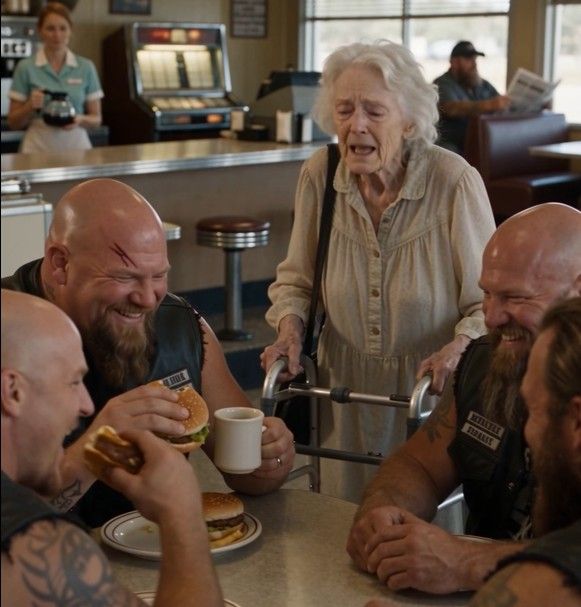
“You were always my son,” Ruth said. “No matter what name you used.”
He broke then. The big, scarred biker wept like a boy. Ruth pulled him close and held him while the creek sang behind them.
Danny, Otis, and Rook stood at the edge of the yard. Otis wiped his eyes with the back of his hand. Danny sniffled. Rook just nodded, slow and solemn.
That night, they stayed. Otis fixed the porch light. Danny made a fire. Rook found a can of soup in the cupboard and heated it on the woodstove. They ate together at the small kitchen table, the five of them, and for the first time in twenty years, the blue house felt full.
Over the next week, they repaired the house. Otis replaced the broken boards on the porch. Danny patched the roof. Rook fixed the fence. Michael rebuilt the swing. The town pitched in. Marge brought pies. Hank the trucker brought lumber. The sheriff stopped by to say the charges against Charles were holding. The trust was validated. The mineral rights belonged to Ruth and her heirs. Caldwell Development was under investigation. Charles would not be coming back.
Ruth grew stronger. She walked to the creek every morning with Michael. They talked about Walter. They talked about the years that had been lost. They talked about forgiveness.
One evening, as the sun set gold behind the pines, Ruth handed Michael a letter. It was old, the paper yellowed, the ink faded.
“Your father wrote this for you,” she said. “The day before he died. He wanted you to have it when you came home.”
Michael opened it with trembling hands. The handwriting was shaky, but the words were clear.
My son,
I’m sorry. I was hard on you. I was afraid. I didn’t know how to say I loved you. The door is always open. The creek still runs. Come home.
Dad
Michael folded the letter and pressed it to his chest. He didn’t speak. He didn’t have to. Ruth took his hand, and they stood together by the creek, the water carrying the last light of day.
On Sunday, they had dinner. The table was small, so they ate on the porch. Marge brought a roast chicken. Hank brought a crate of peaches. The four bikers sat around Ruth, passing plates, laughing, arguing, telling stories. Michael sat at his mother’s right hand.
Ruth looked at them—her real son and her pretend sons—and her eyes filled.
“I don’t have to pretend anymore,” she said.
Danny raised his glass. “To family.”
“To family,” they echoed.
The creek sang. The roses swayed. The blue house glowed warm against the deepening sky. Motorcycles and a battered Ford truck sat in the drive, and from the porch came the sound of laughter, the sound of healing, the sound of home.
And Ruth Miller, who had stopped crying in a diner one afternoon, finally let herself cry again—not from fear, but from joy.
The Blue House by the Creek
