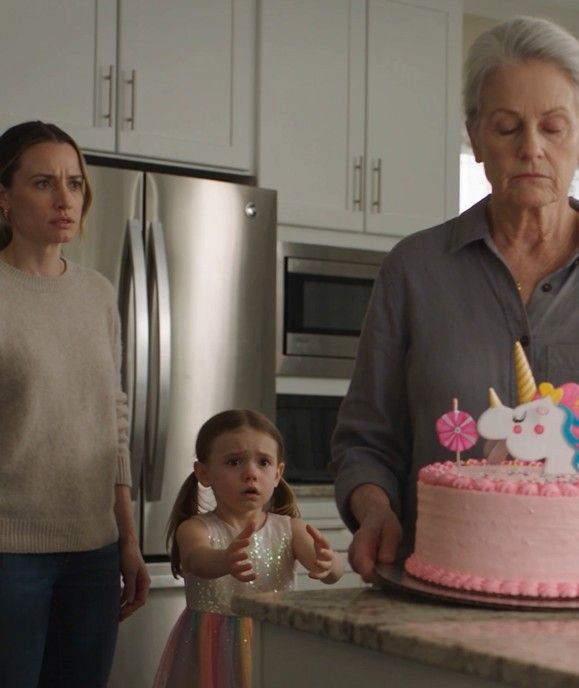
“Where did you find this?” I asked. Emily glanced toward the living room. “Grandma left it by the printer. I saw my name. She said I wasn’t supposed to read grown-up papers.” Her eyes brimmed again. “Then she told me if I told you, you would be angry that I touched it. She said maybe I should live somewhere else because I make you tired.” I sat on the floor because my legs abruptly felt unreliable. The wish Emily had made over her seven candles came back to me: something too soft to catch under the singing. She had not wished for toys or a party. She had wished for someone to believe her.
I wanted to storm into the living room. Instead, I asked one question after another, gently and without suggesting answers. Had Grandma handed the form to anybody? Emily didn’t know. Had anyone from school told her she was moving? No. Had Grandma hurt her? Emily considered this in earnest. “She squeezed my arm when I tried to call you once,” she said. “But mostly she tells me I make everything difficult.” The difference between what my daughter said and what she believed was already becoming clear. She had begun to think adults were allowed to frighten her as long as they called it teaching.
I photographed the form, front and back. I placed it in a clean envelope without asking Emily to touch it again. Then I took her upstairs to wash the frosting from her sleeve and choose a sweater. She asked whether she should stop crying. I told her tears were not a behavior problem. Her shoulders loosened, just a fraction. We put on her favorite striped socks, the ones with tiny yellow suns, and I suggested we finish her birthday at the little bakery near the park. She stared at me. “Will Grandma be mad?” I said, “Grandma’s feelings are hers to manage.” I had never said those words aloud before.
When I went downstairs, my mother was examining the bag I had placed beside the counter. “You have no idea what you’re doing,” she announced. I showed her the photograph of the school form. The color drained from her cheeks. Then she rallied. She said she had only been preparing for emergencies. She claimed I worked too much. She insisted my daughter needed a stricter routine and that the school would thank her for intervening. I asked whether she had signed my name. Her expression narrowed. “If I did something practical, it was because somebody had to.” It was not quite a confession. It was more revealing than one.
I told her she no longer had permission to collect Emily from school or be alone with her. My mother rose so abruptly that the chair legs scraped the floor. She listed sacrifices from thirty years ago, bills she had paid when I was young, illnesses I had failed to appreciate. She reminded me that family should stand together. I looked at the garbage can, where a little plastic unicorn horn was sticking out of old coffee grounds. “Family is supposed to make a child feel safe,” I said. “You frightened her to protect something you wanted. That is not standing together.”
She tried a different tone. Soft now. Trembling. “Your father would be ashamed of the way you’re speaking to me.” I almost answered from habit, explaining, apologizing, trying to make her feel better. Instead I said the only thing that mattered. “Please take your things and go.” For a long moment she seemed incapable of understanding that the argument was finished. Then she took her coat, said Emily would be sorry when nobody wanted her, and walked out. I stood at the locked door until her car pulled away. In the mirror beside the entryway I saw my own face, pale and older than it had looked that morning.
At the bakery Emily chose a cupcake with pink frosting. The owner added a paper crown after hearing it was her birthday. We sat beside a window overlooking the park while children in coats ran between puddles. Emily lifted the cupcake carefully, as though expecting somebody to take it. I said she could eat the frosting first if she wanted. She laughed once, startled at the freedom, and dipped a spoon into the pink swirl. When she asked whether she could make another wish, I told her she could make as many as she needed. She closed her eyes and kept them closed for a long time.
The next morning I called the school before the doors opened. I spoke first to Emily’s teacher and then to the office administrator. Both listened without interrupting. The form had not been processed, the administrator told me. A copy had been handed to the office the previous week, but the discrepancy between the requested address and existing records had triggered their requirement for direct confirmation from a parent. They had left two messages on my home number. We rarely used that telephone. I remembered my mother answering it on Tuesday while I was in the garden. She had said it was a wrong number.
The administrator showed me the visitor log when I arrived. My mother’s name appeared beside an entry dated three days earlier. She had told the receptionist I was recovering from exhaustion and should not be disturbed. The school had refused to make the change without speaking to me. I thanked them for following their procedure, checked my own contact information, replaced the outdated home number with my mobile, and removed my mother from the list of authorized pickups. The school noted my request and agreed to ask for photo identification from anyone collecting Emily. Nothing dramatic happened. A pencil moved across a form. A clerk typed into a database. The ordinary efficiency felt like a miracle.
Emily’s teacher, Mrs. Alvarez, invited me into her classroom after the students left. Near the window hung a line of drawings about favorite places. Emily’s picture showed our kitchen table with a tall rainbow above it and two people holding hands. I recognized the curve of her own handwriting under the crayon sun: HOME IS WHERE MOM BELIEVES ME. Mrs. Alvarez said Emily had become quiet during the previous month and had asked twice whether children sometimes lived with grandparents when their parents got tired. The teacher had encouraged Emily to talk to me, but she had seemed frightened of causing trouble.
My chest tightened. I had mistaken quiet for contentment. I had congratulated myself because Emily rarely complained when Grandma babysat. Mrs. Alvarez didn’t blame me or pretend to know everything. She suggested a child counselor who could help Emily rebuild a sense of control without asking her to repeat the same story for every adult. She also advised keeping written records of what had happened. I left with the name of a licensed professional and the terrible, useful knowledge that attention was not the same as love unless it listened.
That evening my mother began calling. First she threatened to tell relatives I had turned against her. Then she said she was sick. Then she left a long message about how ungrateful I was for years of childcare. I saved the messages and answered only once by text: Do not contact Emily directly. Any necessary communication must go through me, in writing. She responded that I would regret humiliating her. I did not respond. I made dinner, helped Emily with spelling words, and listened while she described a bird she had seen near the playground. For the first time in weeks she finished a story without checking whether I was pleased with it.
Two days later an envelope arrived from my mother’s house. Inside was a second copy of the school request, plus a note written in my mother’s familiar sharp handwriting. It said she had merely wanted to spare me the burden of daily parenting. She claimed the paperwork was a preliminary arrangement, nothing to worry about. But folded behind the note was a sheet from a neighborhood family-service office. It listed questions about guardianship, not a completed application. Next to several questions my mother had written: Mother overworked; child difficult; grandparents can provide discipline. Every phrase reduced our life to something less complicated than the truth.
I took the documents to a family-law attorney for a consultation. She did not promise a spectacular legal outcome. She explained that no one could simply change my daughter’s residence because they preferred stricter rules, that the school had correctly refused an unverified form, and that custody decisions involved actual evidence and legal process. She advised protecting accounts and records, documenting unwanted contact, and reporting suspected forgery if appropriate. I left feeling neither victorious nor invincible. I felt informed. That was enough to begin.
I changed the locks after realizing my mother still had a key. I updated my passwords, checked my bank statements, and told the few people who cared for Emily about the new pickup boundaries. My neighbor helped me carry the old birthday decorations to the garage. When he saw the crushed cake board, he asked whether I wanted it thrown away. I looked at the dented cardboard unicorn, suddenly absurd and heartbreaking. “Yes,” I said. “But leave the little candle holder.” I wanted to keep one object that belonged to the birthday Emily had actually lived through, not the one I had imagined.
A week later my aunt called. She was my mother’s younger sister, and for years I had avoided discussing family conflicts with her because she seemed to know all the old wounds. She spoke quietly when I described the form. “Your mother has always been frightened of losing control,” she said. “That doesn’t make what she did acceptable.” She told me their own mother had routinely threatened to send children away for telling the truth. My mother had sworn at eighteen that she would never live under somebody else’s thumb. It was painful to hear how closely she had repeated the language she once hated.
I thanked my aunt but didn’t ask her to excuse anything. Childhood can explain a person’s fears without giving those fears the right to govern someone else’s child. Later, while I folded laundry, I wondered how many times I had heard my mother call cruelty a lesson. I had inherited those phrases so thoroughly that sometimes I heard myself preparing to say them when Emily spilled juice or forgot her shoes. The realization frightened me more than the paperwork. I began stopping in the middle of certain sentences and choosing new ones. Changing an old pattern sounded small, but it required my full attention.
Emily’s first counseling appointment was mostly about crayons and a dollhouse. She emerged carrying a drawing of a door with a big green handle. She explained that the people inside could decide who came in. That night we made a household rule: nobody was allowed to demand a secret that made her uncomfortable, and no adult could tell her she would be abandoned for speaking honestly. Emily proposed another rule. “If someone ruins a cake,” she said, “we can have cookies instead.” I agreed. Then she added, smiling, “And we still get to be sad about the cake.” I wrote that rule down too.
My mother appeared on our porch the following Saturday. She had brought an expensive bakery box and a gift bag filled with toys. For an instant my heart leaped toward the familiar pattern: accept the offering, apologize, pretend the damage had disappeared. But Emily was visible through the window, painting at the table. My mother looked past me and called her name. I stepped outside, closed the door, and asked her to leave the gifts on the step. She said she had come to make peace. I asked whether she was willing to acknowledge what she had done and why it had frightened Emily.
She began by insisting that the cake had been too sugary. Then she said Emily needed discipline. Finally she admitted that she had signed my name because she was afraid I would say no. The words landed between us like stones. “You knew I would say no,” I repeated. “You decided that made my consent unnecessary.” She tightened her grip on the bakery box. “I only wanted what’s best for her.” I answered, “Wanting something isn’t permission to take it.” She stared at me with an expression I had seen since childhood, the one that warned an argument was about to become a punishment.
This time I didn’t stay to receive it. I told her we would not resume visits until she could respect the boundaries and demonstrate it over time. Any eventual contact would be supervised and guided by Emily’s comfort, not by my mother’s impatience. She called me cruel. I opened the door and went inside. Emily looked up from her paints, waiting for a verdict. “Are we in trouble?” she asked. “No,” I said. “I told Grandma the rules.” I watched my daughter absorb the possibility that rules might protect her instead of trapping her.
The following month brought no cinematic courtroom scene. The police accepted information about the suspect signature and explained how any investigation would proceed. My attorney helped me document the timeline. The school preserved the submitted form and visitor records. I did not know whether my mother would face charges, and I refused to promise Emily something adults could not guarantee. What I could promise was that her school knew who could pick her up, our locks had been changed, and she would never be required to keep a frightening secret for an adult.
There were hard days. Emily asked whether Grandma hated her. Sometimes she missed stories and the familiar smell of lavender soap. I told her people could be missed even when being near them was not safe. I let her grieve the grandmother she had hoped for. I grieved too, not only for our relationship but for the easy certainty that someone older must know better. I was learning that parenthood sometimes meant disappointing the people who raised you in order to protect the child you were raising.
By early spring the paper crown from the bakery was fading on Emily’s bookshelf. Her teacher reported that she was raising her hand in class again. She had made a friend who loved unicorns and disliked loud noises. She had also begun telling me ordinary unpleasant things: that a classmate interrupted her, that a spelling test was difficult, that I had forgotten to cut the crust from her sandwich. I treated every complaint as practice. A child who could safely say her sandwich was wrong might someday safely say something much more important.
On a rainy afternoon Emily asked to bake another cake. We measured flour with a dented cup and argued affectionately about whether two spoons of vanilla were too many. She decorated the top with crooked pink stars, not a unicorn. I was about to carry it to the table when she stopped me and asked for the candle holder we had saved. We lit one candle, not seven. “What’s this one for?” I asked. She looked at the flame and answered, “For the day you believed me.”
I thought again of the folded paper, the wet crash of frosting in the trash, and my mother’s whispered threat. I had believed the birthday was ruined because something sweet had been destroyed. But the day had also given my daughter the courage to show me a truth she was told to hide. I put the candle in the center of our slightly lopsided cake, lowered myself beside her, and waited while she made her wish. I didn’t need to know the words. When she opened her eyes, she knew that I would listen.
