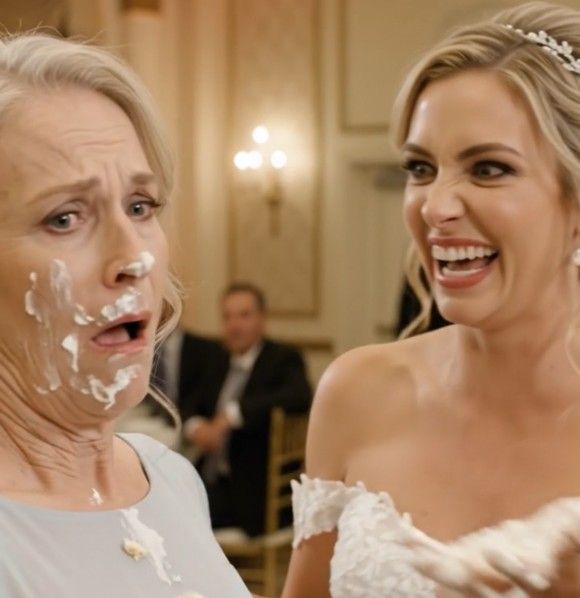
Lauren said I was using money to embarrass her. I reminded her that the problem was never her family’s ability to pay. It was her willingness to lie about who had paid and use someone else’s account. She snapped that a mother should help her son without expecting praise. “I didn’t ask for praise,” I replied. “I asked not to be humiliated and charged for things I never approved.”
Mr. Ellis offered to arrange a quiet room where I could clean up. Before I left, I instructed him to let the guests finish the agreed meal and to apply the hotel policies consistently. Nothing in the contract required a room full of guests to be punished for the conduct of two people. The additional suite and discretionary services could be paused while the charges were reviewed. I would resolve the financial issues through the proper billing process instead of staging a spectacle.
In the restroom, I washed frosting from my hair and neck. The cold water stung where cake sugar had dried near my ear. A younger woman entered and quietly offered me a pack of wipes. She said she was Lauren’s cousin and had been sitting near the cake table. “I don’t know why she did that,” she whispered. I told her neither did I. Then I thanked her, and we stood side by side beneath the bright mirror lights until my breathing settled.
When I returned to the ballroom, David was waiting outside. He apologized for laughing. I asked what he had found funny. He couldn’t answer. “You saw your wife put her hand in the cake,” I said. “You saw what happened next. What part of that made you laugh?” He stared at the carpet. “I was trying to keep it from becoming a fight,” he said. “So you made it a joke at my expense,” I replied. He nodded, tears gathering, and for once did not ask me to make him feel better.
I told David that the missing mother-son dance had hurt, but the damage began long before then. I’d been placed behind flowers at the ceremony, excluded from the family table, and asked to smile in photographs after being treated as an inconvenience. Each separate decision could be dismissed as a minor oversight. Together they formed a pattern: make the mother who helped pay invisible, then mock her when she refused to disappear. David put a hand against the wall. “I didn’t know it had gotten that bad,” he said. I told him he had chosen not to see.
The reception ended earlier than planned. I left before the final songs, carrying a garment bag so I could take the blue dress for cleaning. At home I hung it in the laundry room and sat at the kitchen table without turning on any lights. I had imagined this day for years: the moment my son married, the photograph of us dancing, the feeling that our family had grown. Instead I remembered the sound of his laughter. It was a small sound, but it had changed the shape of a lifetime.
The following morning I received an email from Mr. Ellis. The hotel had identified several charges submitted without adequate authorization, and the staff were reviewing them. He apologized for the billing confusion and assured me the surveillance footage around the cake table had been preserved according to their procedures. He also said a member of his team wanted to speak to me about something unusual. I agreed to meet later that week.
At the hotel, a junior event coordinator named Priya showed me copies of the planning notes. Lauren had repeatedly asked the staff to leave me out of decisions, describing me as “emotionally difficult” and warning that I might disrupt the wedding. She had also said the mother-son dance was canceled at David’s request. Priya had assumed David knew. But on a separate page she had written down his earlier inquiry about the song he’d chosen for us. The two instructions had never fit together.
I closed my eyes. David had chosen a song. For a moment the knowledge hurt worse than if he’d never thought of the dance at all. Priya told me she had kept the note because the scheduling change seemed odd. She wasn’t asking me to use it against anyone. She wanted the record to reflect what had happened. I thanked her for caring enough to notice.
When I showed David the note, his face drained. He said he’d been told the hotel couldn’t fit the dance into the schedule. Lauren had blamed a timing conflict. He called her while I sat across the table. I heard only his side of the conversation: “Did you cancel it?” Then silence. “Did you tell them I asked you to?” Another long pause. Finally he ended the call, put his head in his hands, and said, “She did.”
We sat for a long time without speaking. At last David told me that Lauren had been increasingly anxious about being compared with other brides and resentful of the attention mothers received at weddings. He had tried to avoid arguments by agreeing to changes she proposed. I asked whether he’d ever told her that humiliating me was unacceptable. He shook his head. “I thought she’d settle down after the wedding.”
I told him he had confused postponing conflict with preventing harm. He said he knew that now. Then he asked the question I had been dreading: could we ever be close again? I looked at the boy who used to bring me dandelions in the spring and the man who had laughed while I stood with frosting on my face. Both belonged to the same person. “Maybe,” I said. “But it will take time, and I need you to stop asking me to erase what happened.”
The financial review revealed that Lauren had also charged a jewelry purchase to a card she said was connected to the wedding budget, though the authorization for that use was disputed. We let the bank and relevant professionals handle the transactions. I filed the necessary documentation, reviewed every account for additional charges, and stopped allowing anyone to use my payment details as an informal backup. I did not need a public accusation to protect myself. The records were sufficient to demand proper accounting.
Lauren responded with furious messages. She said I had ruined her wedding, threatened to tell everyone I was controlling, and insisted the cake incident was a prank. David eventually told her he would not participate in blaming me. She accused him of choosing his mother. He said he was choosing honesty. They began counseling, but she would not accept responsibility for the false billing instructions or the canceled dance. Their marriage faltered under those larger questions of trust.
Six months later they separated. I did not demand that David leave Lauren; he had to decide what sort of marriage he could live in. He moved into a small apartment and began repaying the wedding costs he’d personally promised to cover. He offered to compensate me for the dry cleaning and the damaged dress. I accepted the gesture and told him that money was the easiest part of what needed repairing.
On one Sunday afternoon David came over with a stack of photographs from his childhood. He had found them while unpacking. We spread them across the table: birthday parties, school concerts, camping trips, a picture of him losing his first tooth. In one photograph he was seven, sitting on my shoulders at a fair. He said he didn’t remember being carried like that. I told him he’d asked because he wanted to see over the crowd. “You didn’t tell me I was too heavy,” he said. “You weren’t,” I replied. “Not then.”
The joke made us both laugh, then cry. David said he had spent years letting others define what loyalty meant. He thought being a good husband required never challenging his wife. I told him that a marriage should make room for honest disagreement, not demand the abandonment of everyone who loved you before it began. He listened without arguing. It was new enough that I noticed.
Mr. Ellis sent one final letter confirming the billing corrections and the hotel’s changes to its authorization process. He included a small photograph from the planning archive. It showed me standing in the empty ballroom weeks before the wedding, helping a florist arrange chairs while the staff tested the lights. I had forgotten that day. On the back Priya had written, You were the only person who asked whether the people working the event had eaten lunch. I stared at the words for a long time.
I hadn’t helped because I wanted recognition. I had done it because I knew the florist and servers were human beings, not scenery. Lauren had made me feel foolish for caring about things that didn’t look glamorous. The note reminded me that ordinary kindness leaves a record too, even when no one announces it into a microphone.
I began volunteering with a small local organization that helped families organize affordable celebrations. Not lavish weddings, not elaborate displays, just birthdays, anniversaries, and reunions that allowed people to gather without debt. My friend Janet joined me. We sewed table runners, coordinated donated flowers, and helped older relatives find seats where they could actually see. Every event was a quiet rebuttal to the idea that someone could be loved more by spending more.
I also made one boundary unmistakable. David and I met with a family counselor for several sessions, not because I expected a professional to tell him how to love his mother, but because we had developed years of habits we couldn’t easily name. He admitted that he found my disappointment almost unbearable and often tried to dodge it by making jokes. I admitted that I had sometimes offered money and practical help rather than asking for the respect I needed. We practiced stating uncomfortable things without rushing to rescue each other from them. One afternoon I told him plainly that I would no longer pay for major celebrations unless everyone involved understood the terms in writing. He didn’t argue. We left the session and went for coffee, discussing the weather like two ordinary people.
Janet said the change was visible before I could see it myself. I no longer checked my phone every few minutes in case my son needed something, and I didn’t explain away his choices when they were careless. David began offering help without assuming I was incapable of managing alone. When I had a leaking pipe, he asked whether I wanted him to find a plumber; he didn’t take over the house or tell me what I should have done. I appreciated the question more than the repair. It allowed me to accept help without surrendering control.
In autumn David asked whether we could hold the dance we’d missed. I hesitated. I didn’t want to recreate the wedding as though the harm could be undone with one beautiful moment. He said he understood. Then he suggested we dance at my birthday party, where the day would belong to neither his marriage nor his regret. I agreed. It felt small enough to be real.
Before the celebration, I brought the repaired blue dress to Janet and asked her to help me adjust the hem. She spread it across her sewing table and studied the tiny place where the cleaner had removed the last stubborn trace of frosting. Neither of us spoke for a moment. Then Janet asked if I wanted to keep it. I said I did, not because it was expensive or because I wanted to relive the wedding, but because I had chosen it with joy. The bride had damaged a moment. She had not acquired the right to define every object that survived it.
My birthday came on a cool November evening. Janet brought flowers. David cooked dinner, burning one tray of vegetables and apologizing with a grin. After cake, he put on the song he’d chosen for the wedding. It was an old tune his father used to hum while washing dishes. David held out his hand. I took it. We moved carefully around the living room furniture, two people who had known each other a lifetime and still had things to learn.
Halfway through, David whispered, “I should have stood up for you.” I looked at him. “Yes,” I said. We kept dancing. He didn’t try to soften the admission or ask for forgiveness immediately. He simply held my hand gently and let the truth remain between us. When the song ended, he hugged me and waited until I was ready to let go.
Later that night I opened a box of keepsakes and found a little drawing David had made in first grade. It showed a tall figure in a blue dress and a small boy holding her hand under a huge yellow sun. On the back, in his teacher’s handwriting, was his explanation: This is my mom. She always comes when I need her. I’d kept it for thirty-six years. Now I understood why the wedding had hurt so much. I had needed my son to come when I needed him, just once.
The next morning I framed the drawing beside the photograph from the hotel. They didn’t cancel the humiliating memory or guarantee that David would never disappoint me again. They reminded me that a relationship is not defined only by its worst moment, provided the people involved are willing to change what happens next. I stood in the kitchen as sunlight touched the frames. My dress, professionally cleaned and carefully repaired, hung in the closet. My life was not a ruined celebration. It was an open room, waiting for the people who knew how to enter with care.
