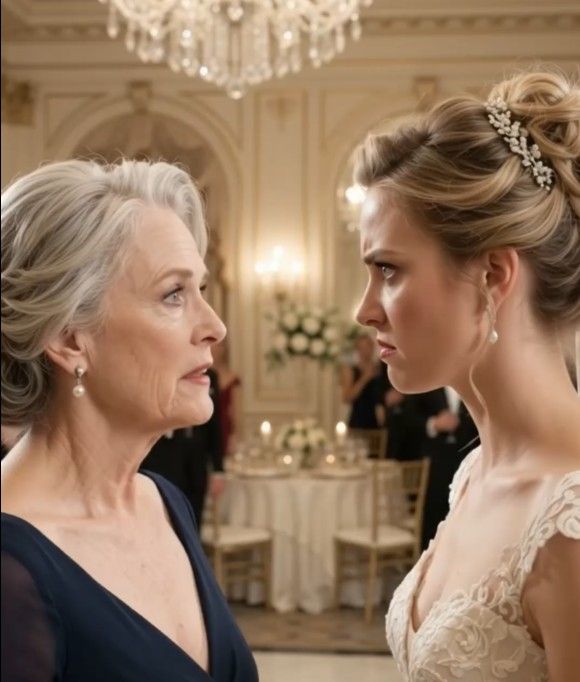
Tiffany looked toward Daniel. “Make her put it back.”
He opened his mouth, then looked at my face again. I waited while the chandeliers hummed overhead and waiters passed with empty trays. He said nothing. Tiffany took his silence as a refusal and pushed past him toward the ballroom.
Her father stayed. “You promised to pay for this wedding.”
“I promised to help my son begin his marriage,” I said. “I didn’t promise unlimited access to my savings or permission to assault me. If the champagne matters that much, the bar manager can give you an invoice.”
His jaw tightened. He did not ask for the invoice. He returned to the ballroom without another word.
I started toward the exit, but Daniel caught up with me. “Mom, please.”
“I need you to let me leave,” I said. “You watched her hit me, and your first concern is whether her party can continue. I can’t talk to you while that’s still the thing you care about most.”
He released the edge of my sleeve. I walked outside into the cool evening air, past a line of parked cars shining beneath the estate’s trees. An employee offered to call me a taxi. I accepted, then sat on a bench where I could see a slice of the ballroom through the windows.
The first change came quietly. The lights over the dance floor settled into their standard setting. A waiter carried away the display for the late-night champagne service. The band finished its contracted set and began packing equipment. I watched guests exchange uncertain looks, not because the evening had suddenly become barren, but because the magnificent excess Tiffany had demanded was gradually being peeled back to what an ordinary, generously funded wedding might have been.
My phone rang three times. I let it. The fourth call was from the venue manager, who asked if I wanted someone to accompany me to my taxi. He also told me there were witnesses to the slap, including two staff members, and that the estate had preserved its ordinary security footage of the corridor and ballroom entrances. He did not promise what it showed. He offered to document what employees had seen.
“Please do,” I said. “Not for gossip. For the record.”
At home I set my purse on the same small table Robert had restored twenty years earlier. His reading chair stood by the window, its cushion slightly faded where the sun reached it every afternoon. I had lived alone since his death, but that night the silence felt unfamiliar. I sat in his chair and touched the cheek Tiffany had struck.
I remembered the afternoon I sold the land. The farmer who bought it had taken off his cap when I signed. He had known Robert since they were boys. “Are you sure?” he had asked. I said yes because Daniel wanted to be happy and I still believed happiness could be funded by someone else’s surrender.
I called my sister, who had attended the wedding, and for the first time told her the truth about the land. She listened without interrupting. Then she said, “Margaret, he loved that field. But he loved you more. He would not have wanted you to sell yourself along with it.”
I cried harder than I had in the restroom. She stayed on the phone until my breathing steadied, and the next morning she came over with groceries and the plain kindness of a person who did not need anything from me.
By breakfast, the wedding had become a story passed between guests. Some were sympathetic. Some claimed they had missed the slap but seen Tiffany screaming afterward. A video taken by a guest showed the moment Tiffany raised her hand and the instant Daniel stopped moving. I refused to watch it more than once. I did save a copy, along with the manager’s written account and the medical note I obtained when I had my cheek examined.
Tiffany sent a message threatening to make me pay the cost of the canceled services. I forwarded it to the attorney who had handled Robert’s estate and asked her to review the contracts. She confirmed that the exercised cancellation clauses appeared valid. Any disagreement could be handled through the ordinary legal process. I didn’t have to accept intimidation as a form of family discussion.
Daniel sent two messages that week. The first asked whether I’d reconsider the brunch cancellation, not realizing it had already passed. The second said Tiffany was devastated by what people were saying. Neither mentioned my injury. I left both unanswered.
On the eighth day, he came to my front door. He looked at the flowerbed rather than at me and held an envelope in his hand. “I brought a letter,” he said. “I didn’t know if you’d let me in.”
I stepped onto the porch and closed the door behind me. “Read it here.”
His fingers shook as he unfolded the paper. He had written that he was sorry I had been hurt, that the wedding had been stressful, and that everyone had said things they didn’t mean. I stopped him midway.
“Daniel, I didn’t strike anyone. I didn’t insult anyone. I said no to an expense I couldn’t justify. Those are not equal things.”
His face flushed. “I know. I keep trying to say it in a way that won’t make Tiffany angrier.”
“Then you aren’t apologizing to me yet. You’re managing her anger.”
He stared at the unfinished letter. I let him sit with that distinction because I had spent too many years protecting him from the discomfort of his own choices.
“I watched the video,” he said at last. “I looked at myself standing there. I didn’t even move toward you.”
“No,” I said. “You didn’t.”
“I think I was afraid she’d turn on me next.”
His admission startled me. I had imagined his silence came from indifference, and perhaps some of it had. But fear was there too, built over months of rehearsed surrender. It didn’t excuse him. It did explain why my son had seemed to vanish whenever Tiffany entered a room.
“Being afraid doesn’t make you helpless,” I told him. “You can get help. You can make a different choice. But I can’t make it for you.”
