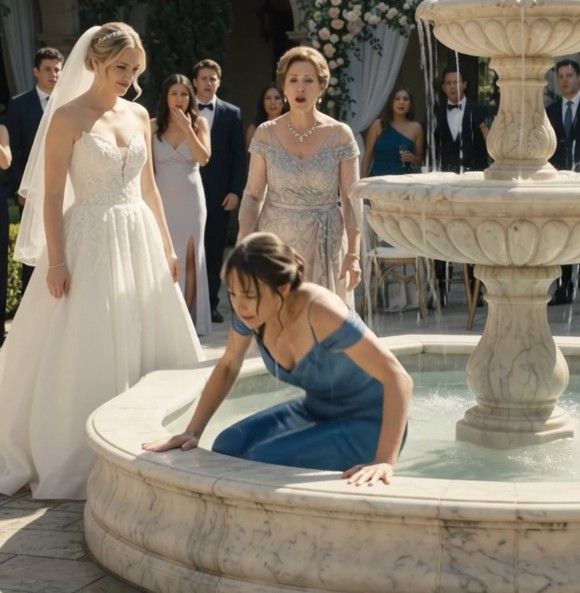
She had given it to me after I graduated from college. Even then, it was already an older garment—a modest tea-length dress with short sleeves, a fitted waist, and tiny fabric-covered buttons running along the back.
Natalie had despised it from the moment she first laid eyes on it.
Now I stood soaking wet in the stone courtyard, Grandmother Rose’s dress pressed against my body, studying every person who had found my humiliation funny.
Then I smiled.
It was the quiet, restrained smile I had perfected during years of being called the “plain” sister.
The “practical” one.
Natalie was still smiling while I studied the damage to Grandmother Rose’s dress. She thought I would lower my head and disappear from her celebration. Instead, I reached into my beaded clutch and found the contact marked “Venue.”
My thumb hovered over the contact for only a second before I pressed it. The phone slipped against my wet palm. At the other end, a familiar voice answered. “Marianne? Is everything all right?” I looked toward Natalie, who was showing a bridesmaid the video of my fall, and said, “No, Thomas. I need you in the courtyard. Bring the incident report form, and please preserve the security footage.”
Thomas Vale managed Willowmere Hall, the historic estate where Natalie was celebrating her wedding. He was also the person who had helped me restore it over the previous three years. My sister knew I’d worked in historic preservation, but she had never cared to hear which buildings I was responsible for. To her, I was the practical older sister with an old blue dress and no glamorous stories. She had never imagined I might own the place where she was standing.
I had purchased Willowmere with money left to me by Grandmother Rose, combined with a substantial loan I was still paying down. Rose had loved the old estate, once the setting of her own wedding, and asked me to save it if I could. I had spent years repairing stonework, restoring gardens, and negotiating with craftspeople who could still recreate the carved plasterwork. The venue was not a monument to my family’s importance. It was work I loved, and an independent business supporting the people who kept it alive.
Thomas arrived with two staff members and a folded navy towel. Unlike my relatives, he did not smile when he saw my condition. “Are you hurt?” he asked. I told him my shoulder and knee ached and I wanted the incident documented before memories shifted. He offered to call a medical professional. I agreed. Then I asked him to escort me to a private room where I could dry off and check for injuries.
Natalie swept toward us, her veil drifting behind her like a small storm. “What’s going on?” she demanded. Thomas introduced himself as the venue manager, though she’d spoken to him many times during planning. I told her I was getting medical attention and preserving a record of what she’d done. She rolled her eyes. “Please. It was a joke.” Thomas replied, “Our policies don’t permit guests to be pushed into water features. We have an obligation to respond when someone is hurt.”
My father laughed again, quieter this time. “Must everything become official?” he asked. I studied his face, the same face that had turned away when I cried as a child after Natalie ruined a school project. For forty years the answer had always been the same: I was expected to absorb what happened so other people could remain comfortable. “When somebody is injured,” I said, “yes. It should.”
In the bridal suite, a nurse who was attending the wedding examined my shoulder and knee while we waited for an urgent-care clinician to call back. Nothing appeared obviously broken, but she recommended evaluation and photographs of the bruising. A staff member brought me dry clothes from the emergency wardrobe Thomas kept for spilled drinks and sudden storms. I asked for my dress to be placed in a clean garment bag. The blue fabric looked very small and fragile hanging there.
From the courtyard came music restarting, then stopping. Thomas returned to say that Natalie had demanded the staff delete the footage and dismiss the two employees who had helped me. He told her the recordings belonged to the venue and would be handled according to policy. She had threatened to leave negative reviews and claim the venue had ruined her day. “I thought you should hear that from me,” he said. “Not from a message she sends tomorrow.”
I asked him to bring the event contract. Natalie’s name appeared as the client, with her husband-to-be, Adrian, as a co-signer. My name was attached to the agreement as the property owner and the person who had offered a substantial family discount. The contract included a conduct clause allowing management to pause service if someone endangered another guest. I hadn’t invented it for my family. It protected every event hosted at Willowmere.
I told Thomas to follow the policy consistently. The fountains would be roped off for the rest of the evening. Alcohol service could be paused while staff assessed the situation, and the event coordinator would remind the couple that harassment of employees was unacceptable. I did not order the guests to leave or demand that Natalie suffer public humiliation. Three hundred people had arrived in good faith. Most had done nothing wrong. I wanted the people who’d caused harm to bear responsibility without making everyone else collateral damage.
Adrian came to the suite before I left for urgent care. His tie was crooked and his face drawn. He had not seen the shove, only the splash and laughter afterward. He asked whether I was safe. I told him I would be. Then he asked, with evident discomfort, why my parents had been laughing. I said I couldn’t explain the joke because I had never found it funny. He looked at the damp dress bag and apologized for his part in not checking on me sooner.
At urgent care, I learned I had bruised my shoulder and strained my knee. The doctor advised rest, follow-up if the pain persisted, and careful monitoring. I sat on the edge of the examination bed while a kind physician described swelling and range of motion. I kept thinking about the way my mother held her hand over her mouth. She had looked as though she was watching an amusing family performance, not her daughter falling backward into stone and water.
Lena, my childhood friend, collected me. She had been at the wedding but was inside the dining hall when I fell. When she saw the bandage on my knee, she swore under her breath and then apologized. I laughed unexpectedly. It was the first laugh of the evening that did not have cruelty inside it. She drove me home, put soup on the stove, and asked whether I wanted company. I said yes, which surprised us both.
The next morning, Thomas sent the incident report and a secure copy of the footage to my attorney. Watching it was worse than I expected. Natalie had glanced toward the fountain, chosen the moment I was standing close to its edge, and pushed with both hands. The shove was not accidental. My father raised his glass after I fell, and my mother was laughing before I’d climbed out. I stopped the video there and went outside to breathe.
My attorney explained that the footage, witness statements, medical records, and contract could support appropriate formal action if I chose. I asked her to preserve the evidence and issue a notice reminding Natalie not to contact employees about deleting it. I wasn’t ready to decide anything else while my knee was still swollen. For once, I allowed myself the luxury of time rather than rushing to make the family comfortable again.
That afternoon Natalie called twelve times. Her messages began with rage about the fountain being cordoned off, shifted to outrage over a temporary pause in bar service, and ended by accusing me of sabotaging her photographs. She never asked whether I was injured. I sent one response: I was evaluated by a doctor. I am safe at home. I will discuss what happened when you’re willing to acknowledge that you pushed me. Then I silenced her number.
My parents arrived without an invitation that evening. Father stood on the porch holding leftover wedding favors. Mother carried a plate of cake as though we were visiting after an ordinary party. I didn’t let them inside. I asked whether they had come to see how I was or to tell me to apologize. Mother began to cry. Father said family shouldn’t involve lawyers. I told him lawyers hadn’t pushed anyone into a fountain. He looked away.
Then Mother said something I had waited my whole life to hear: “I know she went too far.” It should have comforted me. Instead I felt the weight of all the smaller injuries she’d minimized. I asked whether she could name what Natalie had done without using the phrase too far, as though the harm were simply an excess of normal behavior. She stared at her shoes. Finally she said, “Your sister pushed you. We laughed. We should have helped you.”
I stepped aside and let them sit on the porch, not in the house. We spoke for nearly an hour about childhood events they’d long described as harmless teasing. A ruined graduation dress. A birthday cake Natalie smashed because she didn’t like the flavor. My drawings torn from the refrigerator because they made my sister jealous. For the first time my parents heard those memories as a pattern rather than isolated incidents. Father admitted that he’d often thought keeping Natalie happy would keep peace in the house. It had merely moved the conflict onto me.
Adrian requested a meeting the following week. He arrived alone, carrying a folder. Natalie had told him I owned Willowmere only after she tried to persuade him to help her force the venue to surrender its footage. He was stunned that she could celebrate at a place I had restored and then call me worthless in front of its staff. He had also seen the video. “I didn’t recognize the person on it,” he said quietly. I told him he might be seeing a part of her that had been protected from consequence for years.
He showed me photographs from the reception after I’d left. Several guests had confronted Natalie about what happened. She accused them of being humorless, then insulted a server who declined to continue serving a visibly intoxicated guest. Thomas’s team documented the exchange. Adrian said he had gone to a hotel alone rather than return to the bridal suite. They were newly married, but he was uncertain what kind of marriage he’d entered. I listened without telling him what choice to make.
Natalie eventually agreed to meet in my attorney’s office. She arrived with a lawyer of her own and a statement that described the shove as “spontaneous horseplay.” My attorney placed the video stills, medical notes, and employee statements on the table. Natalie watched without speaking. Then she tried to insist I’d provoked her with my dress because Grandmother Rose had loved me more. That familiar grievance sounded suddenly small inside a room full of evidence.
I told her that the dress was not a prize in a competition. Rose gave it to me because I was the one who loved wearing old clothes and repairing them. She had given Natalie a beautiful pearl necklace, which my sister wore at the wedding. Rose had tried to honor us both. Natalie shook her head, crying now. “You always get to be the good one,” she said. I answered, “Being hurt by you doesn’t make me good. It makes me hurt. I want you to stop confusing those things.”
