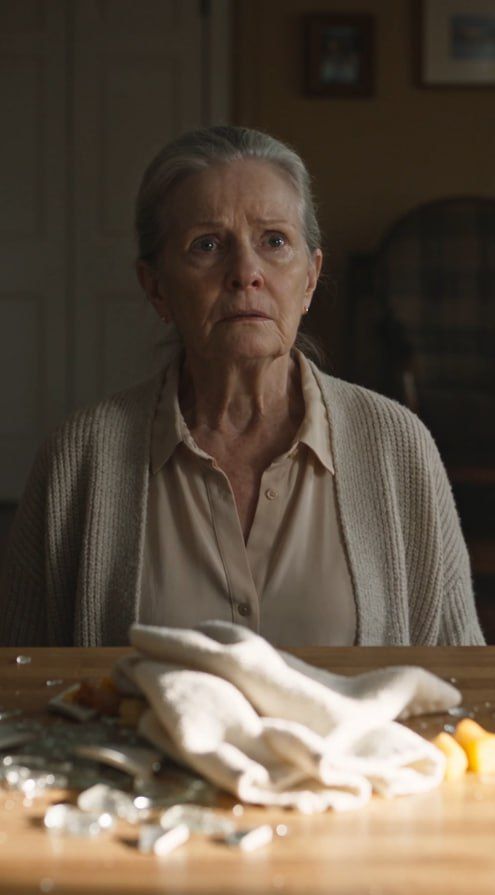
She replaced my embroidered cushions with expensive gray ones.
She threw away the little ceramic birds I had collected during trips with Peter, explaining that the shelves looked cluttered.
Whenever I objected, she smiled patiently.
“Eleanor, we’re just trying to modernize things.”
She started calling the house “our place” when speaking to friends.
By Christmas, she had rearranged every cupboard in the kitchen.
By February, she was opening my mail.
By April, she had begun telling Daniel that I was becoming forgetful.
One morning, I couldn’t find my car keys. Vanessa discovered them inside a kitchen drawer I hadn’t used in years.
“See?” she told Daniel, her voice full of concern. “This is what I’ve been talking about.”
Another time, my prescription glasses disappeared from the bedside table. I found them three days later beneath a stack of towels in the laundry room.
Vanessa watched me searching and suggested that I should have a medical evaluation.
I thought she was being controlling.
I hadn’t yet understood how much worse the truth could be.
The first time she mentioned selling the house, we were having breakfast.
“This place is becoming too much for you,” she said, cutting a strawberry into careful pieces. “All these stairs. All this maintenance. You could be so comfortable in one of those beautiful senior communities.”
“I am comfortable here,” I answered.
Daniel looked up from his coffee.
“Mom, she’s only thinking about your safety.”
I wanted to ask him when my safety had become something everyone discussed without including me.
Instead, I said, “Your father built this house for us. I’m not selling it.”
Vanessa set down her knife.
“Nobody is asking you to decide today.”
That sentence stayed with me.
Nobody was asking me to decide.
As though the decision was already being made somewhere else.
Over the following weeks, Daniel became increasingly distant. He stopped joining me for morning coffee. When I entered a room, conversations ended. Vanessa began taking telephone calls outside, pacing along the back porch with her voice lowered.
Then June stopped spending time with me.
At first, I blamed her age. Twelve-year-olds had their own worlds, and I knew I couldn’t expect my granddaughter to remain the little girl who once followed me around the garden carrying a plastic watering can.
But there was something different about the way June avoided my eyes.
