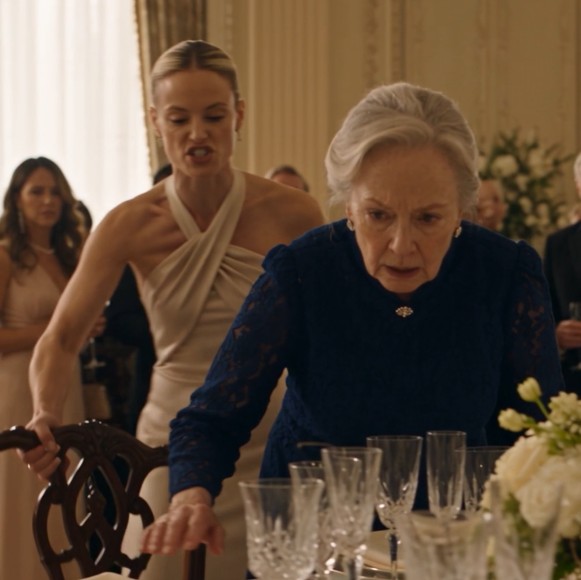
The hotel issued a trespass notice after reviewing the security footage. The bank removed her from future shareholder events as Steven’s guest. The assault complaint related to striking Steven and the fall proceeded through local authorities. Steven did not exaggerate what happened, and Ruth did not ask him to.
Facts were enough.
Ruth’s shares gave her influence, but she refused to use them for personal retaliation.
At the next board meeting, she said one thing about the incident.
“If our hospitality depends on knowing someone’s net worth before deciding whether to protect them, then we do not have hospitality.”
The board adopted new event protocols requiring staff to respond to physical aggression immediately, regardless of donor or shareholder status.
Ruth insisted her name not be attached to the policy.
Steven entered therapy.
For months, he worked through the shame that had made secrecy feel safer than help. He also learned that being slapped, grabbed by a tie, monitored through debt, and threatened with exposure were not ordinary marital conflict simply because he was a man and the harm rarely left bruises.
That realization embarrassed him at first.
Then it angered him.
Eventually, it freed him.
He filed for divorce.
Olivia fought the financial accounting until the records made the facts difficult to deny. The marriage ended without the dramatic ruin she had repeatedly threatened.
Steven lost money.
He moved into a smaller apartment.
He sold a car.
He survived.
The world did not end when he stopped paying for peace.
The weeks after the separation revealed how much Steven had organized his life around avoiding Olivia’s displeasure. He asked Ruth whether he could stay with her. She said no, gently. The answer startled both of them. “You need your own place,” she explained. “And I need my home not to become the next place where you postpone a decision.” Steven looked hurt for a moment, then nodded. He rented a furnished studio near his office. The first night there, he called Ruth because he could not figure out how to reset the thermostat. She laughed so hard she had to sit down. “You are forty-six years old,” she said. “Apparently I’ve been climate-controlled,” he replied. The joke became one of the first ordinary things they shared after the gala.
Steven’s attorney reconstructed the debt history in detail. The original Mercer Street loss had been real and serious. Steven had signed the guarantee. He had ignored warning signs because he wanted the project to succeed. Ruth made sure he did not rewrite that mistake into victimhood simply because Olivia later exploited it. “You made a bad financial decision,” she told him. “Then you made a worse emotional decision by deciding shame meant you had no right to boundaries.” Steven wrote the distinction in a notebook he brought to therapy. He began separating responsibility from humiliation: he could own the loan without accepting a slap; he could repay money without surrendering his voice; he could regret his judgment without agreeing that another person owned him.
Ruth also met privately with Samuel to review her shareholder documents. She had avoided active involvement since Thomas died because the bank had been his professional world, not hers. Yet the incident forced her to ask what she actually wanted from the shares she still held. Samuel expected her to reduce the position or appoint a proxy. Instead, she chose to remain a shareholder and become more informed. “I do not want power over anyone,” she said. “I do want to stop confusing distance with humility.” She began attending quarterly briefings and asked sharp questions about customer treatment, accessibility, and employee complaint procedures. Some older directors seemed surprised. Samuel was not. “Thomas said you always read the footnotes,” he told her. Ruth smiled. “Thomas complained that I always read the footnotes.”
The bank’s internal review found no conspiracy or hidden plot behind the gala. That was important to Ruth. The failure had been ordinary: staff saw a wealthy guest behaving badly and hesitated because they assumed someone higher-ranking should intervene. The board had policies against harassment and aggression, but the policies depended on employees believing they could apply them to powerful people. Ruth pushed for training that used real scenarios without naming her family. “Rules that only protect people after status is verified are not rules,” she said. The bank added authority for event managers to remove any guest for physical aggression without waiting for executive approval. Samuel later told her the change had already been used twice. In both cases, the person removed was angry. In both cases, the event continued.
Olivia’s own life narrowed as consequences became real. Her social circle did not vanish, and Ruth did not want it to. But several people who had witnessed the gala stopped protecting her from what they had seen. One friend gave a statement to investigators. Another refused to repeat Olivia’s claim that Ruth had staged the incident for attention. For the first time, Olivia could not convert every witness into an audience for her version. Through counsel, she entered anger-management treatment as part of the legal resolution. Whether she changed permanently was no longer Ruth’s project. That realization brought unexpected peace. A villain did not need to become good for a story to end. Sometimes the ending was simply that her access to harm other people became smaller.
Steven had one final conversation with Olivia before the divorce was finalized, in a mediator’s office with both attorneys present. He told Ruth about it afterward. Olivia said, “After everything I paid for, this is how you repay me.” Steven answered, “I repaid the money. I will not repay you with obedience.” Ruth closed her eyes when she heard that. “How did she respond?” she asked. Steven gave a tired smile. “She said I sounded like you.” Ruth laughed. “Poor woman.” Then they both grew quiet, because underneath the joke was something healing: Steven no longer heard resemblance to his mother as proof that he was weak or dependent. He heard it as proof that he had finally learned to stand somewhere without asking permission.
Ruth’s relationship with Steven changed too. She stopped hiding every difficult part of family history in the name of protecting him. She told him more about Thomas—not only the successful banker people remembered, but the stubborn husband who once went three days without admitting he was wrong about a renovation, the young father who lost money on a reckless expansion, the man who cried in their kitchen when the 2008 crisis threatened employees he had known for decades. Steven listened with a kind of grief. “I spent my whole life competing with a polished version of Dad,” he said. Ruth nodded. “That was partly my fault.” The beautiful dead are easy to turn into impossible standards. By restoring Thomas’s mistakes to the family story, Ruth gave her son permission to be accountable without believing he was uniquely broken.
Ruth healed more slowly than she expected.
Her hip improved within weeks, but the ballroom stayed with her.
The sound of the chair scraping backward.
The floor rushing up.
Champagne soaking Thomas’s favorite dress.
That part hurt most.
She took the dress to a tailor even though several stains would not fully lift.
The tailor, an older woman named Mina, examined the fabric under bright light.
“I can make it wearable,” she said.
“Can you make it what it was?”
Mina looked at her.
“No.”
Ruth appreciated the honesty.
“Then make it what it can be.”
The dress returned two weeks later with the damaged sleeve repaired and the worst stain hidden beneath subtle embroidery in dark blue thread.
Small leaves climbed from the cuff toward the shoulder.
Ruth stared at them.
“It’s different,” Mina said.
“Yes.”
“Is that all right?”
Ruth touched the embroidery.
“Yes.”
It was more than all right.
Thomas had loved the old dress.
He would have understood why she could not keep it frozen in the condition he last saw.
Six months after the gala, Ruth attended another bank event.
Steven offered to go with her.
She said no.
Not because she was angry.
Because she wanted to walk in alone.
She wore the navy dress.
The embroidered leaves caught the light near her wrist.
At the entrance, a young employee checked her name.
“Mrs. Bennett?”
