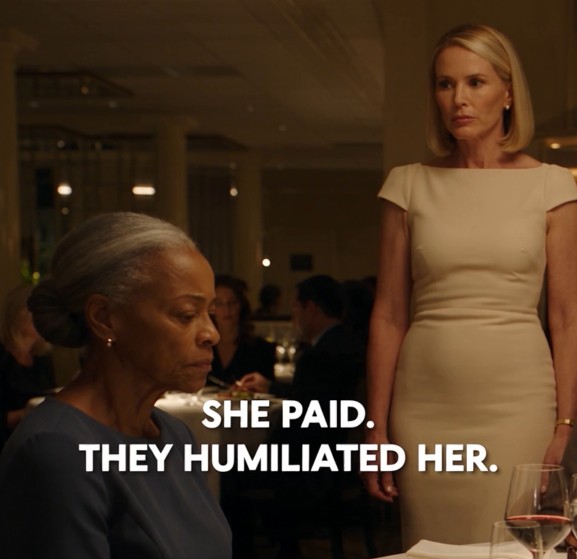
“You know my mother?”
The question came out thin and breathless.
Ruth held her gaze.
The waiter stayed beside the table, still holding the declined card. No one asked him to try it again.
Her son sat forward now, searching his wife’s face.
Ruth had seen Amber contemptuous, impatient, amused at another person’s expense.
This was the first time that evening she looked afraid.
“Does your husband know,” Ruth asked, “why you told him she was dead?”
For several seconds, Amber did not speak.
Ruth’s son, Marcus, looked between them.
“What is she talking about?”
Amber set the plate down so quickly that gravy slid against the rim.
“Nothing.”
Ruth looked at Marcus.
“Ask her again.”
His face tightened.
“Amber.”
She shook her head.
“Your mother is trying to embarrass me.”
Ruth almost smiled.
The sentence carried a strange kind of courage considering what had happened thirty seconds earlier.
Amber had taken food from a seventy-eight-year-old woman in a room full of guests and told her to eat in the bathroom.
Now humiliation had become unacceptable because it might reach her.
Marcus pushed his chair back.
“What does she mean, you told me your mother was dead?”
Amber looked toward the guests.
Ruth understood that instinct.
Public shame had rules.
People endured cruelty differently when witnesses were present.
“This is not the place,” Amber said.
Ruth’s gaze moved around the dining room.
White linen.
Gold votive candles.
Dark wood polished until the chandeliers reflected faintly on the tables.
A jazz trio had stopped playing.
Fifty-three guests were pretending not to stare.
Ruth looked back at Amber.
“You chose the place.”
Marcus stood.
“Is your mother alive?”
