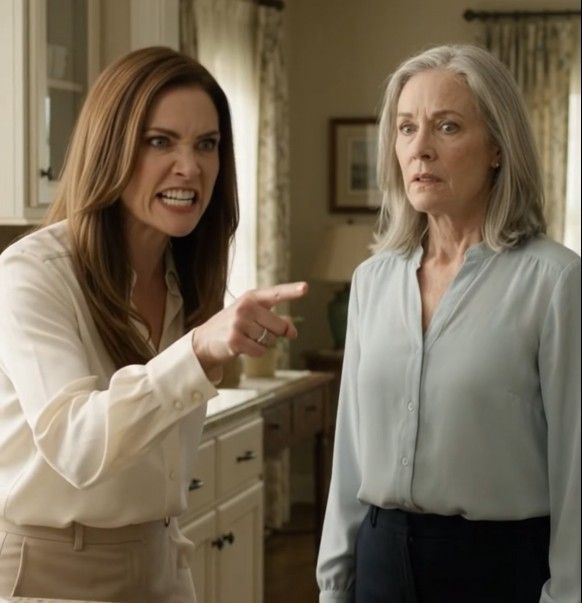
The laundry door opened. Diana filled the doorway, smiling in a way that did not reach her eyes. “Why are you interrogating him?” She listened to my question, then laughed. “Oh, that. You’re making a huge issue out of a preliminary form.” I told her the lender considered it an application. Diana folded her arms. “If your son succeeds, you’ll benefit too.” I asked precisely how a line of credit against my house would benefit a woman who had never asked to borrow a dollar. Diana’s smile disappeared. She said my problem was that I treated Chris like a child and never allowed him to grow. I looked at Chris. “Then he can grow by answering me himself.”
Diana started to speak over him. I held up one hand. “This conversation is over for tonight. Your guests need to leave. And you and Chris need to arrange another place to stay.” A silence fell so abruptly I could hear water dripping inside the washing machine. Chris stared at me. Diana’s face flushed crimson. She shouted that they lived there, that I could not throw them into the street, that I was cruel and unstable. I told them they would receive proper written notice according to the law, but their access to my personal records ended immediately. I did not grab anyone’s belongings or change locks. I was done confusing firmness with revenge.
Diana swept into the dining room and told her relatives I had lost my mind. A brother demanded to know how I could treat family this way. I stood by the door while they collected coats and purses. “I opened my home to two people who needed help,” I said. “I did not give anyone authority to put it up as security for a loan.” The room became quiet. Diana’s mother stared at her daughter. One of her sisters asked whether the loan was real. Diana told her to mind her business. I noticed then that not even Diana’s family had known the whole story.
When their cars finally left, Chris stayed in the hall holding his keys. He looked exhausted. “Mom, I didn’t think it would get this far.” I wanted to comfort him. The habit rose in my chest like a reflex. Instead I asked, “At what point did you plan to tell me?” He said he did not know. I believed him, and that was perhaps the saddest answer he could have given. We both looked toward the framed photograph of his father beside the stairs. Chris began to cry. I did not cross the room. A tear is not the same as accountability, and I needed to learn the difference.
The next morning Ruth drove me to meet attorney Elaine Brooks, a woman with silver glasses and an orderly desk. Elaine reviewed the documents my accountant had obtained lawfully from the lender and listened without interrupting as I described Chris’s admission. She explained that the lender’s investigation would establish who submitted what, and that no one should make accusations beyond the evidence. We sent preservation requests, disputed the unauthorized application, and set in motion formal notice that my son and daughter-in-law’s permission to occupy the house was ending. I asked what would happen if Chris had forged my name. Elaine did not pretend there would be an easy answer. “His choices will matter,” she said. “So will yours.”
Within forty-eight hours Diana’s mood changed from outrage to frantic friendliness. She left tea outside my bedroom. She offered to cook dinner. She told me we could all simply forget a misunderstanding and start fresh. I thanked her for the tea but repeated that they needed to leave under the notice. She switched tactics. She told Chris I was deliberately ruining their future. She called his aunt and claimed I was suffering from confusion. By Friday, my telephone was ringing with relatives who wanted to know whether I was well. I answered their questions plainly and said there were financial documents under review. Some apologized. Others disappeared from the conversation.
The cruelest call came from my sister-in-law Pauline, who had helped me raise Chris after the accident. “Diana says you’re threatening them over business paperwork,” Pauline said. I invited her over and showed her the notice from the lender stating that an unauthorized application had been flagged. Pauline read it twice. “Martha,” she whispered, “why didn’t you tell me?” I said I was ashamed. Pauline placed her hand over mine. “The shame doesn’t belong to you.” She stayed that night, sleeping in the little room where she had once braided Chris’s hair for a school play when he refused to let me touch it. I slept more deeply than I had in months.
A week later a second envelope arrived from the lender. The application had included a digitally uploaded identity document, income records, and a false statement that I had agreed to invest in a new company. The bank had blocked the transaction before any funds were released. Ruth discovered the business named on the request was registered to Diana and her uncle. I wanted to believe Chris was merely careless. Then Elaine found a message he had sent in response to the lender’s confirmation: “Please use the information my wife supplied. Mother prefers not to be contacted until approval.” That sentence remained on the page long after I stopped reading it. He had not just failed to stop the process. He had helped keep me uninformed.
I called Chris into the living room that night. Diana followed, but I said I needed to speak to him without an audience. She resisted until he quietly asked her to leave. I handed him the printed message. His face paled. “I was trying to keep things moving,” he said. “Diana said you would say no automatically.” “And you knew I would,” I replied. “So you helped prevent anyone from asking.” He sank onto the sofa. I remembered teaching him to apologize when he was little: say what you did, understand who it hurt, make it right. That evening he offered only explanations. I told him I would listen when he was ready to take responsibility.
The investigation became a formal matter sooner than either of us expected. The lender referred the suspected forgery to its investigators, and a detective contacted me to take a detailed statement. Diana claimed that my son had promised I would consent. Chris said he had believed a bank could not process anything without my final approval. Their stories did not match. Investigators found that the submitted e-signature came from an account associated with Diana’s business and that a copy of my identification had been altered to include a different address. I was not told every detail of the inquiry, but I knew enough to understand this had moved far beyond a family misunderstanding.
Chris eventually came out and sat on the opposite end of the bench. He looked thinner. “Diana says she feels hated here.” “She may,” I said. “But how did I feel while she ordered me out of my kitchen?” He picked at the paint on the bench. “I should have said something.” “You should have said something the first time, and the tenth time, and yesterday.” He flinched, then nodded. I asked why he had applauded when she shouted at me. After a long silence he admitted he had been trying to prove he was loyal to his wife in front of her family. “And you used me as the price of proving it,” I said. He began to cry again, but this time he did not ask me to forgive him.
Two weeks later we met at Elaine’s office for a conversation about their move-out date. Diana arrived with her uncle, Leonard, a man with an expensive watch and a practiced handshake. He called the bank application a preliminary commercial inquiry and warned that reputations could be damaged by overreaction. Elaine asked whether he had received my authorization in writing. Leonard leaned back, suddenly less comfortable. Diana interrupted with a prepared story about my declining memory. Elaine calmly placed my notarized ownership documents, the lender’s fraud notice, and the preserved correspondence on the table. “We are not discussing whether Martha remembers owning her home,” she said. “We are discussing an application submitted without her informed consent.”
Leonard tried to change the subject to everyone’s feelings. I looked directly at him. “You don’t have to like me,” I said. “You do have to stop using my identity.” He said there was no need for hostility. I answered that the matter was already being handled through appropriate channels. Then Elaine showed the written agreement outlining their departure and the condition of the rooms. Chris said he would sign. Diana pushed back her chair so violently it struck the wall. She shouted that without my property they could lose their investment and the deposit on a studio space. “Then the business was never safe enough to build on my house,” I replied.
The investigation later established that Diana had knowingly submitted false authorization and documents to support the credit request. Leonard’s separate role was reviewed by the authorities. The lender closed the application without disbursing funds, and the business lost its financing arrangement. The case produced charges against Diana for the deceptive submissions; she ultimately accepted a court-supervised resolution that included restitution for documented expenses, restrictions related to the offense, and a permanent record of the finding. Chris was also held accountable for his participation, though his cooperation and the evidence distinguished his actions from hers. I never celebrated any of it. I simply stopped trying to carry the consequences for them.
Their departure date arrived in a cold rain. Cardboard boxes lined the hallway, some marked with the same black pen I had used when Chris moved in. Diana marched around the house muttering that I would regret dying alone. I carried no box for her. Instead I opened the front door and stood beside it. Chris made two trips to the rented van. On the final trip, he paused beside his father’s scratched chair. “Can I take a photograph?” he asked. “Of course,” I said. He knelt and photographed the little gouge in the wooden arm. He told me he remembered making it. “I remember telling Dad I’d fix it when I grew up,” he said. “I think he liked it the way it was,” I replied.
Once the van disappeared, the house seemed impossibly large. I walked from room to room, hearing only the heating system and the rain. The guest room smelled of perfume and cardboard dust. In the kitchen, one chipped mug remained on a shelf. I reached for the dishcloth out of habit, then put it down. It would be there tomorrow. I sat at the table, in the chair nobody had offered me during Diana’s family dinner, and ate a slice of toast with butter. There was no conversation to dodge, no complaint about the seasoning, no one waiting to assign me a task. The silence hurt and comforted me at the same time.
Pauline came the following morning with daffodils and a box of my favorite pastries. She did not tell me I had been brave. She asked where I wanted the flowers. I had to think. For years I had arranged every room around someone else’s preferences. Finally I said the window above the sink. Pauline opened the curtains, letting pale sunlight strike the glass vase. Then she asked whether I still wanted to take the weekend art class we used to discuss. I laughed because I had forgotten that small wish entirely. That afternoon we enrolled together. I was sixty-three, and the first thing I painted was a crooked blue house with a bright yellow door.
Chris called two weeks after moving out. He had rented a small room and found a counselor. His marriage was unraveling; he told me Diana blamed me for everything. He did not ask me to intervene. “I understand that I gave her permission to treat you badly,” he said. “I did it again and again because it was easier than disappointing her.” I held the phone without speaking. He went on: “I also knew enough about the application to stop it, and I didn’t. I’m sorry for what I chose, not just what happened.” I told him I had heard him. Forgiveness, I explained, would have to grow at the speed of trust, not the speed of his regret.
One Saturday Chris brought a small envelope. Inside was a photocopy of a note his father had written on the back of an old picture of our house. I had not seen that picture in decades. The garden was bare, Chris was a toddler, and my husband stood on the porch holding a paintbrush. Under the photograph he had written, “For Martha, who makes every place a home. Promise you’ll keep a corner of it for yourself.” Chris said he had found the note while sorting through boxes and had been afraid to show it because he knew how badly he had violated those words. My throat closed. My husband had seen what I was becoming before I did: a woman who could offer everyone shelter while gradually losing her own place to stand.
Months passed. The house became peaceful without becoming empty. I replaced the sagging sofa because I liked a firmer seat, not because Diana disapproved of the old one. I repaired the porch railing and planted lavender by the steps. Elaine helped me update estate documents and protections against unauthorized credit applications. I gave Chris emergency contact information but no access to financial accounts. It did not feel cold. It felt honest. When he visited, he knocked and waited for me to open the door. The first time he did, I nearly cried at the quiet courtesy of it.
One evening he asked whether he might help me cook. We stood side by side chopping carrots, awkward at first, and he told me he had separated from Diana. The legal and financial consequences were still his to manage. He understood there would be no quick erasure of what he had done. “I miss being your son,” he said. I put the knife down. “You never stopped being my son. But you stopped treating me like a person.” His eyes filled. “I’m trying to learn how.” We finished the soup without pretending the past had disappeared. At the table he pulled out a chair for me before sitting down himself.
The final surprise came that spring, when Pauline helped me sort the attic. At the bottom of a dusty box we found the original letter my husband had enclosed with the deed after the mortgage was paid. He had written that the house was not a reward for sacrifice but a place where I was allowed to rest. “When Chris grows up,” the letter said, “I hope he knows that loving his mother means making sure she still has a life of her own.” I read it aloud twice. I had spent years imagining my husband would have urged me to do anything for our son. The truth was kinder and more demanding. He had wanted me to belong to myself.
That evening I placed his letter in a frame beside the kitchen window. The lavender outside was beginning to bloom. I cooked a small dinner just for me, using exactly as much salt as I liked. Then the doorbell rang. Chris stood on the porch with a pot of yellow flowers and asked whether it was a good time to visit. I looked at the house behind me, at the clear table, at the beautiful ordinary quiet. “Yes,” I said, and stepped aside because I wanted to, not because anyone had claimed the right. He came in, hung up his coat, and asked where I would like him to sit. For the first time in years, I knew the answer immediately.
