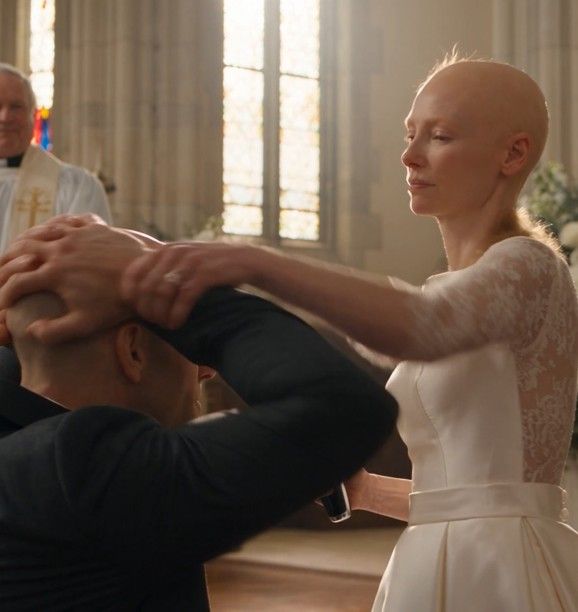
She wouldn’t let him.
She caught his hand and held it tighter and crouched just slightly so her eyes were level with his. “Hey,” she whispered, only for him. “Hey. Look at me.”
He couldn’t. His eyes were fixed on the hair on the floor — hers and his, mingled.
“Look at me,” she said again, softer. And he did, because her voice was the only steady thing in the building.
Her scalp was bare, but now that he was close he could see something he hadn’t noticed from a distance. Faint, pale patches. Uneven skin. The same irregular, smooth islands he saw every morning in his own mirror. His breath stopped.
“What —” he whispered, his fingers hovering near her head but not daring to touch. “Your hair —”
“I didn’t shave this morning for the first time,” she said, so quietly only he and the priest could hear. Her lips trembled for the first time. “I shaved three weeks ago, at home. In our bathroom. After you fell asleep.”
He stared, uncomprehending.
The golden hair on the floor around her dress — it was thick, it was beautiful, but it wasn’t attached. Not all of it. The long strands were a wig. A high-quality one, the kind she’d worn since she was sixteen. She had lifted it off and then run the clipper over the short, patchy growth underneath to make the gesture complete, to make it honest in a way no one would be able to dismiss as impulse.
“I had alopecia areata when I was fifteen,” she whispered, and her voice finally broke. “It took everything in six months. Eyebrows, lashes, everything. It came back patchy. Then it left again. I’ve worn hair since prom. My mother is the only person who knew until now.”
His eyes filled so fast tears spilled before he could blink. He understood then why she had never asked him to take his off. Why she had never flinched when his hat shifted. Why she had always tucked his hair — his fake hair — behind his ear with the same tenderness she gave to everything else.
“You waited,” he choked out. The words scraped his throat. “You knew and you — you let me — you let him —”
“I waited because you needed to choose,” she said, tears now sliding freely down her cheeks, catching on her bare skin. “If I told you I knew in our kitchen, you would have apologized and hidden better. If I told you the night before the wedding, you would have canceled everything. I needed you to be seen, not by me — you already were — but by everyone. And I needed you to see that I wasn’t going anywhere when it happened. I needed you to believe it.”
Behind them, Caleb’s voice had gone thin and desperate. “This is insane. You’re both — you’re making me out to be the villain for a prank —”
“A prank?” The groom’s father stood up. He was a large, quiet man who had not spoken the entire service. His voice shook. “You call humiliating your brother on his wedding day a prank? You promised your mother and me you would support him.”
Caleb looked around frantically for an ally and found none. His own girlfriend in the third pew was staring at him with her arms wrapped tight around herself, shaking her head slowly, tears in her eyes but not for him. Two groomsmen took a deliberate step away from him, leaving him isolated in the open space by the altar.
“You were jealous,” the bride said, not cruel, just exhausted. “You always were. He got sick and you got scared that people would look at him with kindness and not at you at all. So you made sure they looked at him with laughter instead.”
Caleb’s hands curled into fists. For a second something ugly flashed across his face — the urge to lash out, to knock the phone from her hand, to say something worse. Then it collapsed. His shoulders dropped. His eyes darted to his brother’s bare head and he flinched, truly flinched, like he was seeing the cost for the first time.
“I didn’t think you’d —” he started, looking at his brother. “I didn’t think she’d — I just —”
“Leave,” the groom said.
It was the first time he’d spoken above a whisper. His voice was hoarse but it carried. He wasn’t looking at Caleb with hate. He was looking at him with a kind of hollow grief.
“Please leave my wedding,” he said.
Caleb stood there a second too long, breathing hard through his nose, his face red. Then he bent, without thinking, to pick up the hairpiece from the floor — as if to put it back, as if to undo it — and the bride stepped forward and placed her white shoe gently on it.
“No,” she said. “Leave it.”
Caleb stared at her foot, at the dark hair under it, at her bare head bleeding lightly in one spot, at his brother’s tears. Something in him broke. He let his hand fall empty. He backed away, one step, two, then turned and walked. Not down the aisle — he couldn’t bear the aisle — but out the side door by the vestry that banged shut behind him with a flat, final sound. No one followed him.
The silence after was different. It wasn’t shocked. It was held.
The priest, who had married the bride’s parents twenty-eight years earlier and had baptized her, stepped forward. His eyes were red. He looked at the two of them — her in her white dress dusted with hair, him in his suit with his scalp bare and shining under the high windows — and he asked, very gently, “Do you still wish to be married?”
The bride laughed. It was a wet, startled laugh that turned into a sob she pressed her hand over. She looked at the groom.
He was still crying, but he was no longer trying to hide. Tears ran down his face and he didn’t wipe them. He reached up with a shaking hand and, for the first time in years, touched his own bare scalp. His fingertips brushed the smooth, cool skin, the patches, the places where he’d hidden. He felt the air on it. He felt her watching him touch himself without shame.
Then he reached out and touched hers. Lightly. Just the fingertips against her temple, near that small nick of blood. She closed her eyes and leaned into his palm.
“Yes,” he said to the priest, but he was looking at her. “Yes. Please.”
“Yes,” she whispered.
The priest cleared his throat, blinking hard. He had done this a thousand times, but his hands trembled as he opened the book. “Then we will continue,” he said. “If anyone objects —” He stopped, looked around at the faces that were now openly weeping, at the mother who had both hands over her heart, at the guests who had started to stand not out of objection but out of respect — and smiled. “I think we’ve heard enough truth for one day.”
What followed was not the ceremony they had rehearsed.
He had them repeat the vows without the practiced smoothness, with pauses and voice cracks and long silences where they just breathed and looked at each other. When he said, “You may now kiss,” the groom cupped her bare head in both hands like it was something precious, and she cupped his the same way, and they kissed in the middle of that circle of hair on the floor, bald and beautiful and weeping while the whole church stood and clapped with a sound that was more like relief than applause. The groom’s mother was sobbing openly now, her husband holding her, both nodding fiercely at their son as if to say, we see you, we see you.
They walked back down the aisle together, hand in hand, stepping over the fallen hair. No one stared at his scalp now. No one stared at hers. People reached out not to gawk but to touch their shoulders, their arms, to whisper, “You were brave, you were so brave,” and “I’m sorry,” and “We love you.” Her mother, who had helped her glue the wig every morning since sophomore year, caught her in the vestibule and pressed her forehead to her daughter’s bare head and wept, “My beautiful girl, my beautiful girl,” over and over, stroking the pale scalp like she had when her daughter was sixteen and bald from the chemo that had saved her life.
Outside, the late afternoon light was gold and soft. Someone had moved the reception tables onto the church lawn because the hall felt too small after what had happened. There were string lights already hung between the trees, swaying slightly. The caterer, unsure what to do, had kept the champagne cold.
They didn’t change clothes. She kept the dress with hair still clinging to the lace. He kept the suit without the piece. They sat at the head table with their heads bare, and his father stood and, without notes, said, “My sons — my son —” and had to stop and start again. “My son taught me today what courage looks like. Both my children did. I have not been a good father to one of them when he needed me to protect him. I will be now.” He looked straight at the groom and said, “I am proud of you. Exactly as you are. I have always been proud of you.”
The bride’s father, a man of few words, simply walked over and kissed the top of her bald head and said, “I’ve missed this head. I haven’t seen it since you were fifteen. Welcome back.”
Later, when the sun was low and the string lights had come on, the bride kicked off her heels in the grass and pulled the groom onto the small dance floor. The DJ, who had been told the first dance was canceled, looked at the priest, who nodded. He played the song they’d chosen months ago, something slow and simple.
They danced barefoot, bald, forehead to forehead, her hands on his neck, his on her waist. He was still learning how to be touched there. Every time her thumb brushed his scalp he shivered, not from shame, but from the newness of not flinching.
“You had the clipper in your bag the whole time,” he murmured against her temple, smiling through the last of his tears. “Three weeks you waited with that thing.”
“I bought it the day after I found yours,” she whispered back. “I kept it in my drawer and stared at it every night. I was so scared you’d hate me for knowing and not saying.”
“I could never hate you,” he said, and his voice broke again, but it was a different kind of break now, a letting-go. “Do you know how many times I almost told you? In bed. In the car. I had a speech. I had — God, I had it memorized. ‘I have something to tell you, it’s not —'”
“I know,” she said, and she did. She had heard him practice once, through the bathroom door, thinking he was on a work call.
He pulled back just enough to look at her, his eyes searching her bare face. “The wig — the golden hair — was that —”
“It was mine since I was seventeen,” she said. “Real hair, good one. Expensive. Mom and I picked it together after the second round. I was going to wear it today because I thought you needed me to look —” She gestured at the dress, at the idea of a bride. “Perfect. Then I realized if I wore it while you were forced to be bare, I’d be lying too. So I took it off.”
He touched her head again, wonderingly. “You were always this beautiful underneath.”
She laughed, and this time it was clear and unburdened, and she spun slowly under his arm, her white dress flaring, her bald head catching the string lights like a halo.
Around them, their people watched — not with pity, not with shock, but with the quiet, warm attention you give to something holy. His mother had taken off her cardigan and draped it around her own shoulders though she wasn’t cold, just to do something with her hands. Her mother was taking pictures with shaking hands, not of hair or dresses, but of the way their foreheads touched.
