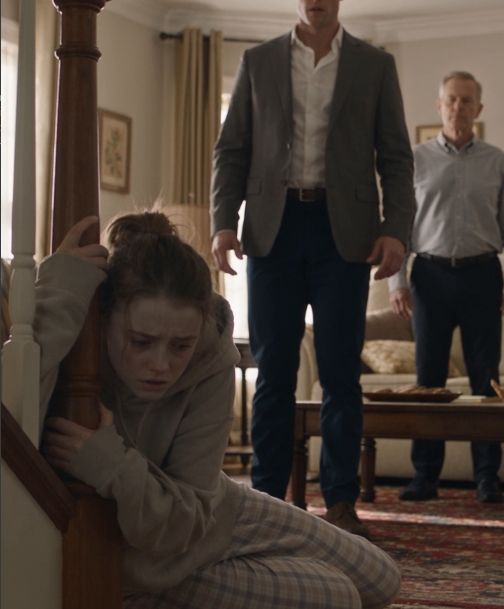
Edward’s hand shook so badly the pen skittered on the wood. He looked at his daughter.
“Clare doesn’t sign,” he said.
“She signs or you lose everything.” Crane’s voice went silken. “That was always the arrangement. Ask your father, girl. He agreed to it before you put on that costume.”
Clare did not look at her father. She kept her eyes on Crane. “My father won’t sign either.”
Something passed over his face — not anger, the particular irritation of a man whose authority has been interrupted mid-sentence. He laughed, low, and leaned in close enough that she could smell the cedar. “Everyone signs for me eventually, sweetheart. His signature was a formality anyway. One way or another.”
Theo reached out and lifted her phone off the sideboard.
He set it on the coffee table between them, red dot still blinking, and did not say a word.
For the first time that evening, Alistair Crane’s face did something unmanaged. “Recordings don’t—”
“Theo?” Edward’s voice was a thread. “What is this?”
Theo opened his own folder. Bank records, dated and tabbed. Three families. Two seized houses. Shell companies with names that all ended the same way. A handwriting analyst’s affidavit about a man in New Jersey who signed Edward Montgomery’s name better than Edward Montgomery did. Six years of paper, laid down in a quiet fan across the coffee table, covering the engagement contract like a hand over a mouth.
“And the original notes,” Theo said, “which you brought tonight because you are arrogant enough to want to watch us read them. There are officers at your door with a warrant for them. I invited them at six.”
Crane stared at the folder. Then at the door. Then at the room, doing the arithmetic of a man who has spent twenty years being the most frightening person present and has just noticed the temperature has changed.
Elise stepped forward. Her voice was steady and quiet and had clearly been rehearsed in a mirror for years. “You told my father I embezzled. You put my name in the paper. My mother still checks the locks three times before she sleeps, because of what you did to ours.” She paused. “I kept every clipping. I’d like you to see them.”
Edward stood up.
He stood badly, one hand on the table, but he stood, and when he spoke his voice cracked down the middle and kept going anyway. “I never signed your paper. Not the first note, not the last one. I was afraid for three years, and I sold my own daughter’s Tuesdays to strangers because of it, and I am going to say it to a judge, and you are going to hear me say it.”
“Edward—” Crane began, and for the first time there was no music in his voice. Just a man in a good suit, older than he had looked at seven o’clock, saying a name into a room that had stopped obeying him.
The front door opened.
Two detectives came in with the warrant, and Crane looked at them the way a man looks at a mirror he doesn’t recognize, and the color left his face in stages — first the tan going flat, then something beneath it going gray. He did not shout. He did not threaten. When they turned him around and took his wrists behind his back, the only sound was the small dry click of the cuffs, and it was the loudest thing anyone in that house had ever heard.
“We can discuss this,” he said, to Edward, hoarse now, ordinary now, a voice with no room left in it. “Edward. Look at me.”
Edward looked. He did not sit down, he did not speak, he did not look away, and after a moment Crane stopped asking.
As the detectives led him past the sideboard, Crane turned his head and found Clare standing there in the hoodie and the white socks and the enormous glasses, and he said, very low, “You look ridiculous.”
“I do,” she said. “And you drove here for it.”
He was gone through the front door before either of them moved, and the house stood still for a long time after, holding the shape of what had just happened in it.
Then Edward sat down hard, and the chair caught him, and he put his face in his hands and did not make a sound.
Clare discovered that she could not fold the napkin. Her hands had gone stupid with adrenaline, working uselessly at the cloth, and she was about to say something funny about it when Theo took the napkin out of her fingers and put it down and then took her hands instead, both of them, in his, and held them until the shaking slowed and stopped.
Nobody touched the wine.
Elise let out a breath she seemed to have been holding for six years, walked to the window, and stood with her forehead against the cold glass, and Clare watched her shoulders come down one at a time.
At eleven o’clock the doorbell rang again and Nadia was standing on the porch with two coffees and a bakery box, having received forty minutes of punctuation-only texts and decided to intervene in person.
“Hi,” she said, taking in the living room, the folder, Theo, the second coffee in her other hand. “I brought emotional support and also a Danish. Should I come back?”
Clare crossed the room and hugged her so hard that coffee went everywhere, down Nadia’s sleeve, across the porch boards, neither of them caring even a little.
