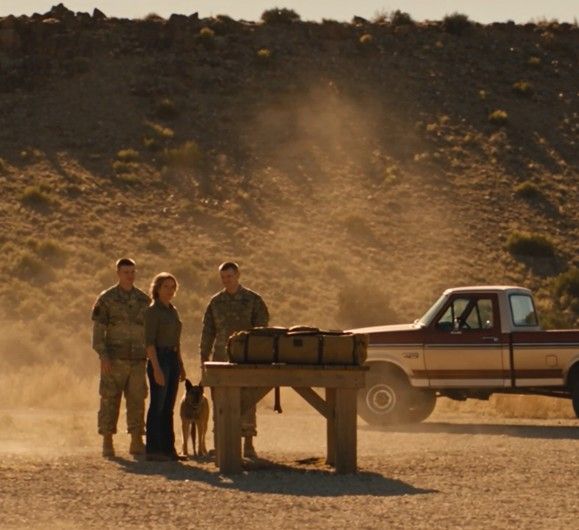
The next week, we stayed seven minutes.
The week after that, ten.
Nobody forced him closer.
Nobody laughed when he shook.
Nobody tightened a chain around his throat and called fear a defect.
One afternoon the range owner walked out to the parking area and leaned against the far side of my truck.
“He’s different,” he said.
“He’s safer.”
“Same thing?”
“Not exactly.”
The Shepherd looked at him, then rested his chin on the seat.
The owner nodded toward the hills.
“Brock hasn’t been back.”
I shrugged.
“His friends have.”
That surprised me.
“They keep to themselves,” he continued. “One of them asked if we could post an animal policy near the office. No dogs tied near active lanes. Water required. Shade required. No deliberate exposure to noise.”
I looked at him.
“You doing it?”
“Already did.”
There it was again. A consequence growing in the quiet place after spectacle.
Not revenge.
Something better.
A rule that might protect the next animal before anyone had to make a bet.
By late summer, the Shepherd had gained weight. His coat darkened and thickened. The raw skin under his neck healed. The ribs disappeared beneath muscle. He still disliked sudden gunfire, but the panic changed shape. He could recover. He could choose distance. He could look to me and then decide what happened next.
So could I.
I had spent two years after leaving the Navy telling myself that the range was where I went to quiet my head. That was only partly true. I went because precision demanded the world shrink to one breath, one target, one decision. It let me pretend control was the same thing as peace.
The Shepherd taught me otherwise.
Peace was not the absence of noise.
It was the presence of safety.
