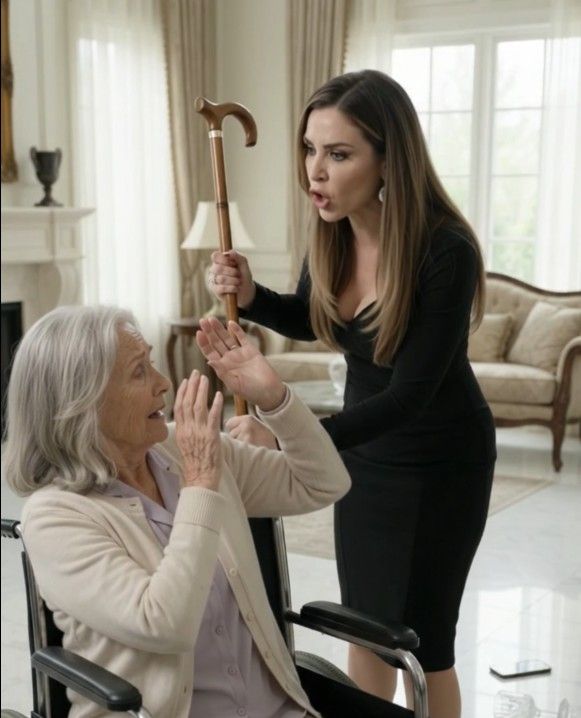
The hardest confrontation came during a scheduled court proceeding. Eleanor testified about the afternoon of the assault and the earlier pressure to surrender her home. Lydia’s lawyer challenged her memory of some conversations, and Eleanor felt herself slipping back into the helplessness she had known in the living room. She took a sip of water and asked for a moment to collect herself. Then she looked toward the judge and said she was certain of the one thing that mattered: she had said no, and Lydia had struck her because she refused to change the answer. Nathan sat behind her, not speaking for her, but present when she turned around.
Lydia’s own words and actions had consequences. After the evidence was considered through the legal process, she was held accountable for the assault and coercive conduct, with penalties and conditions imposed by the court. The protective restrictions remained in effect as ordered, and she had no lawful claim to Eleanor’s mansion. Nathan’s divorce and financial separation took longer, bringing their own expense and sorrow. Lydia had once believed that taking the property would secure her future. Instead, she lost the relationship she had exploited and the access she had used to intimidate an older woman. Eleanor did not feel joy at Lydia’s ruin. She felt a tired, profound relief that the threat had been named and stopped.
Outside the courthouse, reporters were not waiting, and there was no crowd cheering. Eleanor had imagined that justice might feel like a door slamming. Instead it felt like walking slowly down courthouse steps in the afternoon sun, breathing without anticipating an order from someone else. Nathan asked whether she wanted to celebrate with lunch. She said she wanted tea at home. They drove in comfortable silence. When she reached the mansion, she asked him to leave the front door open for a moment so she could watch the light reach the hall. It was a tiny request, almost childish in its simplicity, and he obeyed without comment.
That evening Nathan apologized without defending himself. He told her he had believed that working hard and sending money toward household expenses made him a responsible son. He had not understood that care also meant paying attention when the person being cared for tried to say something was wrong. “I thought keeping everyone happy was the same as keeping everyone safe,” he said. Eleanor studied him for a long time. She loved him, but the love had been bruised by his inattentiveness. “I needed you to believe me before you had proof,” she said. He nodded. “I know.” There was nothing useful he could say after that except that he would listen differently now.
Eleanor asked him to sit beside the window where Samuel used to read the newspaper. She told him about the first time Lydia suggested transferring the mansion. Lydia had presented it as a way of easing Eleanor’s burden, offering to take care of paperwork and bills. Eleanor had declined because she enjoyed making her own decisions. The next suggestion had come with a sharper tone, and later requests had carried accusations about selfishness. Eleanor had kept hoping that affection could soften Lydia’s anger. “I was ashamed to admit I was afraid in my own home,” she whispered. Nathan reached for her hand, then waited until she chose to take his.
They agreed on practical changes. Eleanor kept control of her accounts and legal documents, with an independent attorney reviewing any future transactions. Nathan could help with errands if invited, but could not make decisions on her behalf merely because he was family. The security company reviewed access arrangements, and Eleanor chose which neighbors and professionals she trusted to assist in an emergency. She kept her pendant charged beside the bed each night. Nathan understood that independence was not the absence of help. It was the ability to choose help freely, without surrendering authority to someone who might misuse it.
One morning a woman from a local senior center called to thank Eleanor for a donation Samuel had once made to a transportation program. Eleanor had almost forgotten about it. Samuel had believed that older people should be able to leave their houses and join the world even when mobility became difficult. The woman asked if Eleanor would like to see the program now. She hesitated, uncertain whether she was ready to enter public rooms again. Then she decided to go. Nathan drove her but waited outside during the meeting. She returned smiling, carrying a leaflet about accessible art workshops and community lunches.
The visit changed something in her. For months the mansion had seemed to contain only memories of fear. Now she began to imagine it as a place where friends might feel welcome again. She invited two women from the center for tea, then a small reading group, making sure the rooms were accessible and no one was rushed. She did not turn her home into a public institution or promise access she could not manage. She simply opened the sitting room on days she chose. Sometimes they talked about books; sometimes they sat quietly while rain tapped the windows. Eleanor discovered that safety could grow through ordinary company as well as through locks and legal documents.
Nathan found a small box in Samuel’s old desk while looking for replacement picture frames, with Eleanor’s permission. It held an old medical-alert brochure, a receipt, and a note in Samuel’s handwriting. He brought the box to his mother and asked whether she knew about it. Eleanor stared at the receipt with sudden recognition. Years earlier, after she had begun using a wheelchair for longer distances, Samuel had researched ways she could summon help without having to surrender her independence. He had bought the first alert service for her before his final illness, though the device itself had been replaced several times since. Eleanor had kept the same tiny silver pendant casing because Samuel had chosen it to resemble an ordinary piece of jewelry.
Beneath the receipt lay a folded card Eleanor had never noticed. Samuel had written, “This isn’t for the day you stop being strong. It’s for the day you need someone to hear you while you’re being strong.” The words blurred as Eleanor read them. She had thought of the pendant as an acknowledgment of her limitations. Now she saw that Samuel had understood something deeper: needing an answer did not mean losing her dignity. The small light that frightened Lydia had not merely summoned strangers. It had carried forward a promise made by a man who believed his wife deserved to be heard, even when he could no longer stand beside her.
Nathan sat with the card in his hands. “Dad knew you,” he said. Eleanor smiled through tears. “He listened,” she answered. The difference was not meant as a wound, though Nathan felt it as one. He asked whether she would let him keep a copy. She agreed, and together they placed the original inside Samuel’s photograph frame, protected behind the mat. That afternoon Nathan checked the pendant’s charging instructions without touching it until Eleanor handed it to him. Such small acts had become their new language. Every time he asked rather than assumed, her shoulders seemed to settle a little lower.
The following season, Eleanor hosted a modest dinner for the volunteers who helped with the senior-center transport program. The dining room had once been the setting for Lydia’s demands about property and inheritance. Now it held mismatched flowers, soft conversation, and the sound of silverware against plates. Nathan cooked while Eleanor directed the menu from the doorway and laughed when he over-salted the soup. Nobody called her demanding. Nobody treated her opinions as a problem to work around. At one point a guest complimented the photographs along the mantel, and Eleanor told the story of the family without needing to hide its difficult chapter.
Nathan’s divorce was finalized by the next spring. He moved into a smaller home of his own and started rebuilding friendships he had neglected during his marriage. He continued counseling and visited his mother regularly, always calling first. Sometimes the visits were joyful. Sometimes Eleanor remembered a detail of Lydia’s cruelty and needed to talk about it, even when Nathan wished they could look forward instead. He learned to stay present. He could not reclaim the months he had ignored her fear. He could help make the years ahead different. That was not the flawless reconciliation he wanted as a boy, but it was an honest one.
On a bright afternoon a year after the assault, Eleanor rolled her wheelchair through the front hall and stopped beside the rebuilt coffee table. The family photographs were back in their places, including a new picture of Nathan kneeling beside her in the garden. The marble had been repaired where the wheelchair had scraped it. She could still see the faint mark if she looked closely. Once, she had wanted every trace of the attack removed. Now she understood that a repaired surface did not have to pretend it had never been damaged. It only had to be strong enough to hold ordinary life again.
She reached beneath her cardigan and touched the silver pendant. Its light was steady, almost invisible in the afternoon sun. Nathan came in from the garden carrying fresh flowers and asked where she wanted them. “On the table,” she said, then added, “Beside your father’s photograph.” He arranged them carefully and stepped back so she could see. They spent the evening talking about the center’s next luncheon and the roses that needed pruning. Later, when Nathan said goodnight, Eleanor locked the door behind him and felt no fear in the silence. The house still belonged to her. More importantly, so did her voice, her choices, and the quiet happiness of knowing they would be respected.
