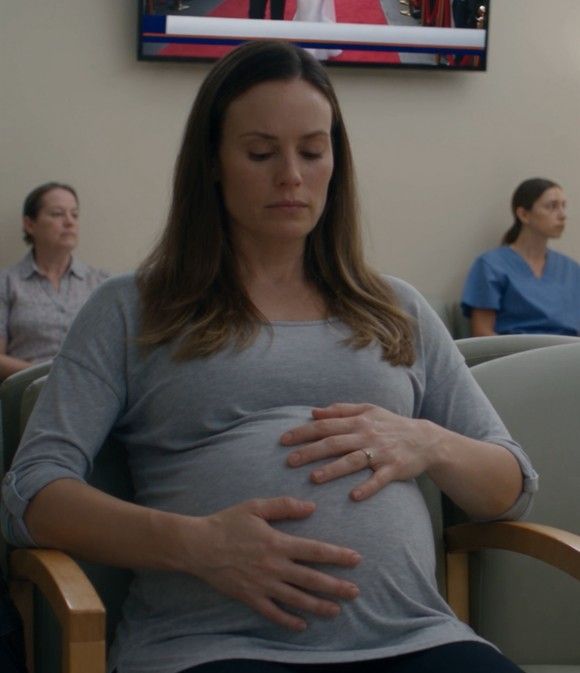
The press attention was brutal for several days. Cameras appeared near the building where Anna lived. Reporters called the clinic until Dr. Miller’s office changed its procedures. Anna hated that the most private fact of her life – the two heartbeats she had watched on a monitor – had become adjacent to headlines about wealth and marriage. She stopped reading coverage. Dr. Miller reminded her that stress was not a moral failure and that protecting her health was work enough. Anna listened.
Julian moved into a hotel and stayed there. He did not use the twins as a reason to demand proximity. He attended medical appointments only when Anna invited him, sat where she indicated, and left when they were finished. At the first appointment after the scandal, he cried when he heard both heartbeats. Anna watched him without reaching for his hand. She could believe his emotion without letting it decide her future. That distinction became one of the strongest things she learned.
Their counseling sessions were not romantic. They were specific and uncomfortable. Anna asked why he had allowed other people to speak for him. Julian admitted that he had spent his life mistaking compliance with family expectations for responsibility. He had thought he could delay conflict until a cleaner solution appeared. Instead, every delay had transferred the cost to Anna. Saying that aloud did not repair it. It did remove the last excuse that he had merely been caught in circumstances beyond his control.
Anna also had to examine what she wanted apart from punishment. There were mornings when leaving Julian forever seemed like the only way to respect herself. There were other mornings when she remembered the marriage before secrecy had entered it and wondered whether rebuilding was possible. She refused to choose while angry people on either side demanded certainty. Her attorney protected her legal position. Dr. Miller protected her medical privacy. Anna protected the time she needed to decide.
The twins arrived early enough to frighten everyone and healthy enough to turn that fear into exhausted gratitude. Samuel came first, furious at the cold air and announcing himself with a cry that made Julian laugh through tears. Grace followed minutes later, smaller and quieter, her fingers closing around Anna’s thumb. In that room, the Sterling name meant nothing. There were no cameras. No live broadcast. Only two newborns, a tired mother, and a father who understood that being allowed to stand beside the bed was a privilege he would have to keep earning.
Julian did not move home after the birth. He learned the night feeding schedule from the apartment down the hall, where he had rented a small place so he could help without assuming reconciliation. Anna could call; she could also not call. Sometimes she handed him a crying baby at two in the morning and went back to sleep. Sometimes she told him she had it. He accepted both answers. The consistency mattered more than flowers, jewelry, or public gestures he could have arranged with a phone call.
Evelyn’s first visit lasted forty minutes because that was what Anna permitted. She arrived without an assistant and without gifts large enough to feel like leverage. She held Grace and began to cry. Anna watched carefully. Evelyn apologized not for the scandal but for the years of treating Anna as an obstacle to plans made by other people. It was the first apology that named the behavior instead of the embarrassment it caused. Anna did not offer instant forgiveness. She said, Thank you for saying it clearly.
Months passed before Anna invited Julian to dinner for a reason unrelated to the children. They ate takeout after Samuel and Grace were asleep. The conversation wandered from diapers to a book Anna had started reading, then to a ridiculous story about Julian ruining a shirt while learning to prepare formula. Anna laughed before she could stop herself. The sound startled both of them. Julian smiled but did not reach across the table. That restraint made the moment safer.
When they eventually discussed living together again, Anna set conditions that would once have seemed painfully formal. Financial transparency. No family representative speaking for either spouse. No legal document signed without both seeing it. Counseling would continue. Julian agreed. More importantly, he asked what should happen if he failed one of those conditions. Anna realized he was no longer asking only how to get home. He was asking how to make the home different.
The answer became practice rather than promise. He corrected Evelyn when she made plans without asking Anna. He told business associates that questions about his family would not be answered through speculation. He learned to say no before a crisis made refusal expensive. Anna watched those choices accumulate. Eventually she stopped checking whether each one was temporary.
By the twins’ first birthday, the television footage had become something other people remembered more vividly than Anna did. She still knew exactly how the waiting room had smelled and how cold her hands felt when Scarlett appeared beside Julian on the screen. But the memory no longer predicted the next scene. Samuel had learned to pull himself upright against the sofa. Grace clapped whenever anyone sang. Their home was noisy, imperfect, and private in ways Anna had once taken for granted.
Reconciliation came without an announcement. Julian brought a small overnight bag one evening and left it by the door because Anna had told him he could stay. Weeks later, the bag was still there, then its contents moved into a drawer. Neither treated that as proof the work was finished. It was simply evidence that enough honest days had accumulated for another day together to feel possible.
She stepped aside.
Anna eventually met Scarlett in a controlled setting arranged through their attorneys. She did not go seeking friendship or a dramatic confession. She wanted to hear, directly, what Scarlett had been told before the televised ceremony. The conversation confirmed how many people had relied on partial truths and assumptions because asking one more question would have disrupted plans already in motion. Scarlett apologized for her part without asking Anna to make her feel innocent. Anna appreciated that restraint.
Leaving the meeting, Anna realized she no longer needed every participant to share the same interpretation of what had happened. The legal record was clear. Julian’s failures were clear. Scarlett’s decisions belonged to Scarlett. Anna’s task was not to organize everyone’s guilt into a perfect moral diagram. It was to decide what conditions made her own life safe and honest. That understanding reduced the scandal to its proper size. It was significant, but it was not larger than her future.
She returned home to find Julian on the floor beside the twins, trying to fold a blanket while Grace repeatedly pulled it apart. Samuel was chewing the corner of a board book. Julian looked up, ready to ask how the meeting went, then stopped himself. Anna noticed. She told him she would talk about it after the children were asleep. He nodded and went back to the impossible blanket. The scene was so ordinary that Anna stood in the doorway for a few seconds longer than necessary. Once, public spectacle had defined her marriage. Now progress could be measured by a man knowing when not to demand an answer.
Later, after the children fell asleep, Anna and Julian sat on the porch beneath a quiet sky. Their marriage certificate still existed, but neither of them treated paper as proof of love anymore. What mattered was the habit they had built since: asking, answering, showing up, and refusing to let another person speak in place of either of them.
Inside, the framed ultrasound rested beside photographs of Samuel and Grace. Anna looked through the window at it and remembered the television screen in the clinic waiting room. That image no longer owned the day. Two heartbeats did.
Anna kept the clinic wristband in a drawer with the first ultrasound photographs. She did not save it as evidence against Julian. She kept it because that day had begun with fear and ended with two steady heartbeats. Over time, the medical detail became more important to her than the broadcast. The twins had been real before the scandal and remained real after it.
