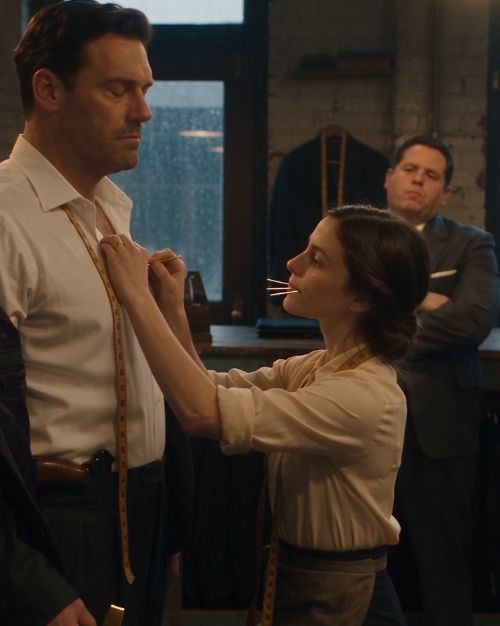
On Saturday at seven forty-five, a black car arrived.
It wasn’t the sedan from before. It was a low, sleek town car with tinted windows. Paulie got out and opened the back door and stood there in the rain without an umbrella, waiting.
I had spent an hour in front of the cracked mirror in the back room. I didn’t own a dress that belonged in Noah Moretti’s world, so I wore the only thing I had that was clean and whole — a dark green dress my mother had made for me before she died, simple, with long sleeves and a hem that brushed my knees. My hair was down. My hands wouldn’t stop shaking so I clasped them together.
My father stood by the cutting table, holding his cap like he was at a funeral.
“You don’t have to go,” he whispered as Paulie waited outside. “We can find another way. We can leave New York. We can —”
“If we leave, we lose the shop anyway,” I said. “And where would we go?”
He had no answer.
I walked out into the rain. Paulie didn’t look at me. He just held the door and said, “Miss Russo,” and shut it after me with a soft, solid thunk.
The car smelled like leather and Noah’s cologne — something clean and smoky and expensive. Noah was already inside, in the back seat, in a dark suit that wasn’t the one I was making. It fit him perfectly. Of course it did.
He looked at me when I slid in, and for a second his face did something complicated. His jaw unclenched. His eyes moved over my dress, my wet hair, my hands knotted in my lap, and something like relief flickered there.
“You came,” he said quietly.
“You sent a car,” I said. “My father thinks I didn’t have a choice.”
“You always have a choice,” he said. He reached forward and pressed a button and the privacy divider went up, sealing us off from Paulie in the front. The car pulled away from the curb, smooth and silent. “Did you think I would force you?”
“I think you own my father’s building,” I said. My voice was sharper than I intended, sharpened by fear. “I think you own his debt. I think you told him you’d forgive it if I had dinner with you. That’s not a choice. That’s a transaction.”
Noah went very still.
The streetlights slid across his face in amber streaks as we moved. Rain traced silver lines down the window. He stared at me, and I stared back, and I refused to look away even though my throat was tight.
“Who told you that?” he asked at last, his voice dangerously low.
“My father. Paulie told him.”
Noah’s hands curled into fists on his knees. The gold lighter was in his fingers again, flipping open, shut, open, shut, a rapid, angry click.
“Paulie,” he said, not to me, to himself, and the name sounded like a verdict.
“He said you bought the debt in February,” I continued, because now that I’d started I couldn’t stop. The words tumbled out, hot and trembling. “That you’ve been letting us stay out of — out of kindness? Or strategy? I don’t know. My mother made a suit for your father once. Is that why? Or was this the plan all along? Bring me close enough to measure your chest so you could ask me if I belonged to anyone?”
The lighter snapped shut one final time and he shoved it into his pocket.
“I did not tell Paulie to say that,” he said. His voice was low and controlled, but underneath it was something raw and furious. “I did not tell him to threaten your father. I told him to tell your father the debt was cleared. No conditions. Do you understand me? Cleared.”
I blinked.
“What?”
“I bought the building because the owner was going to sell it to a developer who wanted to gut the whole block and put up condos,” he said, and he leaned forward, his elbows on his knees, his eyes never leaving mine. The car felt smaller. “I knew your father’s shop would be gone in a month. I remembered this place. My father brought me here when I was ten. Your mother measured me for my first communion suit. She was kind to me when no one else was. I didn’t want it torn down.”
His words didn’t line up with the fear in my father’s face.
“Then why did Paulie —”
“Because Paulie works for my uncle, not just for me,” Noah cut in. “And my uncle thinks a capo should not chase a tailor’s daughter unless he can claim her. He thinks affection is leverage. He told Paulie to make sure you understood the price of saying no.”
The car stopped. We were outside a restaurant I recognized from magazines, a place with no sign, just a single awning and a doorman in a black coat. Through the windows I could see warm light, linen, quiet.
