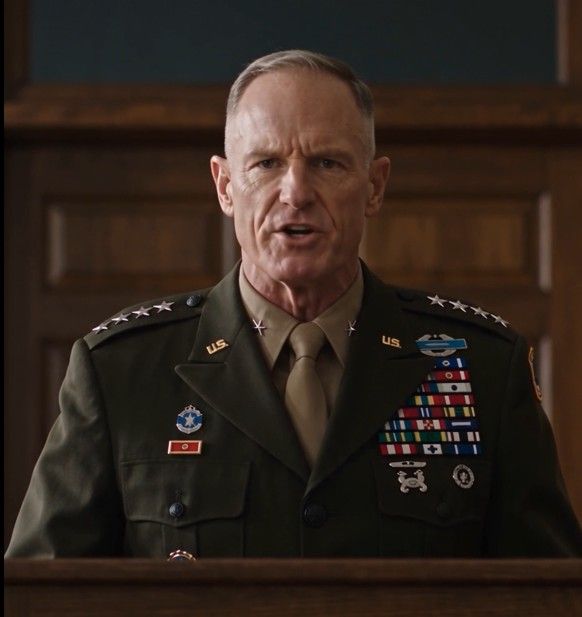
My three-star stepfather told two hundred Army officers that I was nothing more than a glorified secretary who carried his name only because he allowed it. Then, before the laughter had fully died, the double doors at the back of the Fort Bragg auditorium flew open and a JSOC colonel walked straight toward my seat carrying a red steel-mesh Top Secret folder. My name is Claire Bradley, and for thirty-three years, Lieutenant General Richard Bradley had treated me like an inconvenience attached to his family name. That morning, he stood behind the podium in full uniform, three silver stars gleaming beneath the lights, and made certain every person in the room could hear him. “Who gave you permission to speak in here? Sit down. You’re allowed to wear the Bradley name because I’ve been charitable enough to let you. But inside this room, you will always be a zero. Don’t disgrace my reputation.” Laughter moved through the auditorium. I sat in Row Z, Seat 14, at the absolute back of the room and kept my expression unreadable. Richard loved talking about what he called the “Bradley warrior DNA,” particularly when praising his biological son, Tyler. Tyler had been removed from West Point after repeatedly failing fitness requirements, but Richard continued polishing his reputation as though nothing could diminish it. In his version of the family story, I was the civilian-minded stepdaughter. The paperwork woman. The person who supposedly spent her days filing administrative logistics reports. Three nights earlier at the Officers’ Club gala, Richard had even ordered me to bring a senator a drink as though I were part of the staff. He needed everyone around him to believe I was insignificant. For reasons of my own, I had allowed them to. So when he humiliated me from the podium, I remained seated. My breathing stayed steady. Then the wooden double doors suddenly crashed open. The laughter stopped. Colonel Nathan Vance of Joint Special Operations Command entered wearing a faded tactical jacket and worn combat boots. He did not pause to survey the room. He headed directly down the center aisle. Richard’s expression darkened. “Now listen here, Colonel—” Vance barely acknowledged him as he moved past the podium and continued toward the rear rows. Major Thomas Yates, Richard’s constant shadow, quietly stepped back and avoided Vance’s eyes. Two hundred officers followed the colonel’s path until there was nowhere left for their attention to go except Row Z. Except me. Vance stopped beside my small folding table. The cold air-conditioning brushed the back of my neck. He reached inside his coat and removed a red folder reinforced with steel wire mesh. Pentagon flash traffic. Top Secret. He placed it firmly on the table in front of me. “My asset,” Vance said quietly. “Right now.” He did not use my name. He did not address me by rank. From the front of the room, Richard’s voice came again, but it had lost some of its certainty. “Colonel, hold on. She only deals with administrative logistics. She files paperwork. She’s my stepdaughter. She isn’t under your jurisdiction. You’ve got the wrong officer.” Vance did not answer him. Neither did I. I placed both hands on the edge of the table and rose slowly from the plastic chair. Its legs scraped across the floor, a small sound made enormous by the silence. Richard stared from the podium. Yates kept his eyes lowered. Every officer in the auditorium was waiting for someone to explain why a JSOC colonel had just brought classified Pentagon traffic directly to the woman Richard had publicly dismissed as a secretary. I looked down at the sealed red folder. Its contents had not yet been opened, and Richard still had no idea why Colonel Vance had come looking specifically for me. 👇
I did not open the folder in the auditorium.
That was the first thing Richard failed to understand.
He had spent thirty-three years imagining authority as performance—rank worn in public, orders delivered loudly, rooms controlled by force of personality. The red folder on my table represented the opposite. Real authority often began with knowing what not to expose.
I looked at Colonel Vance.
“Secure room?”
“Ready.”
I picked up the sealed folder.
Richard left the podium.
“Claire, I asked you a question.”
I turned toward him.
“No, sir. You made a statement.”
A few officers shifted in their seats.
Richard’s face darkened.
Vance stepped between the aisle and the podium—not blocking him, simply occupying the space with unmistakable intention.
“General Bradley,” he said, “the officer I came for is required elsewhere.”
Richard stared at me. “She is not cleared for whatever you are holding.”
Vance’s expression did not change.
“Sir, I would not have carried it to her otherwise.”
That sentence ended the argument.
Major Yates looked at the floor.
I followed Vance out of the auditorium while two hundred officers remained behind in a silence Richard could no longer direct.
The secure room was three corridors away. Inside, phones were prohibited, blinds were drawn, and a communications officer waited beside an encrypted terminal.
Only then did I break the seal.
I read the first page once.
Then again.
The situation involved a supply and movement network I had spent four years building across joint commands. A failure at one overseas node had disrupted access to equipment needed by a special operations element preparing to move. The details were classified, but the problem was familiar: too many dependencies, too little time, and no tolerance for assumption.
Vance watched me.
“How bad?”
“Recoverable.”
“Timeline?”
“Six hours if the alternate route is clean. Ten if it is not.”
He nodded. “That is why I came.”
For the next ninety minutes, the auditorium ceased to matter.
So did Richard.
I contacted the teams already in the network, challenged two estimates, redirected one shipment, and rejected a shortcut that would have saved time on paper while creating a single point of failure. The work was not glamorous. It was exactly what Richard had mocked: logistics.
The difference was scale, consequence, and trust.
By the time the first movement confirmation arrived, Vance leaned back in his chair.
“Route is holding.”
“For now.”
He smiled. “You always ruin the celebration too early.”
“What celebration?”
“The part where we say the problem is solved.”
“It is not solved until people have what they need.”
“That answer is why I drove across post with a folder in my coat.”
I closed the file.
“Is Richard still in the auditorium?”
Vance’s smile disappeared.
“Yes.”
I stood.
