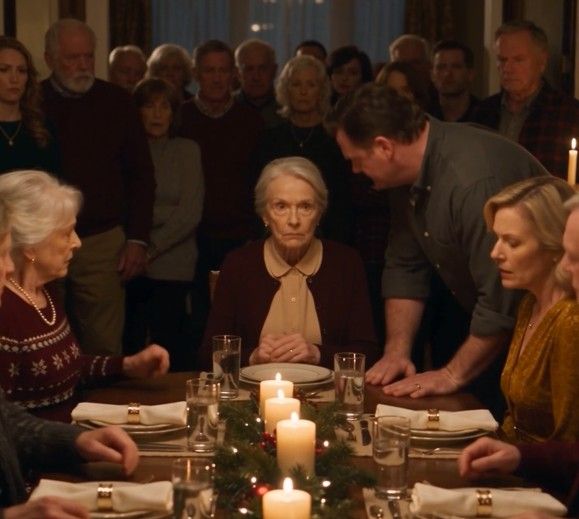
The house sold in eleven days.
The proceeds paid the bank, restored most of the older woman’s retirement account, and covered the children’s educational trust. Daniel entered a repayment agreement and began working for a restoration company, where he learned to repair other people’s mistakes without pretending they had never happened.
Melissa found part-time work at a dental office. She and Daniel separated, not with a dramatic announcement, but with the quiet recognition that a marriage built around concealment could not be repaired by changing the locks.
They remained civil for the children.
They also attended counseling.
The first time Daniel saw his mother afterward, he sat six feet away from her and did not ask for money.
That was how she knew something had changed.
CHAPTER 5 – The Blue Door
Spring arrived slowly.
The apartment the older woman had rented was small, bright, and entirely hers. It had wide windows, a balcony crowded with herbs, and a blue front door that the landlord had painted before she moved in.
She still woke some nights expecting to hear Daniel’s footsteps in the hall.
When she did, she sat up, listened, and remembered where she was.
No one was angry in the next room.
No one was waiting for an answer she could not afford to give.
She would put her feet on the floor and breathe until the morning returned.
Linda visited every Thursday. They drank tea at the little table by the window and argued about crossword clues. Marianne came once a month with updates, most of which were ordinary: documents filed, payments made, accounts restored.
Ordinary became a kind of miracle.
Ethan began technical college in September. His tuition came from the trust, but his tools came from his own summer wages. On his first day, he arrived at his grandmother’s apartment carrying a wooden box.
“I made this,” he said.
She opened it.
Inside was a small brass key.
Her breath caught.
“It’s not for anything,” Ethan said quickly. “I made it because I wanted you to have one that doesn’t open a room full of bad memories.”
She ran her thumb over the rough edges.
“What does it open?”
He smiled.
“A drawer in my workbench.”
She looked at him.
“So I can keep the things you give me safe.”
Her eyes blurred. She reached across the table and held his hand.
“I never gave you enough.”
“You gave me a beginning.”
Noah, now twelve, joined the school orchestra and learned the cello. He sent his grandmother recordings that contained more squeaks than music. She listened to every one.
Melissa apologized again in small, practical ways. She stopped asking for explanations when the older woman said no. She paid her share at restaurants. She learned how to manage her own accounts and taught Noah how to read a bank statement.
Daniel kept his repayment schedule.
He also began visiting on Sundays.
The first visit was awkward. He stood outside the blue door holding a paper bag of groceries.
“I didn’t know what to bring.”
“You could have called.”
“I did.”
“I mean before you came.”
He nodded.
She let him in.
He placed the groceries on the counter. “I bought the tea you like.”
“I can see that.”
“I wasn’t sure if you still liked it.”
“Tastes change. Tea doesn’t usually.”
He looked at her, trying to determine whether that was forgiveness.
It wasn’t.
But she made a cup for him anyway.
They sat at opposite ends of the small table.
Daniel told her about the restoration company. He described an old porch he had rebuilt for a widow whose husband had died. He spoke carefully, without making himself the hero.
“She kept apologizing for the cost,” he said.
“What did you tell her?”
“That the cost was the cost.”
His mother looked at him over her cup.
“And did you charge her?”
“Yes.”
A faint smile touched her mouth.
“But I didn’t inflate the invoice.”
