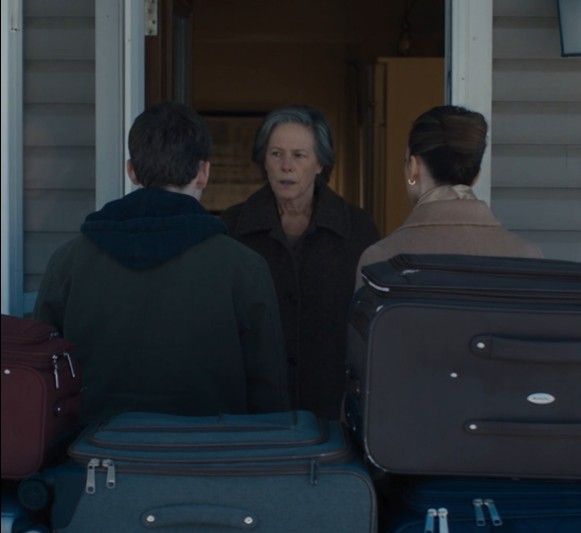
The suitcases told Bessie the truth before her son did. On a freezing October morning, sixty-four-year-old Bessie opened her front door and found Terrence standing beside his wife, Lennox, with enough luggage stacked along the porch railing to make one thing painfully clear. They had not come for breakfast. And they were not visiting. Terrence looked exhausted. His shoulders sagged beneath his jacket, and he barely met his mother’s eyes. Lennox, by contrast, stood perfectly composed in expensive clothes, her expression calm enough to suggest she was checking into a hotel instead of asking someone else to absorb the consequences of whatever had gone wrong. Bessie looked at the suitcases. Then at her son. “Tell me.” Terrence swallowed. They had sold the Maple Street house. For $620,000. Bessie stared at him. Years earlier, she had taken $40,000 from retirement savings she had spent decades building to help them buy that house. She even contributed toward renovations because she believed she was giving her son something solid. A future. Security. A place that would eventually belong to him free and clear. “So where are you living now?” Terrence looked down. “Mom… can we stay here for a little while?” Cold moved through Bessie that had nothing to do with the October wind. She glanced again at the luggage. “Where did the money go?” Nobody answered. Dead leaves scraped across the porch. Finally, Lennox spoke. “Expenses.” Bessie waited. Lennox began listing them with startling calm. Jewelry. Designer clothes. A luxury California trip. Car upgrades. Credit cards. Bessie listened without interrupting. But she had spent too many years budgeting, saving, and stretching every dollar to accept numbers that refused to make sense. “Six hundred and twenty thousand dollars?” Lennox’s expression tightened. “It was our money.” “I didn’t say it wasn’t.” “You’re acting like we need permission to spend it.” Bessie looked at Terrence. He still wasn’t speaking. That frightened her more than Lennox’s defensiveness. Her son wasn’t arguing. He wasn’t supporting his wife. He sat pale and silent, looking less like a careless man who had wasted a fortune and more like someone trapped inside a story he was terrified to explain. Bessie lowered her voice. “Terrence, what happened?” His eyes lifted briefly. Lennox answered for him. “We need somewhere to stay. That’s what happened.” And suddenly Bessie understood what they wanted. Not help. No questions. They wanted her house, her money, her patience—and most importantly, her silence. She loved her son. But she had already sacrificed enough to build the life standing in ruins on her porch. So she looked at both of them. “No.” Lennox stared at her. “What?” “No.” The composure vanished. Her voice rose instantly, accusing Bessie of abandoning her own child, of being selfish, heartless, controlling. Loud enough for neighbors to hear. Loud enough to make Bessie look cruel. The argument spilled onto the porch, and somewhere in Lennox’s fury, she crossed a line Bessie knew she would never forget. That afternoon, Bessie called her attorney. Not for revenge. For answers. The investigation began quietly. Then subpoenas opened the financial records. Hidden debts appeared. Unexplained transfers. Secret accounts. Numbers Terrence had never admitted existed. And suddenly the vanished $620,000 looked less like reckless spending and more like the surface of something much deeper. Then Bessie’s attorney placed one final set of documents in front of her. She read the first page. Her hands went cold. Because Terrence had not simply lost his money. He had been hiding how trapped he really was. And whatever Lennox had concealed was far worse than Bessie had imagined. 👇
Bessie read the first page twice.
Then she looked at her attorney.
“Tell me I’m reading this wrong.”
Angela Morris did not answer immediately.
That was answer enough.
The document was a bank authorization tied to an account Bessie had never seen before. Terrence’s name appeared on it. So did Lennox’s.
But the signature beside Terrence’s name did not look like her son’s handwriting.
Bessie knew that handwriting.
She had watched him print birthday cards at seven, sign school forms at sixteen, and write his name on the closing papers for Maple Street while she cried because she thought she had helped him build something secure.
“This isn’t his signature.”
Angela nodded.
“We don’t believe it is.”
Bessie’s hands went cold again.
The account had received more than two hundred thousand dollars from the house sale within forty-eight hours of closing.
From there, money moved through two business accounts and a brokerage account Lennox had never disclosed.
Terrence was listed as an owner on one business.
He had never mentioned owning a business.
“What is it?” Bessie asked.
“A consulting company on paper. We have not found evidence that it did meaningful business.”
“And Terrence knew?”
“That is what we need to determine.”
Bessie stared at the documents.
She had wanted an answer simple enough to fit inside anger.
They spent too much.
They were irresponsible.
Lennox manipulated him.
Terrence lied.
Instead, the records showed something messier.
Credit cards had been opened in Terrence’s name without matching application signatures. Loans had been taken against assets he thought were paid off. Tax notices had been redirected to an electronic mailbox Lennox controlled. The Maple Street sale proceeds had been divided among accounts so quickly that the ordinary spending Lennox listed on the porch represented only part of the loss.
“Where is the rest?” Bessie asked.
Angela turned another page.
“Some appears spent. Some appears transferred. Some may still be recoverable.”
“Transferred to whom?”
“Mostly Lennox. Some to entities connected to her.”
Bessie sat back.
“And Terrence?”
“There are documents he signed.”
That mattered.
Angela did not let Bessie turn her son into an innocent child because the truth had become painful.
“He participated in some decisions,” she said. “We also have evidence he may have been deceived about others. Both can be true.”
Bessie closed her eyes.
That sounded like Terrence.
He had always hated conflict. As a boy, he would agree to anything if it ended an argument. As a man, that habit could become consent on paper long after it stopped being consent in practice.
“Does he know you found this?”
“Not yet.”
“Then I’ll tell him.”
Angela looked at her carefully.
“Do not confront Lennox alone.”
“I won’t.”
