Peyton asked where I could meet him safely. I said the main branch, after I called my lawyer. He also arranged for the personal account restrictions to be reviewed directly with me. A concern raised under a power of attorney had triggered security holds; the bank would not simply remove them because I was angry on the telephone.
I understood that. What I wanted was a path back to my own life, not another promise that somebody knew best.
Desmond knocked on the car window. I lowered it an inch.
“Who was that?”
“The bank.”
“I told you I’d handle it.”
“I heard you.”
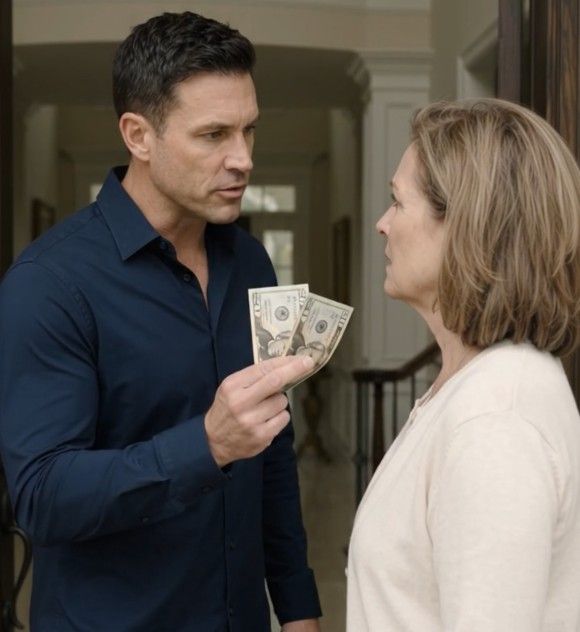
I raised the window and drove away. In the mirror, I saw Karen come down the steps to stand beside him. He still held the forty dollars.
My lawyer, Elaine Porter, had handled business matters for us since before the second dealership opened. Her assistant found an appointment that afternoon after I said the words power of attorney and account restrictions. I stopped first at my friend Judith’s house because I needed somewhere to sit that wasn’t a parking lot.
Judith listened without interrupting, then put a sandwich in front of me. I hadn’t eaten since breakfast. When I said I couldn’t believe Desmond would do this, she asked whether I wanted belief or a ride to the bank.
“Both,” I said.
She took her coat from the hook.
At the branch, Peyton met us in a small conference room. Elaine joined by phone while a manager reviewed my identification and asked questions without addressing Judith instead of me. I had not realized how much that courtesy would matter until I felt my shoulders loosen.
Peyton showed me the transfer request. A company called KDM Advisory was to receive a substantial advance described as transaction coordination. The supporting papers included an authority document bearing my signature.
“I don’t know that company,” I said.
Elaine asked for copies through the proper channels. She did not announce a crime based on the name of a recipient. She asked what had been verified, what had been requested, and what remained pending.
Then we reviewed the personal restrictions. Desmond had reported that my financial access might be compromised and that I was vulnerable to manipulation. The bank had placed holds while it assessed the concern. He had also contacted card issuers, including American Express, under the authority he claimed to have. The failed cards had not all been frozen by a single button at First National. He had worked through the channels I had given him to help me.
“Who did he say was manipulating me?” I asked.
The manager checked her notes. “An unnamed acquaintance encouraging unusual purchases.”
I had recently told Desmond I planned to fund a training program for young mechanics and take a long trip with Judith. He had called both wasteful. Now ordinary disagreement had been dressed as danger.
Elaine helped me begin revoking the power of attorney and giving formal notice to the institutions involved. She cautioned that notifications, records, and replacement access would take time. A signed revocation in her office would not magically reach every company that afternoon.
Peyton arranged a limited amount of access once the branch’s review permitted it. I withdrew enough of my own money for the week. The teller counted the notes onto the counter, and I nearly cried over how ordinary the act should have been.
At Elaine’s office afterward, we compared the authority papers Desmond had supplied with the limited arrangements I remembered signing during recovery. She kept copies of the versions sent from her office and asked me to describe who had brought each document to the house.
“He had a folder,” I said. “Routine payments, payroll contingencies, things for the month.”
“Did you sign in front of him?”
“Yes. He brought coffee. I was tired, but I wasn’t unconscious.”
She wrote that down without turning it into either incapacity or certainty. I remembered signing pages. I did not remember authorizing the sale of everything I owned.
The version presented to the bank included a broad authority page that was not in Elaine’s retained copy. My signature appeared on a separate signature sheet. That discrepancy required investigation. It did not prove, by itself, how the pages had been assembled.
Elaine asked for the original file and communications surrounding it. She also contacted the company’s outside counsel about any proposed sale. If Desmond was negotiating with a buyer, they needed to know that his claim to my approval was disputed.
Before I left, Elaine opened the trust summary she had prepared when Warren died. I had read it then, but grief had reduced every page to another place where his name appeared beside a word meaning gone.
