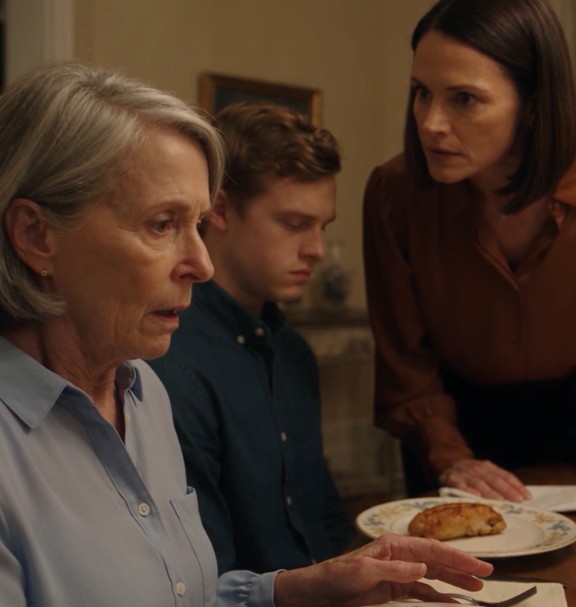
“The proceeds,” she said. “Obviously.”
I turned the page. Beneath the imitation of my signature was a purchase price, a company name, and a paragraph promising that the property would be delivered vacant. Friday. Five days away.
There was nowhere on the paper for the woman who lived here.
Wesley whispered, “There’s an apartment.”
Bianca’s expression hardened.
“Don’t.”
But he was already pulling his phone from his pocket. He opened an email and put it beside my plate. A furnished studio, rented for thirty days, beside a highway I avoided because the merging lanes frightened me.
Thirty days.
“And after that?”
Neither answered.
I stood. My knee struck the table, rattling the cutlery, and Wesley flinched as if I had hit him.
Bianca moved toward the doorway.
“We should all calm down before anybody does something they regret.”
I picked up my phone.
For the first time that evening, she looked afraid.
I called Ruth next door. She answered over the sound of running water.
“I need you to come over,” I said. “Bring your phone. Please.”
Then I called the police.
Wesley bent forward, elbows on his knees. Bianca said my name once, sharply, the way someone might call a dog back from traffic.
I gave the dispatcher my address.
While we waited, I photographed every page. Bianca said the paperwork was private. I kept taking pictures. Wesley sat motionless until I asked for my deed, then slid it toward me with both hands.
Ruth arrived wearing gardening shoes and carrying no purse. She took in the cooling dinner, my son’s face, the papers.
“Where do you want me?”
“Beside me.”
She pulled out a chair.
The responding officer listened without promising anything. He explained that ownership and eviction questions would need legal attention, but an allegation of forged signatures could be documented immediately.
Then he asked whether I wished to make a formal complaint.
Wesley finally looked straight at me.
I saw him at seven, waiting outside the principal’s office. I saw him at sixteen, beside a dented fender. All the times I had stood between him and the sharpest edge of a consequence crowded into that single moment.
“Mom,” he said.
My mouth opened before I knew what I would say.
Bianca spoke first.
“Tell her about the eighteen thousand.”
Wesley went white.
She folded her arms.
“If you’re going to make me the villain, tell her what you already took.”
The officer’s pen paused.
“What eighteen thousand?” I asked.
Wesley pressed his palms together until the fingertips blanched.
“An advance from the buyer. Against the sale.”
“Where is it?”
“Gone.”
The word came out barely audible.
He had lost his job four months earlier. The morning departures, the complaints about traffic, the sandwiches I wrapped because he said lunch near the office cost too much—all of it had continued after there was no office to go to.
Some money had paid debts. Some had covered overdue credit cards. Bianca had told the buyer I needed a quick sale for medical reasons.
“I was going to replace it,” Wesley said.
“With what?”
He stared at his hands.
I looked at the officer.
“Yes. I want to make the complaint.”
Wesley closed his eyes. I did not take the words back.
Bianca’s voice changed then. The polished patience vanished.
“She agreed to let us handle things. She forgets conversations. Ask him.”
“Is that true?” the officer asked Wesley.
Bianca turned toward him, chin lifted.
He took so long that I felt something inside me begin to close.
“No,” he said finally. “She doesn’t forget. She never agreed.”
Bianca made a small, contemptuous sound.
Wesley unlocked his phone.
“There are messages. And another document.”
