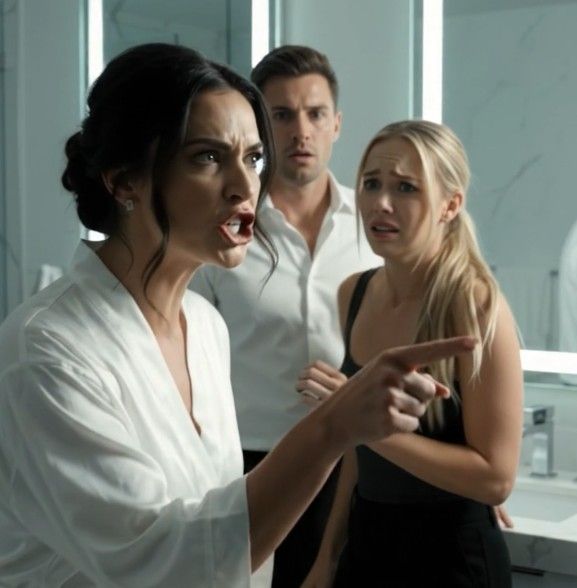
The owner made notes. She asked a few precise questions about the sequence, and Mom answered without looking toward me. I realized she had rehearsed this, perhaps during all the evenings when I thought she was simply reading in her room.
Then Celia turned to me. “And you think you get to walk away?”
“No. The apology and repair costs are being handled. I won’t say you deserved what I did.”
That answer left her without the argument she had prepared. She folded her arms and faced the owner again.
Mom asked for one more thing: a correction to the appointment record, which described the service as a requested restyle. The owner agreed to add Mom’s account and preserve the original entry rather than erase it. Mom requested a copy. It was a small administrative act, but I watched her grip on the folder loosen when the owner said yes.
Outside, I asked whether the meeting had helped.
“I don’t want her hands near me again,” Mom said. “But I needed her to hear me finish a sentence.”
We walked past the salon window. In the glass, our reflections appeared side by side, her short gray hair and my coat hanging open in the wind. She didn’t turn away from the reflection this time.
That evening, my phone rang with Evan’s mother’s name. I answered because she had several boxes of things from the bridal shower, and I wanted to arrange collection without involving Mom.
“Celia says your mother is determined to ruin her livelihood,” she said.
“Mom asked for an accurate record.”
“Surely losing the wedding has been punishment enough for everyone.”
I looked at the notebook where I had listed deposits, rent, and repairs. Every column involved a consequence. Her version still had no column for the decision that started them.
“The wedding wasn’t a punishment,” I said. “It was a choice about my future.”
She began to answer, then stopped. I gave her my friend’s number for arranging the boxes, with my friend’s permission, and said practical matters could go through her. After the call, I silenced the family group chat. I had spent days waiting for the right explanation to make them fair. Letting go of that hope left me tired enough to sleep.
I started therapy with an unflattering account of the salon. When I tried to explain how protective I felt, the therapist asked what protecting Mom might have looked like if I had listened to her first.
Driving her out. Asking whether she wanted photographs. Finding someone she trusted to repair the cut. Letting her choose what happened next. The answers were painfully ordinary. None required scissors.
I told Mom that one evening while we washed dishes. She rinsed a plate and placed it in the rack.
“I knew you were angry for me,” she said. “I needed you beside me, though. Not out in front making another mess.”
“I know.”
“You know now.”
She handed me the next plate, and we kept working.
I moved into a small apartment six weeks later. Mom helped line the kitchen drawers with paper she insisted was better than the expensive kind. Evan sent one message after the final joint payment cleared. He said he was sorry for treating my mother’s refusal as something to get around. I read it twice, as I had read the other message. This one asked nothing from me.
I replied that I hoped he kept understanding it. Then I put the phone down and helped Mom find the scissors for the drawer paper.
She held them up, met my eyes, and gave a small, crooked smile. It was not a joke exactly. It was permission to stop holding my breath forever.
In early summer, I drove her back to June. Her hair had grown enough to curl at the nape. June asked whether she wanted to keep growing it or maintain the shape, and Mom studied herself in the mirror before answering.
“Keep the length today,” she said. “Just tidy the ends.”
June repeated the request, and Mom nodded.
I waited with a magazine open on my lap. Through the mirror, I saw Mom settle into the chair, shoulders easing beneath the cape. When June lifted the first section, she showed Mom the ends between her fingers. Mom considered them, then said yes.
Outside afterward, a breeze moved the hair around her face. She stopped at the bakery window and pointed to two almond pastries. I went in to buy them while she chose a table in the sun. When I came out, she had turned the spare chair toward her, leaving room for me to sit beside her.
