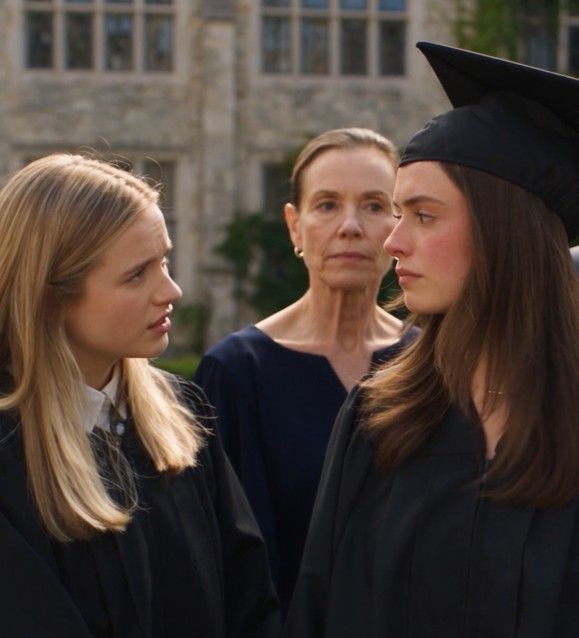
The slap landed before I had even finished celebrating my graduation, sending my cap across the university courtyard while hundreds of conversations died at once. My father, Arthur Vance, pointed at me in front of graduates, professors, and families and shouted, “You didn’t earn that diploma!”—but the fear on my brother Julian’s face told me this was no longer about humiliating me. My cheek burned as my cap rolled across the stone walkway and stopped beside the diploma I had fought four years to earn. Cameras lowered. People stared. My father stood over me with the same cold expression I had known since childhood. “You’ve embarrassed this family enough,” he snapped. “Standing up there pretending you’ve accomplished something.” Before I could answer, my mother forced her way forward. “A loser in a graduation gown is still a loser!” she said loudly enough for the surrounding crowd to hear. “Stop pretending you’re someone special!” A campus security officer started toward us, but I raised one hand. “It’s okay,” I said quietly. “Please… let them finish.” My best friend Paige rushed to my side. “Audrey, are you alright?” I gave her the smallest smile. “I’ve been waiting for this day.” She had no idea what I meant. For four years, my parents had told relatives and family friends that I had dropped out because I was lazy, irresponsible, and ungrateful. At the same time, they celebrated my younger brother Julian as the child who could do no wrong. The truth was completely different. Before my freshman year began, I earned a competitive scholarship. I worked breakfast shifts at a neighborhood diner before sunrise, tutored struggling students in the afternoons, and spent most evenings studying until the library lights shut off. Nearly every extra dollar went toward tuition. There were nights I cried alone in empty study rooms and mornings when exhaustion made getting out of bed feel impossible. But I never quit. Minutes before my father confronted me, the dean had called my name with highest honors. The courtyard filled with applause. That was when I noticed Julian. Standing behind our parents in an expensive designer suit, he had stopped smiling. He looked frightened. My parents had always somehow found money for his vacations, cars, watches, and failed business ideas. Whenever I asked for help with school, they insisted the family could not afford it. Watching me cross that stage had exposed at least one thing they could no longer explain: I had never dropped out. I bent down, picked up my cap, dusted off my diploma, and stood. “You’re right about one thing,” I told my father. “Everyone here deserves to hear the truth.” My mother’s face changed immediately. “Audrey,” she hissed, stepping toward me. “Don’t you dare.” I walked past her. Hundreds of eyes followed as I crossed the courtyard toward the ceremony podium. The university president looked uncertain but did not stop me. From a hidden pocket inside my gown, I removed a thick sealed envelope I had carried all morning. Inside were documents I had spent four years collecting. I stepped to the microphone and looked across the silent crowd. “Before I leave this campus today,” I said, my voice carrying through the speakers, “I need everyone to know who took my college tuition, forged financial records in my name, and spent years trying to erase me from my own family.” Below the stage, my father’s composure finally broke. “Audrey! Don’t say another word!” My mother went pale. Julian did not move. The microphone was live, the entire courtyard was silent, and I slowly reached into the envelope for the first document. 👇
The paper made a soft rasp as I pulled it from the envelope, and in that strange courtyard silence, the sound seemed louder than my father’s shout.
I unfolded the first document and held it where I could see it clearly.
“This is a statement from the education account my grandfather opened for me when I was eleven,” I said into the microphone. “It had forty-eight thousand dollars in it before I started college.”
A murmur moved through the crowd.
My mother took one step toward the stage.
“Audrey, stop this now.”
I kept reading.
“The account was closed three months before my freshman year. The withdrawal request carries my name. It also carries a signature I did not write.”
My father pointed at the podium. “Get down from there.”
The campus security officer who had started toward us earlier changed direction and positioned himself between my parents and the steps.
I did not look at him. I looked at Julian.
He had gone completely still.
“The money did not disappear,” I continued. “It was transferred in pieces. Some went into an account controlled by my parents. Some went to a company formed by Julian two weeks later.”
Julian’s face drained of color.
“Audrey,” he said.
It was the first time he had spoken.
I pulled out a second page.
“This is the incorporation record. This is the transfer receipt. And this is the bank statement showing the same amount arriving three days later.”
The university president stood a few feet behind me, his expression no longer uncertain. He looked toward my father, then toward the people gathering along the walkway.
My father raised both hands as if he could still reduce the moment to a family disagreement.
“She does not understand what she is reading. We moved money for tax purposes.”
I almost smiled.
That answer had once frightened me. For four years, complicated words had been one of his favorite weapons. Tax purposes. Family accounting. Temporary transfer. Responsible management. He spoke as though confusion itself proved he was right.
“Then explain this,” I said.
I held up a copy of a loan application opened in my name during my sophomore year.
“I never applied for this loan. I never received the money. But my Social Security number is on the form, my address is wrong, and my signature appears on the last page.”
Paige covered her mouth.
My mother’s voice cracked. “You do not know what we sacrificed for you.”
I turned toward her.
