He stepped away from the head table.
“Amelia,” he said. His voice broke on the second syllable. He swallowed. “Amelia.”
Margaret’s hand shot out and closed around his wrist. Her nails were perfect. Her grip was iron.
“Ethan, dear, you are making a scene,” she whispered, still smiling for the tables. “These children are not ours to claim. Sit down. Olivia is waiting.”
Ethan looked down at his mother’s hand, and for the first time in his life, he pulled away.
He walked the ten steps between the head table and the doorway. Every eye followed him. The quartet had stopped entirely. A waiter stood frozen against the wall with a tray held mid-air.
He knelt. The polished floor was hard against his knee. He was now eye level with the three children, and up close the resemblance was undeniable, terrifying in its precision. The boy had his jawline. The middle girl had his sister’s eyes, the sister who had died as a child. The youngest had the exact small gap between her front teeth that Ethan had had until he was seven.
“Hi,” he whispered. He couldn’t get any louder. “Hi.”
The oldest boy stared at him, unsmiling, protective. “We told you not to make Mommy cry,” he said quietly, not as an accusation but as a fact he had carried for a long time.
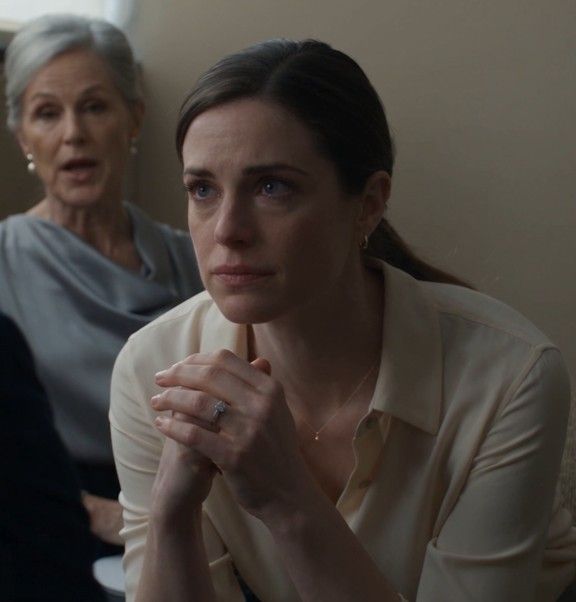
Amelia’s breath caught. She put a hand on her son’s shoulder to steady him and herself.
“I know,” Ethan said to the boy, his eyes filling before he could stop them. “I know you did.”
Margaret laughed, a single, brittle sound.
“Enough of this theater,” she announced, rising now, her chair scraping loud against the marble. “Amelia Carter left this family four years ago of her own accord. She made her choices. To return now, at my son’s wedding, with children of uncertain parentage and attempt to -”
“They’re mine,” Ethan said without looking at her.
The room sucked in a breath.
Margaret’s composure cracked for half a second. “You cannot possibly know that.”
“I know,” he said, still kneeling, still looking at the children. His voice steadied as he said it again, louder. “They’re mine.”
Olivia took a step forward. Her hands were clasped so tightly her knuckles had gone white, but when she spoke, her voice was calm and kind.
“Margaret,” she said. “Stop.”
Margaret turned on her, incredulous. “Olivia?”
Olivia didn’t flinch. “I asked you earlier if you really wanted this marriage,” she said to Ethan, but she was speaking to the whole room. “You said ‘of course.’ I knew you were lying. I knew it for months.” She glanced at Amelia, and there was no jealousy in her face, only a deep, tired relief. “I didn’t know how you were lying until last week.”
Amelia’s head snapped up. “What?”
Olivia reached for the small, pearl clutch on her chair and withdrew a folded envelope, worn at the edges. She held it out, not to Ethan, but to Amelia.
“This was delivered to my apartment,” Olivia said. “No return address. Inside were copies of medical records. And a letter.”
Margaret went utterly still.
Amelia took the envelope with cold fingers. The children pressed against her, watching. She unfolded the papers with one hand. The top sheet was a lab report from the clinic where she and Ethan had gone four years earlier, the evaluation Margaret had insisted on. The name at the top was hers. The result line, stamped clearly, read: WITHIN NORMAL LIMITS. NO IMPAIRMENT DETECTED. PROGNOSIS: EXCELLENT FOR CONCEPTION.
The second sheet was Ethan’s. Same stamp. Same words. EXCELLENT FOR CONCEPTION.
Amelia’s hands began to shake violently. She looked up at Margaret, her eyes suddenly wet and furious.
“You told us it was uncertain,” she whispered. “You told us both – you sat in that office and told us the doctor said it might not be possible.”
Margaret lifted her chin, but color had drained from her neck. “I protected my son from a life of disappointment. The doctor explained -”
