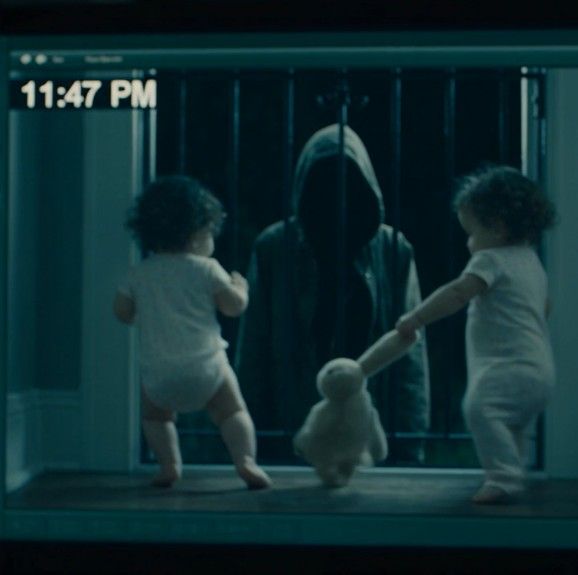
My hand hovered over the emergency alarm while a stranger stood beneath my daughters’ nursery window after midnight. One press would bring security running across the north lawn within seconds. I didn’t press it. Because Rosalyn wasn’t afraid. My three-year-old daughter ran barefoot across the nursery floor toward the window, while two-year-old Camille followed behind her dragging a stuffed rabbit by one ear. Under the green glow of the security camera, the woman outside opened a worn canvas bag. She didn’t reach for the window latch. She didn’t search for a way inside. Instead, she removed a small metal container and carefully pushed it through the iron bars. Then my daughters began to eat. Not like children sneaking a late-night treat. Like children who were starving. I leaned closer to the monitor. Rosalyn ate quickly, protecting every bite with both hands. Camille reached for more before she had even finished what was already in her mouth. Something inside me went cold. For years, I had built my life around noticing what other people missed. Restaurants. Construction companies. Shipping investments throughout Tennessee and Kentucky. Detail had made the Alvarez family wealthy. Then Elena died. One ordinary morning became an ambulance, doctors, unanswered questions, and two little girls without their mother. After that, protection became my obsession. My Nashville estate sat behind private roads, tall gates, reinforced windows, screened employees, and layers of security. The children’s wing was almost impossible to enter without authorization. People jokingly called it the Iron Cradle. I had believed the name meant safety. Every week, my household manager, Hilda Dawson, placed reports on my desk. Fresh seafood. Organic fruit. Special nutrition products. Expensive meals planned down to the smallest ingredient. I approved thousands of dollars in expenses every month without hesitation because nothing mattered more than my daughters. Then one Sunday morning, I lifted Rosalyn into my arms. She felt too light. Her arms were fragile beneath my hands. “Sweetheart,” I whispered, “have you been eating?” Her eyes dropped. She said nothing. When I questioned Hilda, she barely reacted. “Rosalyn is simply a difficult eater.” Then she showed me photographs. Beautiful plates. Perfect portions. Expensive food arranged with almost unnatural precision. “Who takes these pictures?” I asked. “I do.” “When?” A pause. “Before the meals are served.” “Before the girls eat?” Hilda smiled. “For records.” It was a tiny hesitation. Most people would have missed it. I didn’t. After she left, I called Calvin Pierce, my closest friend and security advisor. “I need more cameras.” He frowned. “We already have surveillance everywhere.” “Not everywhere.” His expression changed. “What exactly are you looking for?” I looked toward the nursery. “My children are telling me something is wrong.” By sunrise, eleven hidden cameras covered places no one inside the estate knew I could see. So I watched. I waited. And at 11:47 that night, the woman emerged from the woods. I watched my daughters hurry toward her. I watched her feed them through the bars. Every instinct told me to send security outside. Then another camera activated. The hallway. Hilda appeared carrying a dinner tray. I stopped breathing. She walked toward the nursery, then suddenly stopped directly beneath one of the hidden cameras. For several seconds, she stood perfectly still. Then, very slowly, Hilda lifted her head. Her eyes settled directly on the lens that she was never supposed to know existed. And that was when I understood the stranger outside might not be the person I needed to fear most. 👇
I did not move from the monitor.
Hilda stood beneath the hidden camera for five long seconds, looking directly into a lens Calvin had installed less than twenty-four hours earlier.
Then she smiled.
Not warmly.
Not at anyone in the hallway.
At me.
She lifted the dinner tray and continued toward the nursery.
My first instinct was to trigger the alarm and have security surround her before she touched the door.
I stopped myself.
The woman outside had fed my daughters. Hilda was carrying the meal my household records claimed cost more than most families spent on groceries in a week.
I needed to see what happened next.
Hilda entered the nursery.
Rosalyn and Camille ran from the window so quickly they nearly collided.
On the camera, Hilda set the tray on a small table.
Two porcelain plates sat beneath silver covers.
She removed the lids.
There was food.
Not much.
Half a plain chicken breast cut into pieces between both plates. Six green beans. Two spoonfuls of rice. No fruit. No milk. Nothing resembling the photographs she had shown me that morning.
Rosalyn climbed onto her chair.
Hilda did not let her touch the plate.
She took out her phone first.
My pulse began pounding.
Hilda moved the pieces together, angled the plate toward the light, and took three photographs.
Then she removed half the chicken.
She put it back on the tray.
I stopped breathing.
She did the same with Camille’s plate.
Rosalyn watched without speaking.
