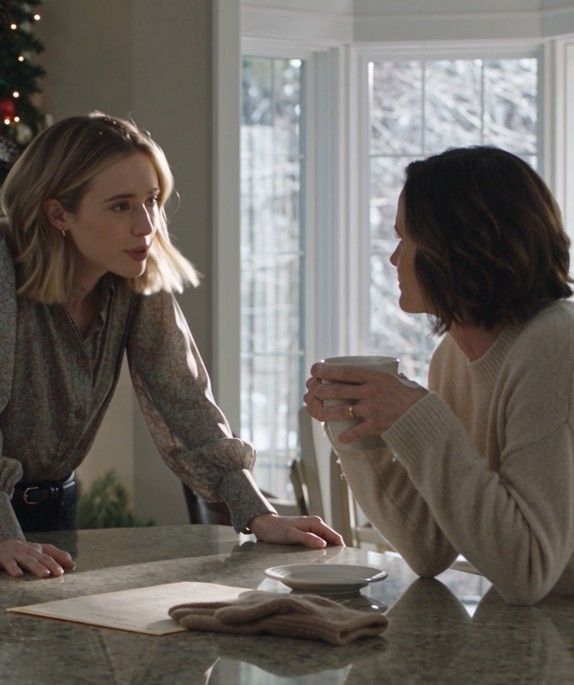
“Carolyn, you’re hosting twenty-five people, and I already promised everyone they could come.” Whitney planted both hands on my kitchen island as though the polished granite belonged to her. I stood across from her holding a warm cup of coffee, trying to understand how my daughter-in-law had managed to organize Christmas inside my house without ever asking whether I agreed. “I won’t be here,” I said. Her confident smile remained for half a second before disappearing. “That isn’t funny.” “I wasn’t joking.” The refrigerator hummed behind her while silence settled between us. Then Whitney looked past my shoulder and noticed the suitcase beside the coat closet. Her eyes shifted again, this time toward a cream envelope on the console table near the front door. A law office letterhead was visible across the top. “What is that?” she asked. I took another sip of coffee. “Something you should have thought about before making plans inside someone else’s home.” Her face tightened. Before she could answer, the front door opened. My son Trevor walked in wearing his charcoal office coat with his laptop bag over one shoulder. His gaze moved from me to Whitney, then to the suitcase. “What happened?” Whitney turned immediately. “Your mother has decided to abandon Christmas because she’s upset.” I set my cup down. “Your wife invited twenty-five people here.” Trevor frowned. “She invited them?” “Yes,” Whitney said quickly. “Because this has always been the family Christmas house.” The words landed harder than she intended. Trevor glanced around the kitchen at the decorations, the stacked extra chairs, and the boxes of holiday dishes I had used for decades. “Mom,” he said carefully, “people already made plans.” “I’m sure they did.” “Some are driving from Cincinnati.” “Then they should ask Whitney where she plans to serve dinner.” Whitney stared at me. “You can’t be serious.” “I am.” “Carolyn, everyone knows this is where we gather.” “This is where everyone gathered because I opened my home.” “You enjoyed doing it.” “I enjoyed Christmas.” I looked at Trevor. “That doesn’t mean I agreed to become unpaid staff for everyone else’s holiday.” He lowered his eyes. That tiny movement told me he understood more than he wanted to admit. Whitney folded her arms. “You’re making this dramatic.” “Am I?” She gave a short laugh. “We’re talking about one dinner.” “One dinner?” “Yes.” “For how many people?” “Twenty-five.” “How many turkeys?” Whitney paused. “What?” “How many pounds of potatoes?” She stared at me. “I haven’t planned every detail.” “How many beds need fresh sheets?” “Some people can stay at hotels.” “Which hotel?” Her mouth opened, then closed. “How many chairs did you rent?” “Carolyn.” “How much did you budget for groceries?” Whitney looked toward Trevor, waiting for him to step in and smooth everything over the way he always had before. This time, he remained silent. The kitchen clock ticked. Winter wind moved through the bare trees outside. Whitney had clearly prepared herself for resistance. She had not prepared herself for questions. “You’re interrogating me,” she said. “No.” I looked at the shopping list lying beside her gloves. “I’m asking who was supposed to do everything.” Nobody answered. Whitney looked at the unopened boxes, then at the decorations, then finally back at me. Trevor cleared his throat. “Mom, we could all help.” I nodded slowly. “You said that last year.” His face changed. “I helped.” “You carried one bag of ice.” Trevor looked down. Whitney immediately stepped in. “He works all week.” I held her gaze. “So did I.” And for the first time since she announced Christmas in my home, Whitney had no answer ready. 👇
Whitney recovered first.
“So what exactly are you planning to do?”
I looked toward the cream envelope on the console table.
Trevor followed my eyes.
“Mom,” he said, “what is in that envelope?”
I set my coffee cup in the sink.
“Closing documents.”
Whitney stared at me.
“Closing documents for what?”
“The house.”
For several seconds, nobody moved.
Then Trevor laughed once, the automatic sound people make when a sentence is too large to accept on the first hearing.
“What do you mean, the house?”
“I sold it.”
The color left Whitney’s face.
“You sold this house?”
“Yes.”
“Without telling us?”
I looked at her.
“It is interesting how important permission becomes when the decision is not yours.”
Trevor closed his eyes.
Whitney ignored the point.
“When?”
“The offer came three weeks ago. I accepted it last Friday. Closing is January fifth.”
Trevor stared around the kitchen as though the counters had become temporary while he was standing beside them.
“Why would you do that?”
I had asked myself the same question for two years before finally acting.
The answer was not Christmas.
“Because this house is too much for me now,” I said. “Not living in it. Maintaining what everyone expects from it. Every holiday has become a production. Every summer somebody asks whether cousins can stay. Every birthday becomes my kitchen, my cleaning, my spare rooms, my grocery bill. I kept saying yes because I thought that was what made this the family house.”
