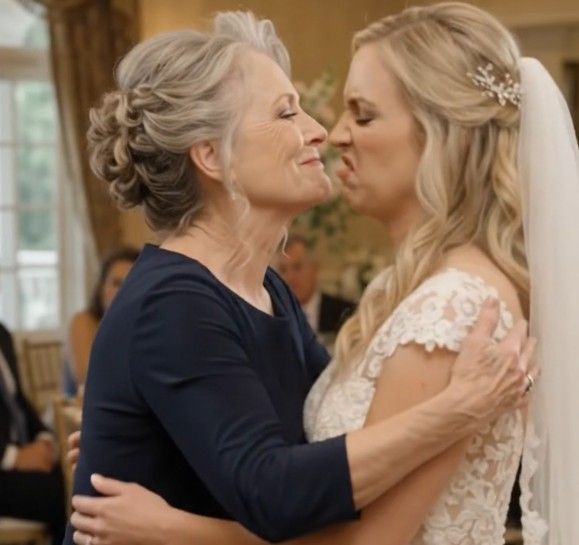
My mother’s hand was still suspended between us when I answered Ashley. “I’m going to stand beside her,” I said. The words surprised me because they were so simple. For two years I’d imagined that any disagreement between my wife and my mother required negotiation, compromise, and a careful balance of feelings. But Mom hadn’t done anything except offer a hug. Ashley had humiliated her for it. There was nothing left to negotiate in that moment.
I stepped away from Ashley and stood beside Diane. Her cheeks had turned an alarming red. She lowered her arms and tried to smile, the reflex I’d seen a thousand times when someone hurt her. “It’s all right, Ethan,” she whispered. “It’s a big day. Everyone’s tired.” I wanted to tell her she didn’t have to make it easier for me, but I couldn’t find the words yet. I just placed a hand gently against her back.
Ashley looked around the circle of watching guests and laughed. “Seriously? You’re choosing your mother over your wife at our wedding?” Melissa, her maid of honor, set her glass down. I asked Ashley to apologize. She looked at Mom, then at the cluster of relatives nearby. “I’m sorry you took offense,” she said. My mother flinched. I told Ashley that wasn’t an apology, and for the first time I didn’t soften my voice to protect her pride.
The music continued somewhere beyond us, cheerful and painfully out of place. Guests began moving away, pretending they had not heard. Ashley whispered that I was embarrassing her in front of everyone. I told her we needed to speak privately. She said she’d never forgive me for causing a scene. I looked at her, trying to reconcile the woman I’d promised to love that morning with the person who couldn’t bear to say she’d been cruel.
In a quiet room near the reception hall, Ashley launched into a familiar explanation. My mother was overbearing. She made Ashley feel judged. She never understood boundaries. I listened carefully and asked for a specific example of Mom violating a boundary that day. Ashley mentioned the attempted hug. I asked whether she’d ever told Mom not to hug her. She said no, but insisted Diane should have known. I asked why she had made a remark about manure. Ashley shrugged. “She comes from a farm family. It’s just a joke.”
My grandparents had indeed kept a small farm outside town. Mom grew up there and worked summers in its fields. My father Robert loved to tease her about how easily she could fix a fence and how hopeless he was at changing a tire. But she had come to the wedding in a clean navy dress, having spent hours running errands for Ashley. The insult wasn’t about a smell. It was about a background Ashley had learned to use as shorthand for embarrassment.
I asked Ashley whether she had ever respected my mother. She folded her arms. “I respect people who know their place,” she replied. The sentence made me feel physically cold. I thought of Mom by the hospital bed where Dad died, holding his hand without letting any of us see her fear. I thought of her working overtime when I was in college and telling me not to worry about the bill. I thought of every kindness Ashley had dismissed as interference. Her place, apparently, was wherever her usefulness ended.
I told Ashley I couldn’t return to the dance floor and pretend the conversation hadn’t happened. She demanded that we finish the reception and sort it out tomorrow. I said I needed her to apologize honestly to Diane first. She refused. “Then I need some space,” I replied. Ashley stared at me for a long moment, waiting for the familiar concession. When it didn’t come, she walked out and slammed the door.
I stayed behind, shaking. Marriage was supposed to begin with joy, not a question about whether I’d ignored warnings for two years. I had just made vows. I loved Ashley—or had loved the person I believed her to be. My stomach turned at the thought of hurting her. Yet for the first time, the fear of upsetting her was not enough to make me erase what I’d seen.
Melissa knocked softly. She asked whether we could talk. I’d known her only through wedding preparations; she had always seemed loyal to Ashley, eager to smooth over any disagreement. Now she looked tired and frightened. “I should have said something earlier,” she began. She told me that Ashley had mocked my mother throughout the planning process, calling her “the free wedding assistant” and joking that she would be useful until the ceremony was over. Melissa had laughed awkwardly at first, then stopped. She hadn’t known how to tell me.
I asked what else she knew. Melissa took out her phone and showed me a message Ashley had sent three weeks before the wedding: Once the photos are done, I’m making sure Ethan stops running back to his farm-girl mommy. No more guilt trips. I read it twice, trying to find some context that would make it less ugly. There wasn’t any. Another message described Mom’s contribution to the floral emergency as “one more task before I retire her.”
For a moment I couldn’t speak. I’d told Mom that Ashley was shy, that she had a different way of expressing affection, that our families just had different styles. My explanations had become a shield behind which Ashley could say anything she liked. Melissa said she was sorry. I told her I wished she’d said something earlier but was grateful she was telling me now. She nodded and left me alone with the messages.
I found Mom sitting outside under a pergola, still holding her small evening bag. The sunset had faded to a gray-blue line beyond the hills. I sat beside her and said, “You don’t smell like manure.” She let out a surprised laugh. Then I told her I was sorry for making her defend herself against comments she hadn’t caused. Mom looked down at her hands. “I thought if I kept being helpful,” she said, “Ashley might eventually like me.”
The words hurt because I had taught her to think that. Every time Mom said Ashley was cold, I explained why she should be patient. Every time plans were canceled, I told her not to take it personally. I’d asked the person who loved me most consistently to make herself smaller so that I could avoid a difficult conversation. “You shouldn’t have had to earn respect by carrying everybody’s problems,” I said. She turned toward me, eyes bright. “I know,” she whispered. “But I hoped you’d see it yourself.”
We sat in silence while the wedding band began a slower song. Then she asked whether Ashley and I were all right. Even after being insulted, Mom was worried about me. I told her the truth: I didn’t know. I needed time to understand what had happened and what it meant for the vows I’d just made. Mom did not tell me to leave Ashley or to forgive her. She squeezed my hand and said I could stay at her house if I needed somewhere quiet to think.
I returned to the reception and asked the coordinator to wind down the party after the scheduled meal. I was not going to make a public announcement about my marriage while guests were still celebrating. I thanked the people who had traveled and left when the music ended. Ashley made several attempts to pull me into photographs, then stopped when I told her I wasn’t comfortable pretending. Her anger was evident, but I refused to argue in front of our relatives.
The next morning I visited Mom. She was sitting at the kitchen table with her coffee and a stack of receipts. When she saw my face, she pushed the papers aside. I asked whether she had paid more toward the wedding than she’d told me. She hesitated. Then she admitted she’d covered several extra charges: flowers, revised catering, the additional rehearsal dinner guests, and a last-minute fee for the venue. She had done it to spare me stress because I was already working long hours.
I looked through the receipts and found payments that should never have been hers. Ashley had told me her parents covered the flower upgrade. In fact, the invoice bore my mother’s card details. Another vendor had been instructed to bill Diane directly because Ashley said I was “too busy to approve expenses.” Mom’s generosity had been presented as someone else’s contribution. I felt an old shame rising, this time accompanied by clarity.
Mom told me she hadn’t wanted recognition. “Your father used to say a wedding isn’t about the price of the flowers,” she said. “It’s about whether the people in the room are glad you found each other.” She smiled faintly. “I was glad for you, Ethan. I wanted to believe Ashley was glad too.” I leaned forward and cried, not from gratitude alone but from the knowledge that my mother’s trust had made her easier to exploit.
I called the vendors and requested copies of the authorization records. Some payments were proper gifts from Mom; others appeared to have been arranged without her clear agreement about the amounts. We involved a lawyer to separate disputed charges from voluntary ones and ask for appropriate remedies. I did not want to use money as a weapon against Ashley. I wanted an accurate account of what had happened so neither Mom nor I could be bullied by conflicting stories.
Ashley agreed to meet with a counselor after I told her I would not resume living together without discussing the insults and financial decisions honestly. At the first session she described the incident as a “minor joke blown out of proportion.” The counselor asked whether she could acknowledge the impact on Diane regardless of intention. Ashley answered that my mother was too sensitive. Then she accused me of abandoning our marriage before it had begun. I looked at the counselor and understood that accountability couldn’t be dragged out of someone by choosing the perfect words.
After several sessions, Ashley admitted she’d asked vendors to charge Mom because she knew Diane rarely said no. She insisted she’d intended to reimburse her eventually. I asked why she had told me someone else paid. Ashley said she didn’t want people to think we needed help. I reminded her that needing help wasn’t shameful. Lying about the person who gave it was. She stared at me as though my moral objection were a personal attack.
There was a final revelation that made the decision unavoidable. Melissa forwarded an apology of her own, along with a message Ashley had sent before the wedding saying she planned to move across the country afterward and expected me to stop visiting Mom except on major holidays. It was framed as a new beginning. Ashley had never discussed such a move with me. When I asked her about it, she said I would have resisted, so she’d planned to tell me once we were married. That was the moment I understood our future had been designed without my consent.
I told Ashley I could not build a marriage on contempt and concealed decisions. We separated and sought legal advice about ending the marriage according to the rules where we lived. The process was sad and sometimes bitter. There were practical questions about payments, shared belongings, and the short time we’d lived as spouses. I kept records, followed advice, and resisted the temptation to turn every disagreement into proof that I had been right all along. It was enough to know the relationship was unsafe for the kind of family I wanted.
Ashley blamed Mom for the separation, at first publicly and then in messages to friends. Melissa corrected some of the claims because she’d witnessed the events and had the original texts. The disputed vendor charges were addressed through the appropriate payment and legal channels. Ashley was no longer able to present Mom’s money as a gift from her own parents. I didn’t celebrate her embarrassment. I simply stopped protecting a false account of what had happened.
I spent the next several months living in a small apartment near work. I visited Mom on Sundays and called during the week. At first she tried to send me home with casseroles every time, as though feeding me would make the sadness easier. One afternoon I asked if we could make lunch together instead. She taught me how to knead bread properly, laughing when I scattered flour across the counter. The ordinary intimacy of it was a relief. Neither of us was performing a role for someone else’s approval.
We talked about Dad more often. Mom told me he used to leave little notes in her lunch bag during harvest season, when she worked long days helping my grandparents on their farm. She showed me a faded photograph of him standing in muddy boots, grinning beside her. I realized that Ashley’s insult had struck at one of my mother’s happiest memories: the soil, work, and family that shaped her life. I was ashamed that I’d let anyone turn that into something dirty.
One Saturday I drove with Mom to the old farm property. Most of the fields had been leased to neighbors, but the farmhouse still stood, paint peeling gently from the porch rail. Mom showed me where she and Dad had planted an apple tree after their engagement. The tree was gnarled and stubborn, still producing small fruit. “He said it didn’t matter if it grew crooked,” she told me. “As long as it kept growing.” We stood beneath its branches without speaking for a while.
I asked whether she’d ever been lonely after Dad died. She laughed softly. “Of course. But lonely isn’t the same as empty.” Then she said something I hadn’t expected: “I don’t want you to make your life about making up for what happened to me.” I told her I needed to become a better son. She agreed, but reminded me that I also needed to learn to become an honest partner, a good friend, and a man capable of choosing without fear. “Your father would tell you to go live,” she said. “And call your mother occasionally.”
I took her advice. I began seeing friends I’d neglected, returned to volunteer work I’d dropped during wedding preparations, and spent evenings learning to cook without asking Mom for every instruction. In therapy I looked at how easily I had mistaken peacekeeping for kindness. Avoiding confrontation wasn’t neutral; it had consequences for the people who counted on me. I learned that a loving boundary can be stated calmly, and that another person’s anger doesn’t automatically mean you’ve done something wrong.
